

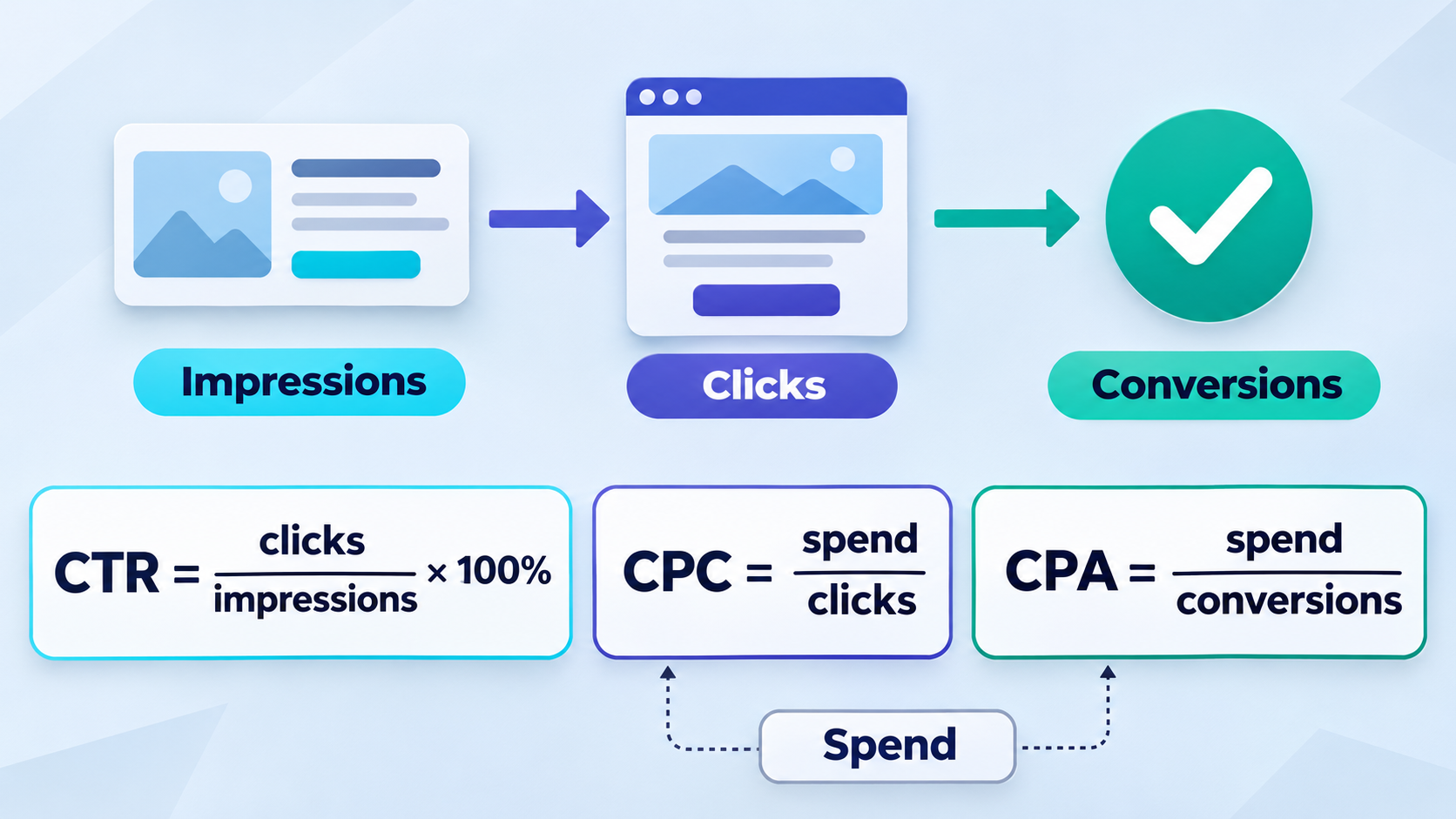
Build measurable ads, trustworthy event pipelines, and controlled experiments
High-converting advertising does not come from a universal creative formula. It comes from matching a clear message to the right audience, measuring the complete path from impression to business outcome, and testing one defensible hypothesis at a time. In this guide, we explain the metrics, event design, creative structure, attribution constraints, and experiment controls developers need to support that process. We also show how to expose a local conversion receiver with Localtonet when an authorized advertising platform or test system must reach it during development.
📋 What's in this guide
There is no universally perfect ad
An ad is one component in a larger conversion system. The creative earns attention and communicates a promise, but the audience definition, placement, auction conditions, landing page, product, price, checkout, measurement code, and attribution rules all influence the reported result. A strong click-through rate can coexist with poor revenue. A visually modest ad can outperform a polished one if it attracts people who are more likely to complete the intended action.
Developers should therefore model conversion as a sequence of observable stages rather than treating the creative as a single success or failure. A common sequence is impression, view or engagement, click, landing-page session, qualified action, purchase or lead, and retained value. Not every advertising platform exposes every stage, and privacy controls can prevent deterministic linkage between stages. The model remains useful because it identifies where evidence becomes weak and where an engineering defect might be distorting a marketing conclusion.
Before implementing tracking, write an explicit definition for the primary conversion. “Lead” is too vague if one team counts a submitted form while another counts only a verified and sales-qualified contact. Specify the event, its required fields, the system that decides it occurred, the point at which it becomes final, and whether later cancellation or refund events can revise its value.
Advertising dashboards apply their own attribution windows, identity rules, filtering, delayed processing, and reporting time zones. Treat platform reports as one analytical view. Reconcile them with your application, payment, CRM, and finance records instead of expecting every system to produce identical totals.
The metrics developers should calculate and validate
CTR, CPC, and CPA answer different questions. They should be read together and segmented by campaign, creative, audience, placement, device, geography, and time where the available data and privacy rules permit it. Aggregation can hide a failing segment behind a successful one, while very narrow segmentation can produce samples too small to support a decision.
| Metric | Formula | What it helps diagnose | Important limitation |
|---|---|---|---|
| Click-through rate | Clicks ÷ impressions × 100 | How often an impression produces a recorded click | A click can be accidental, unqualified, duplicated, or disconnected from a later outcome |
| Cost per click | Spend ÷ clicks | The average media cost associated with a recorded click | It does not measure landing-page quality or commercial value |
| Conversion rate | Conversions ÷ eligible visits or clicks × 100 | How effectively traffic proceeds to the defined outcome | The denominator must be stated because click-based and session-based rates differ |
| Cost per acquisition | Spend ÷ validated acquisitions | The average media cost for the defined acquisition | Its meaning depends entirely on what qualifies as an acquisition |
| Return on ad spend | Attributed revenue ÷ ad spend | Revenue attributed for each unit of media spend | Revenue is not margin, and attribution does not prove incremental causation |
| Revenue per click | Attributed revenue ÷ clicks | Whether click value offsets traffic cost | It is sensitive to attribution windows, delayed purchases, and outliers |
CTR is an attention and relevance signal
CTR can reveal whether an ad prompts people to continue, but a higher CTR is not automatically better. A vague promise, sensational hook, or misleading visual may increase clicks while reducing qualified conversion. Compare CTR with post-click engagement, conversion rate, CPA, refund rate, and retained value. If CTR rises while downstream quality falls, the creative may be attracting the wrong intent.
CPC is a cost ratio, not a creative property
CPC depends on spend and clicks, but auction mechanics and campaign settings also influence it. Developers should not encode the assumption that improving CTR must always reduce CPC. Platforms differ, auction conditions change, and available evidence does not support a universal causal rule. Report what occurred in each controlled test without turning a historical correlation into a guaranteed platform behavior.
CPA depends on event integrity
CPA is only as trustworthy as the conversion count. Duplicate events make CPA appear artificially low. Missing events make it appear high. Test orders, internal traffic, fraudulent leads, and unqualified submissions can all contaminate the denominator. A robust pipeline gives every logical conversion a stable identifier, validates required fields, records processing status, and distinguishes accepted events from rejected or quarantined events.
Use guardrail metrics
A primary metric determines the experiment winner, while guardrails prevent a local improvement from damaging the wider system. For example, a checkout-completion test might use validated purchases as its primary metric and monitor refund rate, payment failures, page errors, latency, and customer-support contacts as guardrails. Select these before the test starts. Choosing a favorable metric after seeing the outcome introduces decision bias.
Confirm currency, tax treatment, time zone, conversion definition, attribution window, click versus view attribution, and event timestamp semantics before comparing two dashboards. Apparent tracking failures often come from mismatched definitions rather than lost events.
A practical structure for ad creative
A useful creative structure has three functional parts: a hook, a value-bearing message, and a call to action. This is a design framework, not a promise of performance. Format, sequence, wording, accessibility, and platform policy still matter, and the winning implementation can vary by audience and placement.
Message match is the continuity between ad and destination. The landing page should preserve the essential offer, terminology, visual identity, and expected next step. If an ad promotes a specific feature but links to a generic home page, users must reconstruct the path themselves. That friction can reduce conversion and also makes diagnosis harder because the click and destination represent different propositions.
Creative formats should be chosen according to what must be communicated. A static image can isolate a headline or product proposition quickly. Short video can demonstrate motion, workflow, or transformation. A carousel can separate features, products, or sequential steps. Full-screen vertical content must remain understandable in its intended aspect ratio, and captions or visible text can preserve meaning when audio is unavailable. Interactive formats can demonstrate product mechanics, but they also require more implementation and quality assurance.
Authenticity must not become deception. User-generated-style presentation should not falsely imply that a paid actor is an independent customer, fabricate a testimonial, or conceal material sponsorship. Developers who build creative tooling should support required disclosures and maintain an auditable relationship between approved copy, rendered assets, destination versions, and campaign identifiers.
Design for comprehension, not only interruption
An attention-grabbing opening is useful only if viewers can understand the offer. Ensure readable contrast, avoid excessive text density, keep essential information away from placement overlays, and do not depend on color alone to communicate state. Review each rendered placement rather than assuming one master asset will crop safely everywhere.
Turn competitor ad research into testable creative ideas
Before producing a new creative, study how other advertisers present similar offers. Spy.House is a competitor ad monitoring and analysis service that lets you research advertising creatives and compare approaches by source, geography, device, language, and vertical. Use it to identify patterns in hooks, visual formats, messages, and calls to action that are relevant to your audience.
Turn those observations into a short research brief: which problem the ad addresses, what benefit it promises, how it presents evidence, and what action it asks the viewer to take. Then create an original variant for your own product and audience. A competitor's long-running ad can be worth investigating, but its visibility or duration does not establish its conversion rate, acquisition cost, or profitability. Validate each hypothesis with your own campaign data.
Spy.House supports the research stage, while Localtonet can support the development and verification stage when an external test system needs to reach a local conversion receiver. Together, these fit into the workflow described here: research a creative idea, build the variant and destination, verify measurement, and run a controlled test. Use competitor materials for analysis and obtain the necessary rights before reusing any assets.
Track creative identity as structured data
A filename is not an adequate creative registry. Assign stable identifiers to the concept, variant, copy version, asset version, destination version, and experiment. This lets analysts distinguish a new hook from a resized export or typo correction. Keep human-readable labels too, but do not use mutable names as database keys.
{
  "campaign_id": "campaign_2026_04",
  "creative_concept_id": "concept_problem_demo",
  "creative_variant_id": "variant_b",
  "landing_page_version": "pricing_v3",
  "experiment_id": "exp_hook_012",
  "event_name": "landing_page_view",
  "event_id": "generated-unique-event-id",
  "occurred_at": "2026-04-15T10:30:00Z"
}
This is an illustrative internal schema, not a payload for any particular advertising platform. Use the official schema and current field requirements for each destination. Avoid putting secrets, raw payment details, or unnecessary personal data into campaign parameters or browser-visible URLs.
Design a trustworthy conversion-tracking architecture
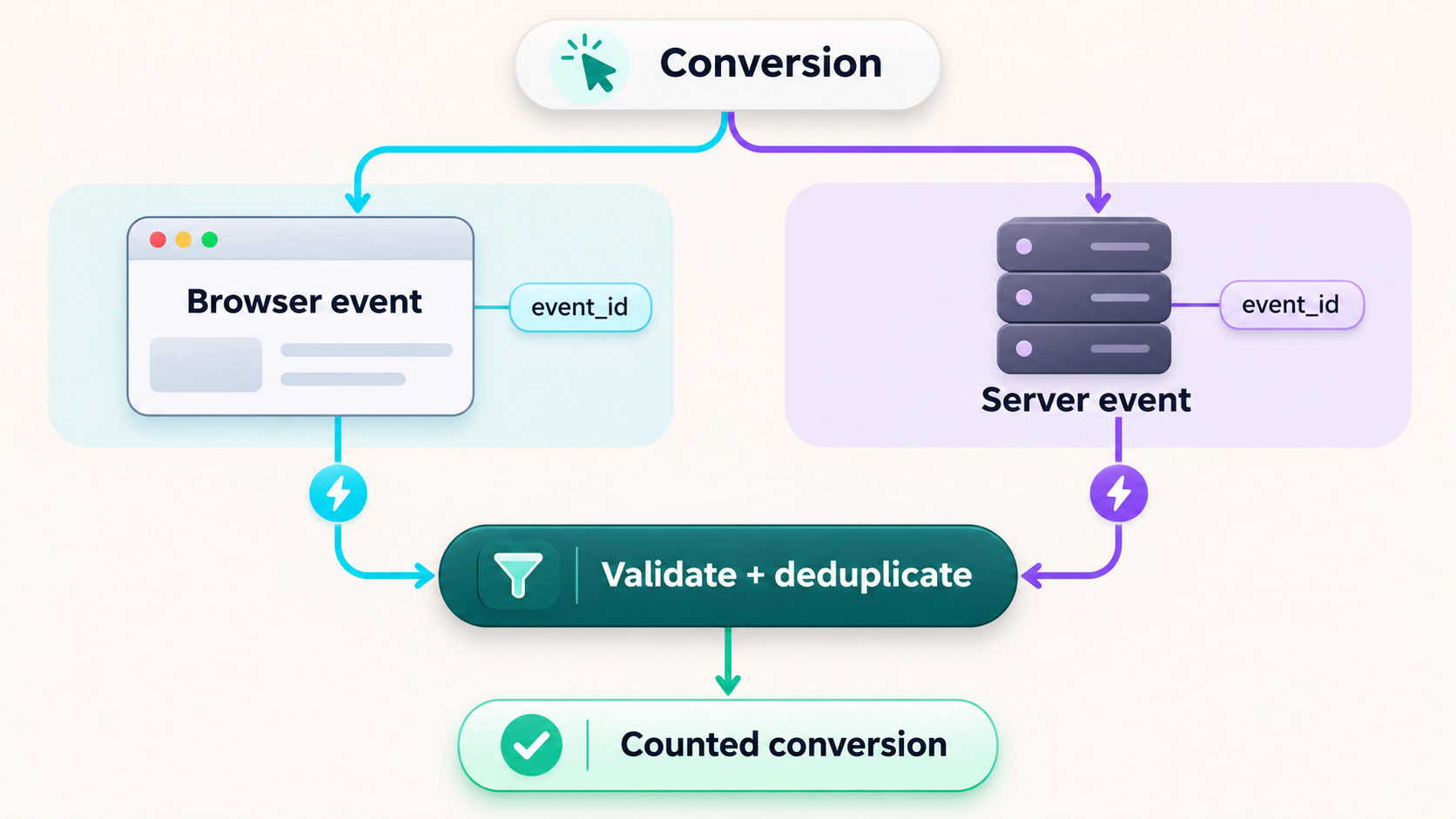
A practical measurement design usually combines browser observations, application events, and authoritative business records. Browser code can observe page interaction, but it may be blocked, interrupted, or prevented from running after navigation. Server-side application logic can record accepted form submissions or completed transactions, but it must handle retries and duplicate delivery. Payment or CRM systems may provide the final business status after the initial web session has ended.
Define the event contract
Document the event name, business meaning, producer, required properties, identifier format, timestamp semantics, consent requirements, and validation rules. Version the contract when a change would alter interpretation.
Generate a stable event identifier
Give each logical event a unique identifier that survives retries. If the same purchase is sent through browser and server paths, use the destination's documented deduplication mechanism rather than assuming similar payloads will be merged automatically.
Validate at ingestion
Reject malformed input, constrain accepted content types and body sizes, verify authentication or signatures where the sender supports them, and record a reason code for rejected events. Do not silently convert invalid values into plausible data.
Separate receipt from processing
Record whether a request was received, validated, deduplicated, queued, delivered downstream, retried, or permanently failed. A successful HTTP response from your receiver does not necessarily mean every downstream destination accepted the event.
Reconcile against authoritative records
Compare validated conversion events with the system that owns the business outcome. Investigate differences by event date, processing date, source, status, and identifier rather than adjusting totals manually.
Use idempotent processing
Webhooks, job queues, and network clients commonly retry. The receiver should be able to process the same logical event more than once without creating multiple conversions. A typical design stores the event identifier under a uniqueness constraint and returns a safe response for a previously accepted event. Exact behavior should match the sender's retry requirements, especially its timeout and response-code rules.
Keep event time and processing time separate
Store when the business event occurred and when each system received or processed it. Late delivery is normal in distributed systems. If reports group by ingestion time in one place and occurrence time in another, daily totals can disagree even when no event is missing.
Minimize sensitive data
Collect only fields needed for a defined measurement purpose. Apply consent choices and applicable legal requirements before sending data to an advertising destination. Do not log authentication secrets or full request bodies indiscriminately. Restrict access to conversion data, establish retention limits, and document deletion behavior.
Treat it as hostile-input territory. Require the authentication or signature mechanism supported by the authorized sender, validate timestamps if the protocol provides them, prevent replay where possible, rate-limit abusive traffic, and never trust a request merely because it reached an unguessable URL.
Run controlled creative and funnel experiments
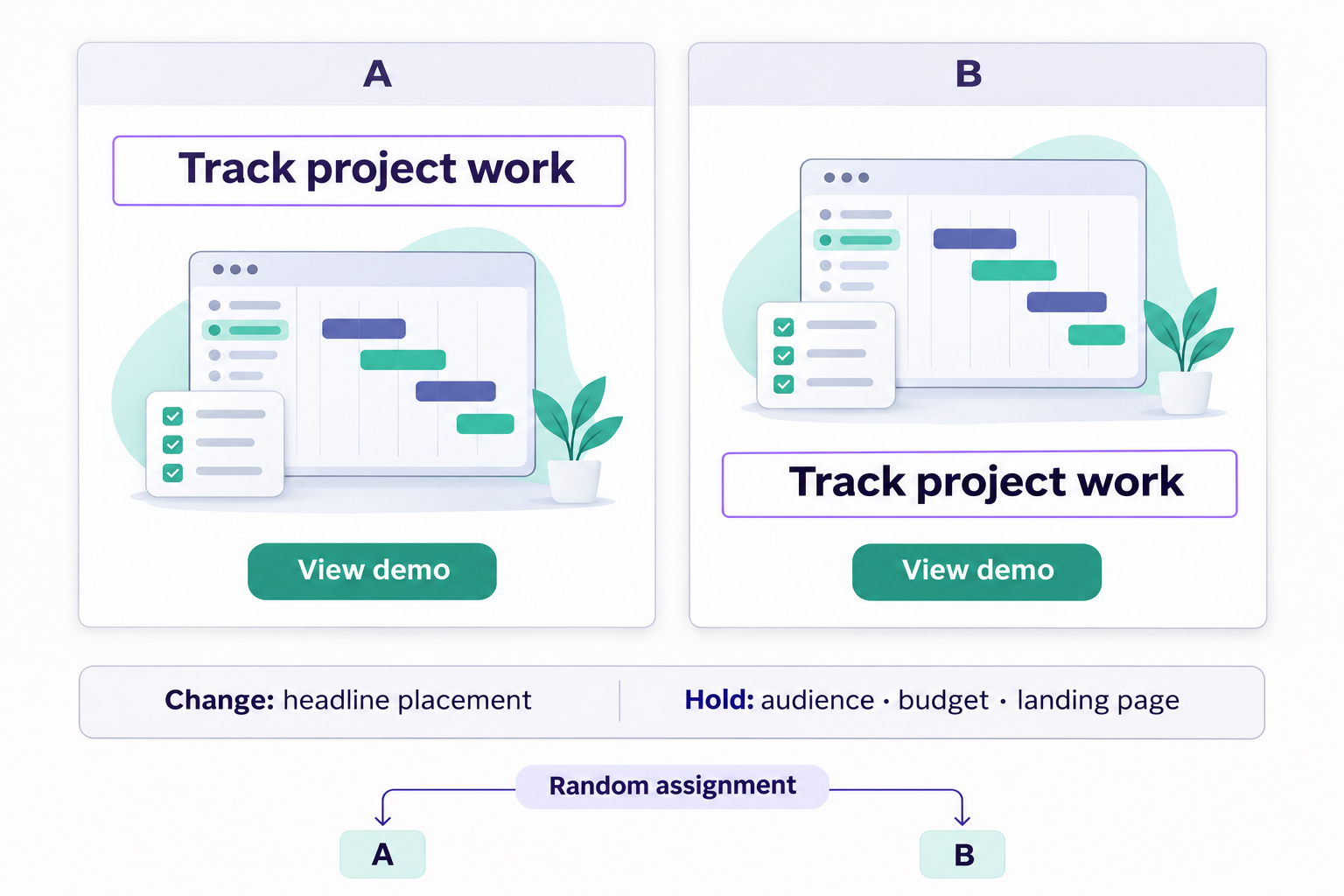
A/B testing is a method for comparing variants under controlled allocation. It does not automatically explain why a difference occurred, and it cannot repair poor instrumentation. Begin with a falsifiable hypothesis such as: “Replacing a generic headline with a concrete workflow benefit will increase validated signup rate for new visitors without increasing cancellation rate.”
Change the smallest useful unit. If variant B has a new video, new headline, different offer, and different landing page, a result cannot identify which change mattered. Multivariable tests are possible, but they require an appropriate design and usually more traffic than a simple two-variant comparison.
State the hypothesis and decision rule
Define the population, control, treatment, primary metric, guardrails, minimum detectable effect, intended analysis, and action you will take for a positive, negative, or inconclusive result.
Verify instrumentation before allocation
Confirm that both variants generate the same event definitions, timestamps, identifiers, and eligibility rules. Run test conversions and trace them through receipt, validation, storage, and reporting.
Assign subjects consistently
Use a stable assignment unit appropriate to the experience, such as a user or session. Prevent one subject from switching variants unexpectedly, and record the assigned variant independently of conversion events.
Monitor quality without repeatedly declaring a winner
Watch allocation balance, event volume, error rates, latency, and guardrails. Repeatedly checking an ordinary fixed-horizon significance test and stopping at the first favorable result can inflate false-positive risk.
Analyze the predetermined population
Apply the planned exclusions and attribution rules consistently. Report effect size and uncertainty, not only a binary winner label. Check whether missing data or sample-ratio mismatch undermines the result.
Document and operationalize the result
Preserve the hypothesis, versions, dates, allocation, anomalies, outcome, and decision. If the treatment is adopted, continue monitoring because auction conditions, audience composition, and creative fatigue can change performance.
Avoid common experimental traps
Do not compare variant A this week with variant B next week if seasonality, budget, auction conditions, or news events could differ. Do not exclude users because they failed to convert. Do not select a winning audience segment after inspecting many segments without accounting for that exploration. Do not conclude that “no statistically significant difference” proves equivalence. It may simply mean the test was not precise enough to detect a meaningful effect.
Sample-size planning depends on baseline rate, minimum effect of interest, allocation, desired error rates, and analysis method. There is no defensible universal number of clicks or conversions. Use a statistical method suited to the decision and have a qualified analyst review high-impact experiments.
Verify the conversion pipeline locally
Local testing should prove more than whether an endpoint returns a successful status. Exercise the full event lifecycle with test data: request authentication, schema validation, deduplication, storage, queueing, downstream handling, reconciliation, and observability. Keep test conversions clearly separated from production reporting.
Recommended verification cases
| Test case | Expected behavior | Evidence to retain |
|---|---|---|
| Valid new event | Accepted once and moved through the intended processing states | Event ID, state transitions, timestamps, and sanitized logs |
| Duplicate event | Recognized without creating a second logical conversion | Original record reference and deduplication result |
| Invalid schema | Rejected with a controlled response and reason | Validation code without unnecessary sensitive payload data |
| Invalid authentication | Rejected before business processing | Security event with secret values removed |
| Delayed delivery | Preserves occurrence time separately from receipt time | Both timestamps and attribution handling |
| Downstream outage | Follows the documented retry or failure policy without duplication | Attempt count, status, and final disposition |
Use synthetic identifiers and non-production credentials in development. If a platform provides a dedicated test-event mode, follow its current official instructions. Platform APIs, payload schemas, authentication methods, and test tools change over time, so this article deliberately does not invent platform-specific endpoints or fields.
Observability should let a developer trace one event without searching raw personal data. A correlation identifier, event identifier, experiment identifier, and processing state are usually more useful than dumping an entire request. Metrics should track accepted, rejected, duplicate, retried, and failed events separately. Alert on meaningful deviations from a normal baseline rather than on every individual client error.
Expose a local conversion receiver with Localtonet
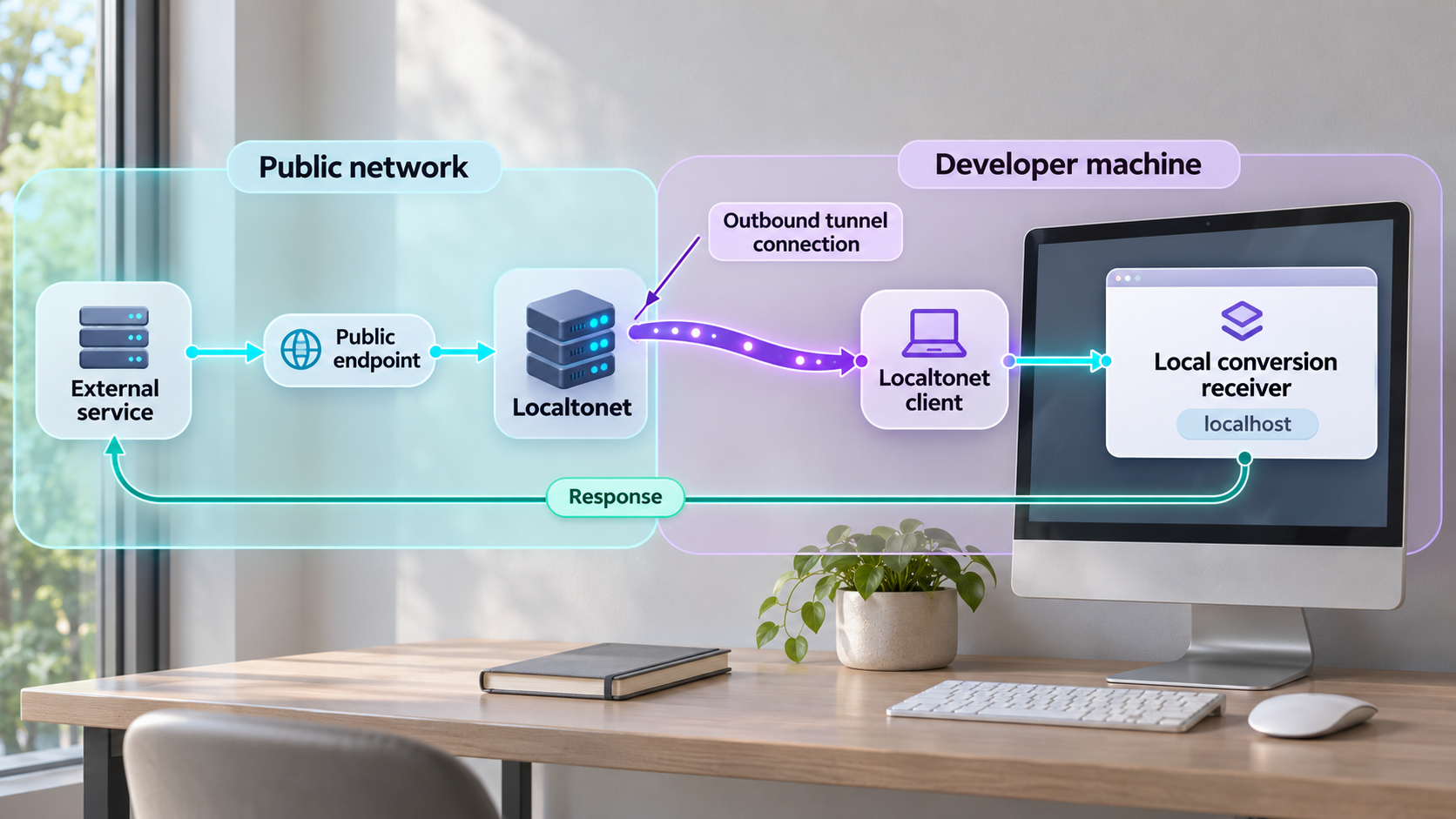
Some authorized advertising systems and webhook senders cannot call localhost on a developer machine. With Localtonet, the client on that machine establishes an outbound connection to our relay server and provides a public address for the local service. This avoids inbound router port forwarding, firewall changes, VPN setup, and the need for a public IP address.
For an HTTP conversion receiver, use an HTTP tunnel that points to the local IP address and port where the application is already listening. The tunnel remains available only while the selected Localtonet client or device is connected and the tunnel is running. Creating a tunnel does not start it automatically.
Install and run the Localtonet client
Run our client on the development device that can reach the local conversion receiver. Confirm the receiver itself works locally before introducing remote access.
Authenticate or select the device
Use the device-specific authentication token provided through Localtonet. Treat the token as a secret, never place it in source code, screenshots, logs, or this endpoint's public response.
Select an available relay server
Choose from the server or region values currently available in the dashboard. Availability can vary, so do not hardcode a server code copied from an unrelated environment.
Create the HTTP tunnel configuration
Point the tunnel to the local IP address and port used by the receiver. HTTP tunnels can use a random subdomain, a custom subdomain where supported, or a custom domain. Check current documentation before configuring custom-domain DNS.
Start the tunnel
Use the Start control after creating the tunnel. Wait until the selected client is connected and the tunnel is running before configuring the assigned public HTTPS address in an authorized sender.
Test, observe, and stop access when finished
Send a test event through the public address, trace it through the local application, and verify deduplication and rejection cases. Stop or delete the tunnel when remote access is no longer required.
Everything can be managed from one Localtonet dashboard or through the REST API, but this guide does not provide API payloads because no verified endpoint contract was supplied for this workflow. The dashboard sequence above stays within the documented Localtonet lifecycle. For the current product workflow, consult the Localtonet documentation.
Do not expose an unprotected event receiver. Enforce authentication or signature verification in the application, validate every payload, minimize returned information, restrict accepted methods and paths, and keep test data separate from production. Stop the tunnel after the test if continuous public access is unnecessary.
A saved configuration is not the same as a running tunnel. The public endpoint works only while the chosen device is connected and the tunnel has been started. Check both conditions before diagnosing the advertising platform or changing application code.
Troubleshoot discrepancies systematically
The public URL cannot reach the receiver
First test the receiver locally from the same device that runs the Localtonet client. Confirm that the application process is running and listening on the exact local IP address and port configured as the tunnel target. Then confirm that the selected Localtonet device is connected and that the tunnel was started. A created but stopped tunnel is not available.
The receiver works locally but rejects remote events
Inspect sanitized validation results. Common causes include a content-type mismatch, malformed JSON, unsupported method, incorrect path, invalid signature, stale timestamp, or body transformation before signature verification. Signature schemes often depend on the exact raw request bytes, but implementation details vary by sender. Follow the sender's current specification rather than reconstructing a signature algorithm from examples.
Conversions appear twice
Determine whether the same logical event was retried, sent through both browser and server paths, or generated twice by application code. Compare stable event identifiers rather than timestamps alone. Enforce uniqueness at a durable storage boundary. If a destination provides a documented deduplication field, populate it consistently across delivery paths.
The application records more conversions than the ad dashboard
Check whether the application includes organic, direct, internal, or unattributed conversions. Compare attribution windows, consent state, event eligibility, time zones, delayed processing, and destination rejection reports. An application transaction and an attributed advertising conversion are not equivalent populations.
The ad dashboard records more conversions than the database
Look for duplicate tags, events triggered before the business action became final, test traffic included in production, multiple conversion actions representing the same outcome, or imported events that were later cancelled. Reconcile by stable business and event identifiers where policy and privacy constraints allow it.
CTR improved but CPA became worse
The new creative may attract broader or lower-intent traffic, create an expectation the landing page does not satisfy, or shift delivery into a different audience or placement mix. Verify that tracking stayed constant, then inspect conversion rate, qualification, revenue, refunds, and segment composition. Do not scale solely because clicks became cheaper.
An experiment has a sample-ratio mismatch
If the observed allocation differs materially from the intended split, investigate assignment logic, caching, bot filtering, eligibility conditions, redirects, missing exposure events, and variant-specific errors. Do not interpret the conversion result until the allocation problem is understood. A broken randomization or exposure record can invalidate the comparison.
Frequently asked questions
What is the most important advertising conversion metric?
There is no universal metric. Choose a primary metric that represents the decision you need to make, then protect it with guardrails. CTR can diagnose response to an ad, CPA can describe acquisition cost, and revenue or margin can describe commercial value. None is sufficient without a clear definition and trustworthy event data.
Does a higher CTR always reduce CPC?
No. CTR and CPC can be related within a campaign, but CPC is also affected by auction conditions, audience, placement, bidding, competition, and platform behavior. Measure the actual outcome instead of assuming a guaranteed causal relationship.
Should conversion tracking run in the browser or on the server?
The appropriate design depends on the event and destination. Browser events can observe interaction, while server events can originate from authoritative application logic. Some systems use both. If both paths represent one conversion, implement the destination's documented deduplication method and apply consent, security, and data-minimization requirements to each path.
How long should an A/B test run?
There is no fixed duration that applies to every test. Plan using the baseline rate, minimum effect worth detecting, traffic volume, allocation, statistical method, and relevant business cycle. Define stopping rules before launch and avoid ending an ordinary fixed-horizon test merely because an early result looks favorable.
Can Localtonet expose a local conversion webhook receiver?
Yes. An HTTP tunnel can point to a local IP address and port reachable from the device running our client. The public endpoint is available while that device is connected and the tunnel is running. The receiver still needs its own authentication, payload validation, deduplication, and access controls.
Does creating a Localtonet tunnel make it active immediately?
No. Creating the configuration does not mean the tunnel is running. Start it with the Start control and keep the selected client connected. You can stop or delete the tunnel when testing is complete.
Why do the advertising platform and internal database show different totals?
They may use different populations, attribution windows, identity methods, time zones, event timestamps, consent rules, filters, and processing schedules. Reconcile records by clear definitions and stable identifiers. Exact equality should not be assumed when the systems measure different concepts.
Explore Spy.House with the Localtonet reader offer
To put creative research into practice, explore Spy.House and use the ideas you find to build your next controlled experiment. Spy.House has provided Localtonet readers with promo code LOCALTO30 for 30% off their first Spy.House subscription. Check that the discount is applied before completing your purchase.
Test your local conversion receiver with Localtonet
Build and verify the endpoint locally first, then use an authenticated Localtonet HTTP tunnel when an authorized external system needs temporary access. Keep the receiver protected, trace every test event, and stop the tunnel when the workflow is complete.
Get Started Free →