

Build a verified RDP connection path without changing your router
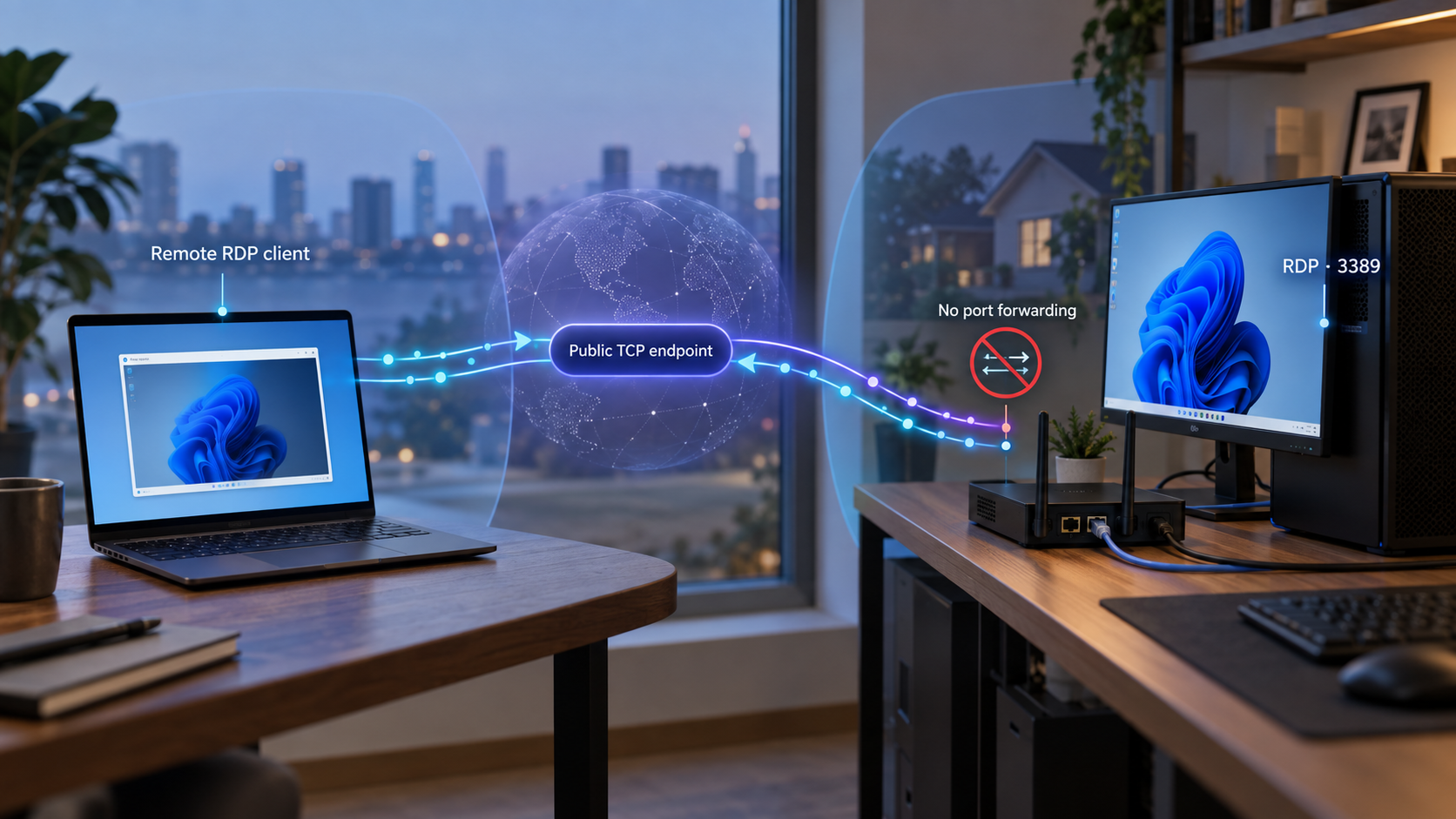
Windows Remote Desktop needs a network path to the computer hosting the session. That path can be difficult to create when you are behind carrier-grade NAT, do not control the router, or do not have a public IP address. With Localtonet, the client establishes an outbound connection to our relay, which can publish the verified Windows RDP listener through an assigned public host and port. This guide covers prerequisites, local verification, client setup, tunnel configuration, external testing, security, routine operation, troubleshooting, and the private VPN Manager alternative.
📋 What's in this guide
How Remote RDP Access Works Without Port Forwarding
A conventional internet-facing RDP setup creates an inbound router rule that forwards a public port to TCP port 3389 on a Windows computer. That design depends on having administrative control of the router and an internet connection on which unsolicited inbound traffic can reach it.
Carrier-grade NAT, often abbreviated as CGNAT, breaks that assumption. Under CGNAT, an internet provider places subscribers behind an additional upstream translation layer. A customer router may receive an address from 100.64.0.0/10 or another non-public range. A forwarding rule on that router cannot create a mapping through the provider's upstream NAT.
Localtonet uses a different connection direction. The Localtonet client runs on the Windows computer, or on another permitted device that can reach it, and establishes an outbound connection to a Localtonet relay. When the tunnel is running, a remote RDP client connects to the assigned relay host and port. The relay carries that connection through the outbound tunnel to the configured local RDP listener.
Remote RDP client
        |
        | Internet connection to assigned public host and port
        v
Public Localtonet relay endpoint
        |
        | Outbound tunnel established by the Localtonet client
        v
Localtonet client device
        |
        | 127.0.0.1:3389 when RDP is on the same computer
        | or
        | Private-LAN-IP:3389 when RDP is on another permitted computer
        v
Windows Remote Desktop listener
No inbound forwarding rule is added to the router. The Windows host still performs RDP authentication, however, and the public relay endpoint is still an internet-reachable path to the selected service while the tunnel is running.
| Network condition | Effect on direct inbound RDP | Localtonet approach |
|---|---|---|
| Carrier-grade NAT | A router rule cannot create a mapping through the provider's upstream NAT. | The client initiates an outbound connection to our relay, so no inbound provider mapping is required. |
| Dynamic public IP address | A previously saved public destination can stop working after an address change. | Use the public endpoint currently displayed for the running Localtonet tunnel. |
| No router administration | You cannot create or maintain a forwarding rule. | The normal tunnel workflow does not require a router configuration change. |
| Another upstream router | Forwarding only the nearest router leaves the second NAT layer unresolved. | The outbound tunnel does not depend on inbound mappings across either router. |
| Restricted managed network | Administrative policy may prohibit inbound access or unapproved remote-access software. | An outbound tunnel works only when the network permits the client connection. It must not be used to evade organizational policy. |
Avoiding router port forwarding does not make RDP private. A Localtonet TCP or combined UDP/TCP tunnel publishes a relay host and port that can carry traffic to the configured RDP service. Keep Windows supported and patched, require Network Level Authentication, restrict authorized users, protect the device token, and stop the tunnel when it is not required. If only approved devices should reach the computer, consider VPN Manager instead of publishing a raw RDP endpoint.
Prerequisites and Architecture Decisions
Complete the following checks before installing or configuring the tunnel. These requirements help separate Windows problems from network and Localtonet problems later.
127.0.0.1:3389 when Localtonet and RDP run on the same computer. Use the RDP host's private address when the client runs on another permitted LAN device.
Check the Windows edition and lifecycle
Open Settings → System → About and review the edition under Windows specifications. Microsoft's current guidance explains which Windows editions can act as a Remote Desktop host in its Remote Desktop access documentation.
Windows 10 reached the end of standard support on October 14, 2025. A computer that still runs Windows 10 should be evaluated against Microsoft's Windows 10 lifecycle information and any currently applicable Extended Security Updates option. Do not publish an unmaintained RDP host to the internet.
Choose where the Localtonet client will run
The simplest layout runs Localtonet on the same Windows computer as RDP. In that design, the tunnel targets 127.0.0.1, the loopback address. Traffic reaches only a service listening on the same computer.
A second design runs Localtonet on another device in the same trusted LAN. That client targets the Windows computer's private IP address, such as an address assigned by the local router. This requires working LAN routing, a stable way to identify the Windows host, and a Windows Firewall rule that permits RDP from the Localtonet client device or applicable trusted subnet.
Neither layout requires an inbound forwarding rule on your router. If an old RDP forwarding rule already exists, remove it after confirming that it is not needed by another approved system. Leaving both paths active creates an unnecessary additional exposure.
Prepare and Verify Windows Remote Desktop
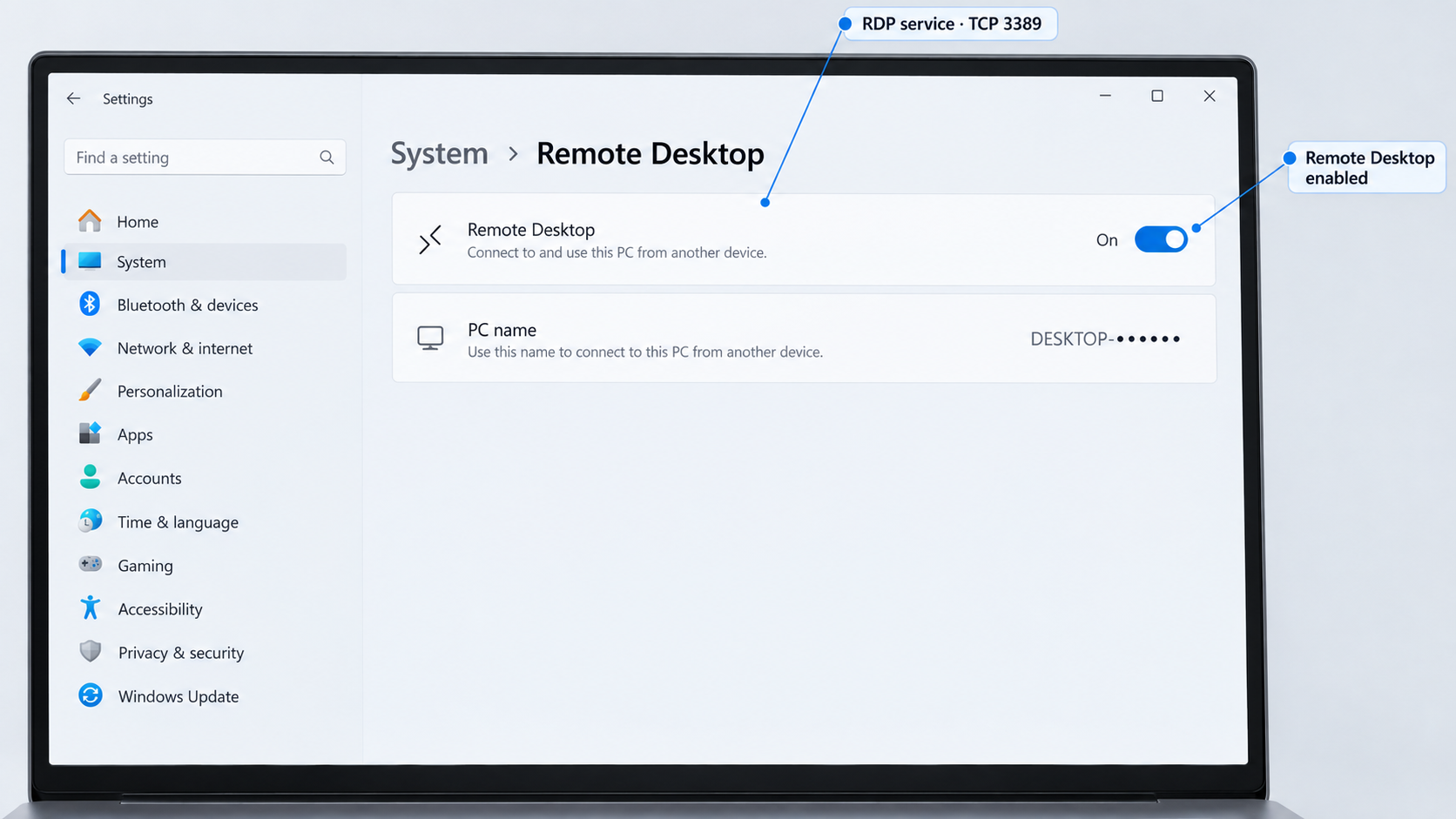
Configure and test RDP locally before involving Localtonet. A successful same-LAN test proves that the Windows listener, firewall policy, user authorization, and credentials are functional.
Install Windows updates
Apply current security and servicing updates, restart if required, and confirm that Windows Update reports the expected state. Remote access increases the importance of keeping the operating system maintained.
Enable Remote Desktop
Open Settings → System → Remote Desktop, turn on Remote Desktop, and confirm the change. The supported Settings workflow normally enables the related Windows Firewall rules.
Keep Network Level Authentication required
Retain the option requiring Network Level Authentication. NLA requires authentication earlier in the connection process. Update incompatible clients instead of weakening the host to accommodate obsolete software.
Authorize only necessary users
Use the Remote Desktop users control to grant access only to approved accounts. Prefer a standard user for routine work and elevate separately when administration is necessary. Record the correct sign-in form, such as COMPUTERNAME\username for a local account or the appropriate Microsoft or organizational account identifier.
Confirm the local listener
On the Windows host, open PowerShell and check whether the normal RDP TCP port is listening. If RDP was intentionally moved to another port, substitute that verified port throughout the tutorial.
Verify Windows Firewall and same-LAN access
Confirm that the Remote Desktop firewall rules are enabled for the intended network profile. Then connect from another trusted device on the same LAN using the Windows computer's private address. Do not continue until that local connection succeeds.
Check the listener with PowerShell
Get-NetTCPConnection -LocalPort 3389 -State Listen
Test-NetConnection 127.0.0.1 -Port 3389
The first command looks for a listening TCP socket on port 3389. The second checks whether the local computer can establish a TCP connection to that listener. A successful TCP check does not validate credentials or complete an RDP sign-in, but it confirms that something is accepting TCP connections on the target port.
If Get-NetTCPConnection returns no listener, revisit the Remote Desktop setting, restart the computer if Windows requests it, and verify that the host edition supports incoming RDP. Do not create an arbitrary firewall opening to compensate for a missing listener.
Review the Windows Firewall rules
Get-NetFirewallRule -DisplayGroup "Remote Desktop" |
  Select-Object DisplayName, Enabled, Profile, Direction, Action
The display-group name can be localized on non-English Windows installations. You can also inspect the rules through Windows Security → Firewall & network protection → Allow an app through firewall or through Windows Defender Firewall with Advanced Security.
If Localtonet runs on another LAN device, test the target from that device or from another trusted Windows computer:
Test-NetConnection PRIVATE-LAN-IP -Port 3389
Replace PRIVATE-LAN-IP with the actual address of the RDP host. After the transport check succeeds, use Remote Desktop Connection to complete a real sign-in. This catches authorization, password, NLA, and session-policy issues that a port test cannot detect.
Install and Authenticate the Localtonet Windows Client
Our current Getting Started documentation provides Windows downloads for 64-bit, 32-bit, ARM, and ARM64 systems. Use that page rather than an old direct-download address so that you receive the package currently offered for your architecture.
Determine the Windows architecture
Open Settings → System → About and read System type. Select the matching 64-bit, 32-bit, ARM, or ARM64 Windows download from the Localtonet documentation page.
Download from the current Localtonet page
Download the Windows client only from the Localtonet-controlled location linked by our current documentation. Avoid repackaged installers and old third-party mirrors.
Install or launch the supplied Windows client
Run the downloaded package and follow the controls presented by that release. The verified evidence does not establish a single permanent command-line installation or Windows service command across all client versions, so this guide does not invent one.
Authenticate the device with its token
Obtain the device-specific AuthToken from your Localtonet account and enter it through the authentication control provided by the current client. Do not reuse a token from an unrelated device, expose it in a screenshot, or paste it into a public support request.
Confirm that the intended device is connected
Check the Localtonet dashboard and verify that the correct Windows device reports as connected. Match the device deliberately before creating the RDP tunnel, especially when several computers are registered to the account.
The AuthToken identifies the client device. Never include a real token in an article, command example, source repository, screen recording, or shared troubleshooting transcript. If you suspect that a token has been disclosed, replace it through the supported account controls and reauthenticate the intended device.
Create and Start the RDP Tunnel
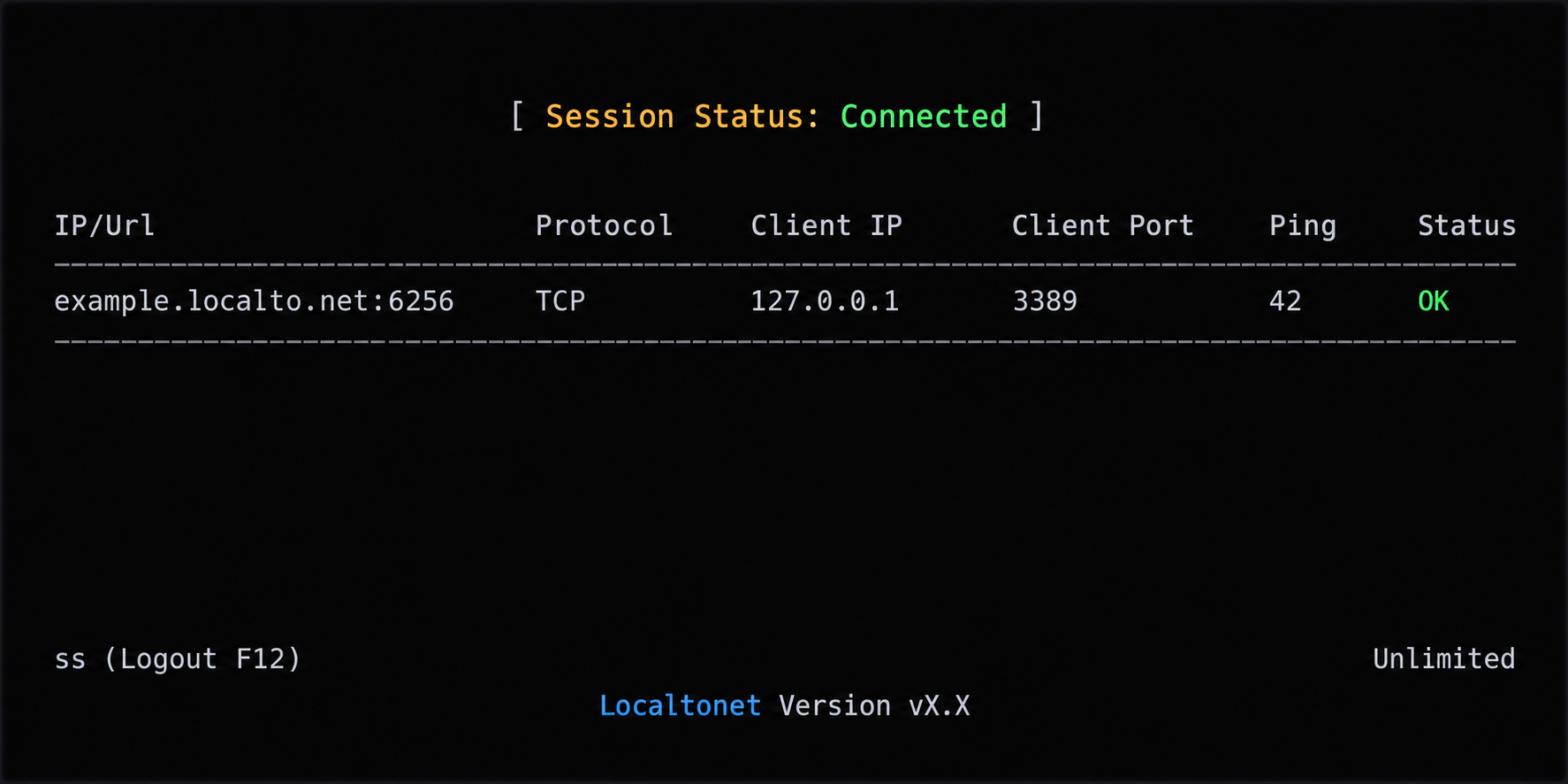
A TCP tunnel is the basic raw-port choice for an RDP listener. RDP also has transport behavior involving UDP in supported configurations, as described in Microsoft's Remote Desktop protocol documentation. Where a combined UDP/TCP tunnel is shown in your current dashboard and available for your configuration, it can point both protocols to the same RDP target. Do not assume that every tunnel family, relay location, endpoint option, or capability is available in every plan.
The documented Localtonet sequence is to install and run the client, open the required tunnel page, select the AuthToken and server, enter the local target, and press Start. Creating a tunnel entry does not mean the tunnel is already running.
Open the TCP or UDP/TCP tunnel page
In the Localtonet dashboard, open the page for the raw tunnel family you intend to use. Choose TCP for the basic configuration. Use combined UDP/TCP only when it is currently available and you specifically want both transports directed to the same local service.
Select the AuthToken
Select the token for the connected device that can reach the Windows RDP listener. This can be the RDP host itself or another explicitly permitted device on the same LAN.
Select an available relay server
Choose from the servers or regions currently offered in your dashboard. Available values must come from the live product rather than a server code copied from an older tutorial.
Enter the verified local IP address and port
Enter 127.0.0.1 and 3389 when Localtonet runs on the RDP host. If Localtonet runs elsewhere on the trusted LAN, enter the Windows host's verified private address and port 3389. Use another port only when you have intentionally reconfigured and tested the Windows listener on that port.
Press Start and record the assigned endpoint
Press Start. Confirm that the tunnel reports as running, then record the exact public host and port displayed for it. Use the current endpoint rather than assuming that an endpoint from a deleted or recreated tunnel remains valid.
| Configuration item | Same-host RDP | RDP on another LAN computer |
|---|---|---|
| Client location | On the Windows RDP host | On another permitted device that can reach the host |
| Local IP | 127.0.0.1 |
The RDP host's private LAN address |
| Local port | 3389, unless intentionally changed |
3389, unless intentionally changed |
| Windows Firewall scope | The local listener must accept the connection path on the host | The host must permit RDP from the client device or applicable trusted subnet |
| Common failure | RDP is disabled or no listener exists | Wrong private address, host firewall, isolation, or broken LAN routing |
Test the Public Endpoint from a Different Network
Do not consider the setup complete after a same-LAN test. A proper end-to-end test must originate outside the host's local network. For example, use a laptop on another trusted internet connection or a mobile device using cellular data instead of the same Wi-Fi network.
Confirm the host and tunnel state
Verify that Windows is awake, the Localtonet client device is connected, and the intended tunnel reports as running. Recheck the public host and port in the dashboard.
Leave the local network
Disconnect the test client from the host's Wi-Fi or LAN. Confirm that it is using an independent network. Testing through the private address while still on the same LAN does not validate the relay path.
Check TCP reachability
From an external Windows device, use Test-NetConnection with the assigned relay host and public port. This checks the TCP path without submitting Windows credentials.
Complete an RDP sign-in
Open an RDP client, enter the relay endpoint, and sign in with an authorized Windows account. Confirm that the expected computer name, user environment, and files appear before treating the test as successful.
End the session and test lifecycle control
Sign out or disconnect as appropriate, stop the tunnel, and confirm that the public endpoint is no longer usable. Start it again only if continued access is required.
Test-NetConnection ASSIGNED-RELAY-HOST -Port ASSIGNED-PUBLIC-PORTReplace both placeholders with the values currently displayed in the dashboard. A successful test establishes TCP reachability only. It does not prove that the certificate is expected, that the Windows account is authorized, or that the final desktop session works.
Connect with Windows Remote Desktop Connection
On Windows, search for Remote Desktop Connection or run mstsc. Enter the destination in hostname:port form, using the public host and port assigned to the tunnel. Supply the authorized Windows account when prompted.
Connect from macOS, iOS, iPadOS, or Android
Microsoft now uses the Windows App branding on supported platforms. See Microsoft's Windows App overview for current platform availability and interface guidance. Add a PC using the assigned relay host and port. The exact placement of a separate port field can vary by app version.
Connect from Linux
Use a maintained RDP client such as Remmina or FreeRDP. Let the client prompt for the password or use a properly protected credential store. Avoid placing the Windows password directly in a shell command because command arguments can be retained in history or exposed to other local processes.
An RDP certificate warning can appear because the relay destination name differs from the name on the certificate presented by the Windows host. The warning is not proof that the connection is safe. Verify that you used the endpoint currently shown in the Localtonet dashboard, confirm the expected Windows host through a trusted path, and compare certificate details or a previously recorded fingerprint where your environment supports that process. Do not permanently trust an unexpected certificate without verification.
Public RDP Tunnel or Localtonet VPN Manager?
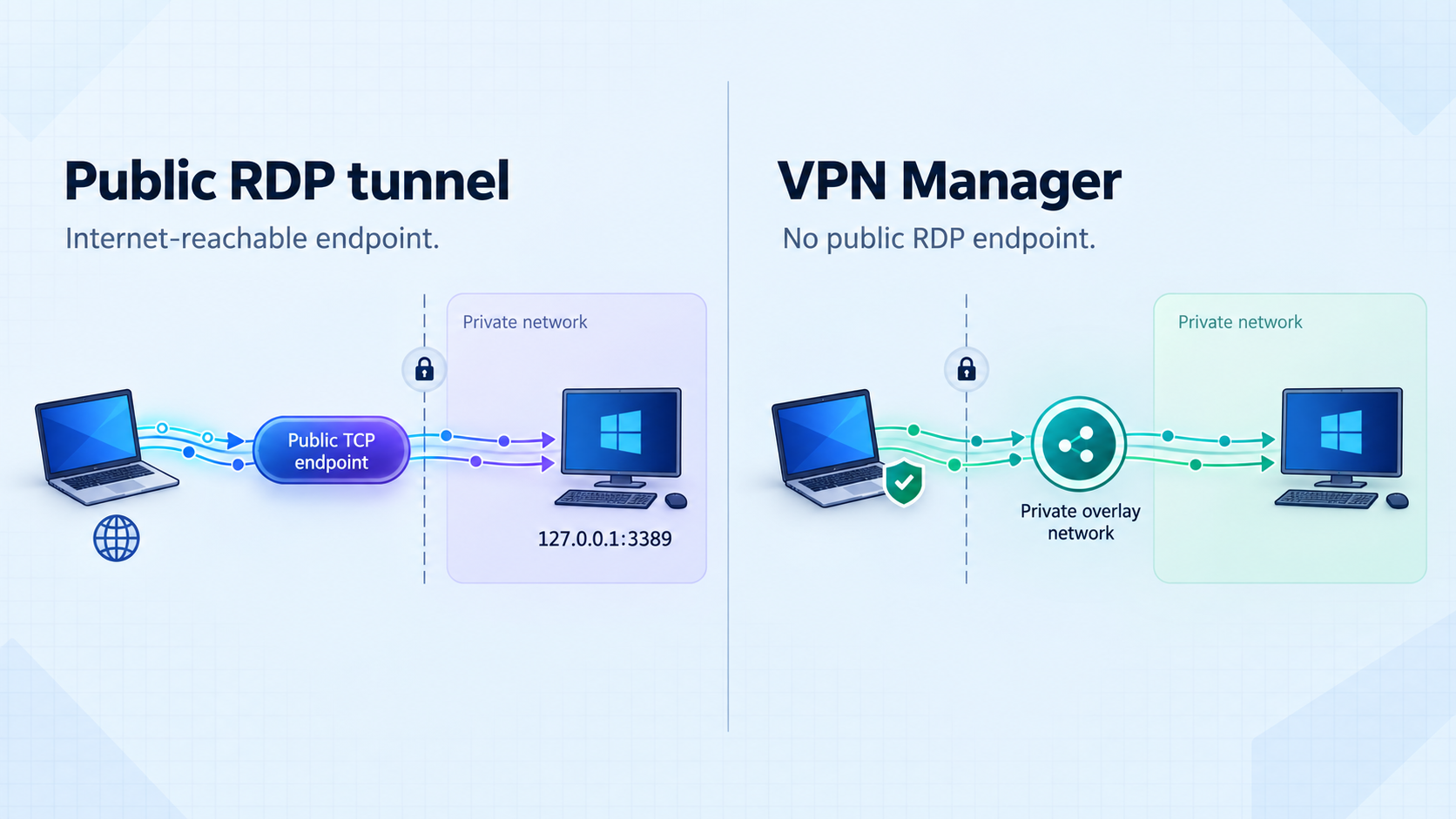
A raw TCP or UDP/TCP tunnel and VPN Manager solve different access problems. The raw tunnel publishes one selected service through a public relay endpoint. VPN Manager creates a private mesh network with granular firewall rules and can bridge permitted local LANs.
If you need to connect from arbitrary RDP clients using a public host and port, a raw tunnel may be the direct fit. If access should be limited to enrolled devices and there is no reason to make an RDP path internet-reachable, VPN Manager is usually the architecture to evaluate first.
| Consideration | Raw TCP or UDP/TCP tunnel | VPN Manager |
|---|---|---|
| Exposure model | Provides a public relay host and port for the selected RDP target. | Provides private mesh connectivity between participating systems and permitted networks. |
| Remote destination | The RDP client uses the assigned public host and port. | The RDP client reaches the host through its private mesh or bridged LAN path. |
| Primary access control | Windows RDP authentication remains essential, together with applicable tunnel restrictions. | Mesh membership and granular firewall rules restrict network reachability, while Windows still authenticates RDP users. |
| Best fit | A narrowly targeted service that must be reached through a public endpoint. | Private administrative access from known devices without an internet-reachable RDP endpoint. |
| Operational responsibility | Stop or delete the tunnel when public access is unnecessary. | Maintain device membership and least-privilege mesh firewall rules. |
VPN Manager changes the network path and exposure model. It does not replace Windows account authentication, NLA, operating-system updates, or RDP authorization. Apply both network-level and host-level controls.
Routine Operation, Reboot Checks, and Safe Shutdown
Remote access remains available only while the Windows target is reachable, the selected Localtonet device is connected, and the tunnel is running. Creating the configuration alone does not keep it active.
Before each remote session
- Confirm that the Windows computer is powered on and not sleeping.
- Confirm that the Localtonet client device is connected.
- Confirm that the intended tunnel is running.
- Read the current public host and port from the dashboard.
- Use only an approved remote device and trusted RDP client.
Test unattended recovery after a reboot
If you require access before anyone signs in locally, configure unattended startup only through the mechanism supported by your installed Localtonet client version. The current evidence supplied for this revision does not establish one universal Windows service command, so old commands should not be copied into the setup.
After configuring the supported startup behavior, perform a full reboot and test in this order:
- Wait for Windows to finish starting without signing in locally.
- Check whether the Localtonet device returns to a connected state.
- Check whether the selected tunnel is running. Do not assume that reconnecting the client automatically starts every tunnel.
- Test the assigned endpoint from a different network.
- Complete an RDP sign-in and verify that the expected Windows host appears.
Also review sleep and hibernation settings. Preventing sleep can improve availability, but it increases energy use and leaves the computer continuously reachable. Choose settings that match your security and availability requirements rather than disabling sleep automatically.
Stop or delete access safely
When temporary access is finished, disconnect or sign out of the RDP session, then stop the Localtonet tunnel. Confirm that its status changes from running and test that the public endpoint no longer accepts the connection.
Delete the tunnel when the configuration is no longer required. If the client device itself is being retired, remove or replace its authentication token through supported account controls and uninstall the client according to the installed package. Removing a dashboard entry does not shut down Windows, and disabling RDP does not automatically stop an unrelated Localtonet tunnel, so verify each layer separately.
Security Checklist for an Internet-Reachable RDP Path
| Control | Why it matters | Recommended action |
|---|---|---|
| Supported Windows release | RDP and its supporting components receive security fixes through Windows servicing. | Use a supported release and apply security updates promptly. |
| Network Level Authentication | NLA requires authentication earlier in the connection process. | Keep NLA required and update incompatible clients. |
| Strong unique password | A public endpoint can receive connection and authentication attempts. | Use a unique password and follow applicable account-lockout and multifactor policies. |
| Least privilege | An administrative account increases the impact of credential compromise. | Use a standard account for routine work and elevate only when necessary. |
| Restricted RDP users | Every authorized account adds another possible sign-in path. | Remove obsolete users and grant access only to named people who require it. |
| Token secrecy | The Localtonet token identifies the client device. | Keep it out of screenshots, scripts, repositories, and public support material. |
| Tunnel lifecycle | A running tunnel keeps the relay endpoint available. | Stop temporary tunnels and delete obsolete configurations. |
| Verified certificate handling | Blindly accepting a changed certificate can hide a wrong destination or interception. | Verify endpoint and host identity before trusting a warning or changed fingerprint. |
| Private architecture where possible | A public endpoint is unnecessary when only approved devices need access. | Evaluate VPN Manager and least-privilege mesh firewall rules. |
Windows Home and Other Remote Desktop Servers
Windows Home can initiate RDP connections but does not include Microsoft's supported Remote Desktop host capability. The supported options are to upgrade to an eligible Windows edition or use reputable remote-access software that officially supports the installed system.
We do not recommend RDP Wrapper or similar tools that patch or alter Windows terminal-service behavior. They can break after updates and may introduce licensing, maintenance, and security problems.
VNC is one possible cross-platform alternative, but implementations differ in authentication, encryption, listening interfaces, and default ports. Do not assume that every VNC server encrypts the full session or listens on TCP port 5900. Follow the selected server's current documentation, enable its authentication and transport protections, verify its actual listening address and port, and test it on the LAN before targeting it with an appropriate Localtonet TCP tunnel.
The same general rule applies to any other remote-access server: first prove that the service works locally, then expose only the verified address and port. A tunnel cannot repair a service that is not listening, rejecting credentials, blocked by the host firewall, or unsupported on the operating system.
Troubleshooting by Connection Layer
Diagnose the path one layer at a time. Randomly changing Windows Firewall rules, tunnel settings, credentials, and relay servers at once makes the original fault harder to identify.
| Layer | What to verify | Safe diagnostic |
|---|---|---|
| Windows service and listener | Remote Desktop is enabled and the intended port is listening. | Run Get-NetTCPConnection -LocalPort 3389 -State Listen and test 127.0.0.1. |
| Windows Firewall | The Remote Desktop rules are enabled for the correct network profile and source scope. | Review the Remote Desktop firewall group. Do not add an unrestricted rule without understanding the existing policy. |
| LAN path | The Localtonet client device can reach the RDP host's private address. | Test the private address and port, then complete a same-LAN RDP sign-in. |
| Localtonet client | The intended token-authenticated device is online. | Check its connected status in the dashboard and verify that the device is the expected machine. |
| Tunnel lifecycle | The correct tunnel was started and points to the verified local target. | Review the AuthToken, server, local IP, local port, running state, and assigned endpoint. |
| Relay path | The external client can reach the assigned host and public port. | Run Test-NetConnection from a different network. |
| RDP credentials and authorization | The account format, password, NLA support, and Remote Desktop permission are correct. | Test the same account through a trusted LAN RDP session before changing the tunnel. |
No RDP listener appears on port 3389
Confirm that the Windows edition supports hosting RDP and that Remote Desktop is enabled. Restart after pending updates or configuration changes if required. If the listener was intentionally moved, identify and test the configured port rather than opening 3389 unnecessarily.
Loopback works, but another LAN device cannot connect
This normally points to the Windows Firewall profile or scope, an incorrect private address, client isolation on Wi-Fi, VLAN boundaries, or another LAN routing restriction. Confirm that the target address belongs to the Windows computer and that the network is classified as intended. Avoid disabling Windows Firewall as a test. Review the specific Remote Desktop rules instead.
LAN RDP works, but the Localtonet endpoint does not
Check whether the selected Localtonet device is connected and whether the tunnel was actually started. Verify the local target carefully. Use 127.0.0.1 only when the client and RDP listener are on the same computer. If they are on different computers, use the verified private LAN address.
Also confirm that the external test uses the current public host and port. A destination copied from an old, deleted, or recreated tunnel may no longer identify the active configuration.
The public TCP test succeeds, but RDP rejects the connection
A successful TCP test proves only that the network path accepted a connection. Check the Windows username format, account password, Remote Desktop Users membership, account restrictions, NLA compatibility, and local security policy. Do not enter a Windows Hello PIN when the remote client expects the account password.
The RDP client shows an unexpected certificate
Stop and verify the dashboard endpoint, the expected Windows host, and the certificate details through a trusted path. A name mismatch can be understandable when a relay hostname leads to a certificate issued for the Windows computer, but an unexplained certificate or changed fingerprint should not be accepted automatically.
The setup works until Windows reboots
Determine which layer did not recover. First check whether Windows has network connectivity. Next check whether the Localtonet device reconnects. Then check whether the specific tunnel is running. Finally, repeat the external port test and RDP sign-in. Client startup and tunnel startup are separate conditions, so verify both.
The session is slow or unstable
Latency, packet loss, display resolution, visual effects, host load, and network congestion can all affect the session. Use an appropriate RDP experience profile, reduce display resolution or visual effects, and test a currently available relay location that is appropriate for the connection. Do not infer a relay problem until local host performance and both internet connections have been checked.
A local user's desktop is interrupted
Desktop Windows editions do not provide the same concurrent multi-user session model as Windows Server Remote Desktop Services. Coordinate with the person using the computer. Do not apply unsupported patches or policy workarounds intended to circumvent Windows desktop session or licensing limits.
Frequently Asked Questions
Does Localtonet work behind CGNAT?
Yes. The Localtonet client establishes an outbound connection to our relay, so the host does not need a public IP address or an inbound router mapping. The local network must still permit the client connection, and the setup must comply with network policy.
Is TCP port 3389 exposed directly through my router?
No inbound router rule is required. However, the assigned Localtonet relay host and port create a public path to the configured RDP service while the tunnel is running. Treat the RDP service as internet-reachable during that period.
Should I use a raw RDP tunnel or VPN Manager?
Use a raw tunnel when you specifically need a public host and port for the selected RDP service. Evaluate VPN Manager when only approved devices should have private network access. VPN Manager provides a private mesh with granular firewall rules and avoids making an RDP endpoint publicly reachable.
Can Windows Home receive an RDP connection?
Windows Home can run an RDP client, but it does not include Microsoft's supported Remote Desktop host capability. Upgrade to an eligible edition or use supported remote-access software designed for Windows Home. Avoid unofficial terminal-service patches.
Will the public host and port always remain the same?
Do not assume that they will. Endpoint behavior can depend on the current configuration or plan. Use the endpoint shown in the dashboard and verify it after deleting, recreating, or changing the tunnel.
Can I connect before anyone signs in locally?
RDP can present the Windows sign-in screen, but the Localtonet client must already be connected and the tunnel must be running. Configure unattended startup only through the mechanism supported by the installed client version, then verify the complete path after a full reboot.
Does Localtonet replace Windows authentication or NLA?
No. Localtonet provides the network path to the configured RDP listener. Windows still authenticates the user. Keep NLA enabled, restrict authorized users, use strong unique credentials, follow least privilege, and maintain current security updates.
Why does RDP work on my LAN but not through the tunnel?
Verify that the intended Localtonet device is connected, the tunnel is running, and the local target is correct. Use 127.0.0.1:3389 only on the same host. For another LAN computer, use its verified private address and confirm that the Localtonet client device can reach it.
Connect to Your Windows PC Without Router Port Forwarding
Verify RDP locally, connect the correct Localtonet device, target the tested Windows listener, and start the tunnel only when access is required. For private access between approved devices, evaluate VPN Manager before publishing a raw RDP endpoint.
Get Started Free →