


Turn an AI career prediction into a practical, evidence-checked plan
Generative AI can alter individual tasks, workflows, skill requirements, and the mix of responsibilities inside a job. That does not mean every exposed occupation will disappear. This guide explains how to assess the impact on your own work and introduces RoleFate, a free, evidence-first tracker that scores over 6,400 occupations against AI exposure using a documented, dated-evidence methodology rather than a single opaque number. It also covers how to protect sensitive career information whenever you check a score online.
📋 What's in this guide
What it means for AI to change your work
Discussions about artificial intelligence often jump directly from “a model can perform this task” to “this job will be replaced.” That conclusion skips several important steps. Most occupations are bundles of activities involving different tools, knowledge, relationships, responsibilities, and levels of judgment. A technology may be effective at one part of that bundle while being unreliable, uneconomical, restricted, or inappropriate for another.
Consider a customer support role. A generative AI system might draft a reply, summarize a conversation, classify the issue, or retrieve a relevant help article. The same system may not be authorized to approve a refund, assess a vulnerable customer’s circumstances, make a contractual commitment, or take responsibility for an incorrect answer. The role can change substantially even when the organization continues to need support professionals.
Four concepts help make the distinction clearer:
These outcomes can occur together. An organization might automate first-draft writing, require employees to verify every factual claim, create a new review process, and increase demand for workers who can resolve unusual cases. Another organization using similar technology might simplify roles or reduce hiring. The underlying model alone does not determine which path is taken.
A tool may estimate how much of an occupation overlaps with current AI capabilities. Unless its methodology explicitly supports a different interpretation, that estimate should not be read as the chance that an individual will lose a job.
Capability is only one part of adoption
A convincing demonstration shows that a system can produce an output under selected conditions. Workplace adoption requires more. The output must be accurate enough for the use case, compatible with existing systems, affordable at the required scale, legally permissible, secure, and acceptable to customers and employees. An employer must also decide who is accountable when the output is wrong.
Tasks involving repeatable digital inputs are often easier to test with generative AI than tasks requiring physical dexterity, tacit organizational knowledge, sustained interpersonal trust, or legal authority. Even within a highly exposed office role, work may divide into routine cases that can be assisted and exceptional cases that still need experienced judgment.
What labor-market research can and cannot tell you
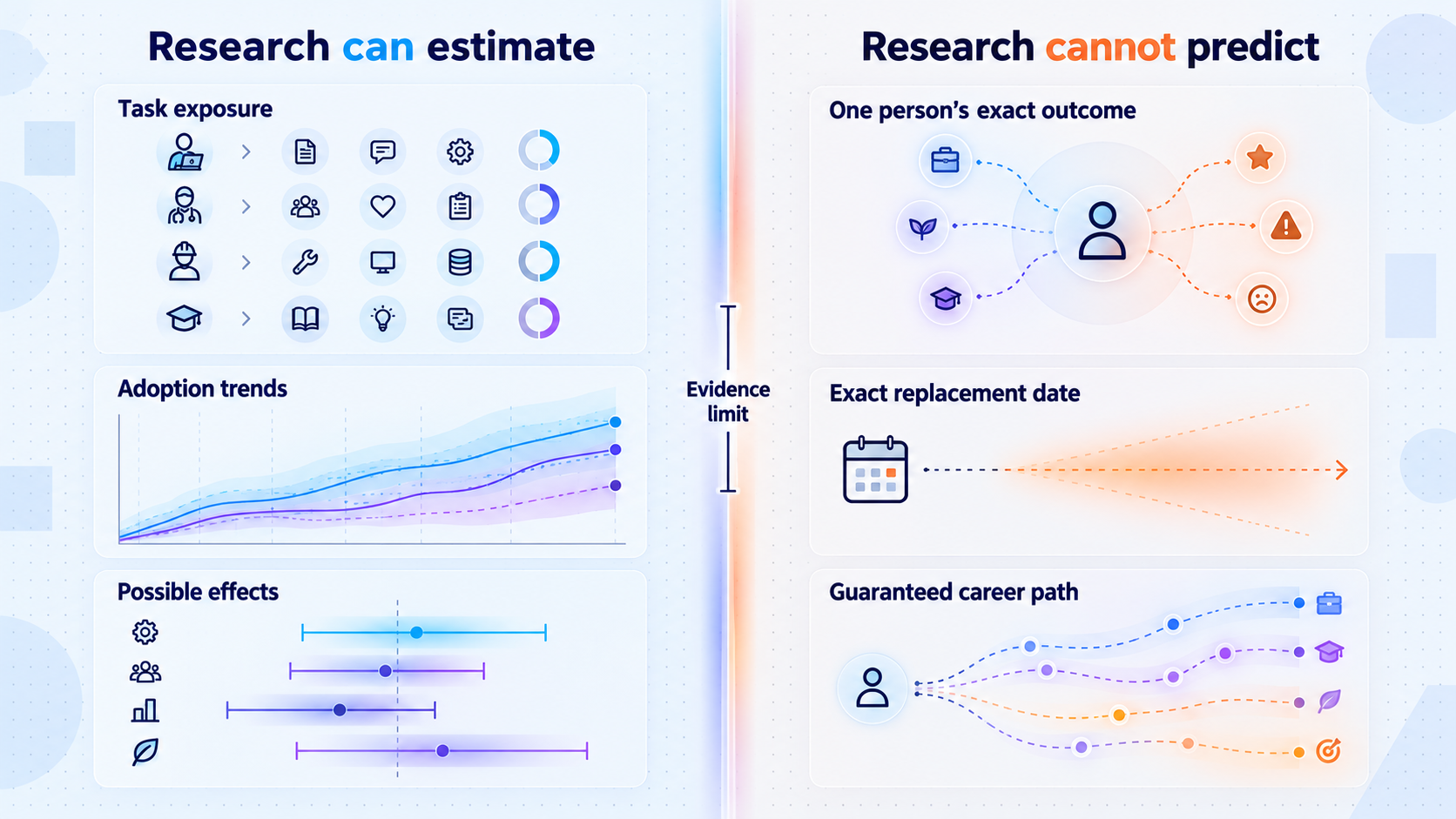
Independent research provides a better foundation than a single career prediction. It can identify broad patterns, compare occupations, and document how employers are adopting technology. It still cannot tell one person exactly what will happen in a particular workplace.
Research from the International Labour Organization has emphasized that generative AI exposure can lead to augmentation rather than complete automation, with effects varying by occupation and country. The OECD Employment Outlook also distinguishes exposure to AI from broader automation risk and examines how technology can affect job quality, skills, and labor demand. These are more useful starting points than headlines that assign a single expiration date to an occupation.
For occupation-level evidence in the United States, the Bureau of Labor Statistics Occupational Outlook Handbook provides descriptions, education requirements, pay data, and employment projections. The O*NET occupational database breaks roles into tasks, skills, knowledge areas, work activities, and context. Those details make it possible to compare a prediction with the actual composition of a job.
| Question | Useful evidence | What the evidence does not prove |
|---|---|---|
| Can AI assist with a task? | Capability evaluations, controlled trials, and tests using representative examples | That employers will deploy it or that it can operate without review |
| Is an occupation exposed? | Task-level mappings between job activities and AI capabilities | That the entire occupation can be automated |
| Will employment grow or decline? | Official projections, industry demand, demographics, investment, and policy | A guaranteed outcome for one employer, location, or person |
| Will a workflow be redesigned? | Employer adoption studies, process data, interviews, and observed deployments | That every organization will adopt the same design |
| Should a worker retrain? | Local vacancies, adjacent-role requirements, personal goals, and skills-gap analysis | That one popular course or tool will remain valuable indefinitely |
Why task-level analysis is more useful
Occupational titles are broad. Two people with the same title may spend their days very differently. A marketing manager at a small company might write copy, purchase advertising, analyze campaign results, negotiate with agencies, manage a budget, and present strategy to executives. A manager with the same title at a larger organization may supervise specialists and do little direct content production.
A task inventory captures that difference. For each recurring activity, record its frequency, importance, inputs, required judgment, consequences of error, and whether a person must remain accountable. This creates a more realistic picture than asking whether “marketing manager” is safe or unsafe.
Why predictions have wide uncertainty
Forecasts depend on assumptions about future model capability, price, reliability, regulation, organizational behavior, and demand. Improvements can make a task technically easier to automate while legal or operational constraints slow deployment. Productivity gains can reduce the labor required per unit of output, but lower costs can also increase demand for the output. Employers may remove roles, expand teams, change entry-level pathways, or combine all three responses in different departments.
This is why a responsible analysis uses scenarios rather than a single definitive future. A near-term scenario might focus on assistance with drafting and retrieval. A medium-change scenario might include redesigned workflows and fewer routine cases. A high-change scenario might consider extensive automation, while still naming the technical and institutional conditions required for it to occur.
RoleFate: an AI exposure tracker that shows its work
Most “will AI take my job” tools hand you a single number and nothing else. RoleFate takes a different approach: it publishes a documented methodology, dates and sources every piece of evidence behind a score, and re-scores occupations on a running schedule instead of leaving a static number to go stale. It currently tracks 6,406 occupations under the ISCO-08 classification, drawing on 29,749 evidence records pulled from official statistics agencies, established outlets, and research bodies such as the ILO, OECD, BLS, and O*NET.
What that looks like in practice on the site:
- Four weighted signals, not one guess. Every score is built from technical capability (40%), market adoption (30%), policy & regulation (15%), and labor supply (15%) - so a heavily regulated or licensed role doesn't get the same treatment as an unregulated one, even if a model could technically do the work.
- A published confidence level. Each occupation is labeled High, Medium, or Low confidence based on how much credible, recent evidence supports it - RoleFate is explicit that a low-evidence score is a placeholder, not a verdict.
- Dated, sourced evidence you can open. Every occupation page links the underlying evidence records, each tagged by tier (official statistic, established outlet, or blog/forum) with a publication date and a link to the original source.
- Country-aware scoring. Alongside a global estimate, RoleFate produces country-specific scores where national evidence exists (the US, UK, Germany, China, Japan, Australia, India, and Canada currently have the deepest coverage), rather than applying one global number everywhere.
- Exposure and employment kept separate. A high exposure score is explicitly not converted into a job-loss percentage; five-year employment ranges are modeled independently and shown as a range, not a single forecast.
- Immutable, versioned history. Every score revision is stored with a timestamp and model/configuration identifier rather than overwritten, so you can see how and when a number moved.
- A public changelog. RoleFate's methodology changelog documents when scoring rules, calibration, or the evidence pipeline changed - useful context if you're comparing scores captured on different dates.
RoleFate itself frames its numbers this way: exposure bands (0-24 low, 25-49 moderate, 50-74 elevated, 75-100 high) describe how much of an occupation's task mix overlaps with current AI capability, and five-year projections are shown as ranges with stated assumptions and reversal conditions - not as promises. Treat a score as a well-sourced starting point for your own research, not a final answer.
Where the free tools live on the site
- Check your own job - pick your occupation, tick the tasks that actually fill your week, and get a personal score in about 60 seconds, with a shareable results card.
- Rankings - browse all tracked occupations sorted by exposure, confidence, or category.
- Compare - put two or more occupations side by side.
- Changes - see which occupations moved the most at the last review.
- Data & API - download the underlying dataset (CSV/JSON) or query it programmatically, with ready-made citation text for research use.
Editorial disclosure
No sponsorship, affiliate arrangement, or payment is associated with this coverage of RoleFate. It's included here because its published methodology and evidence sourcing are unusually transparent for this category of tool. As with any labor-market estimate, pair a RoleFate score with the independent evidence covered elsewhere in this guide before acting on it.
How to get a well-grounded score from RoleFate
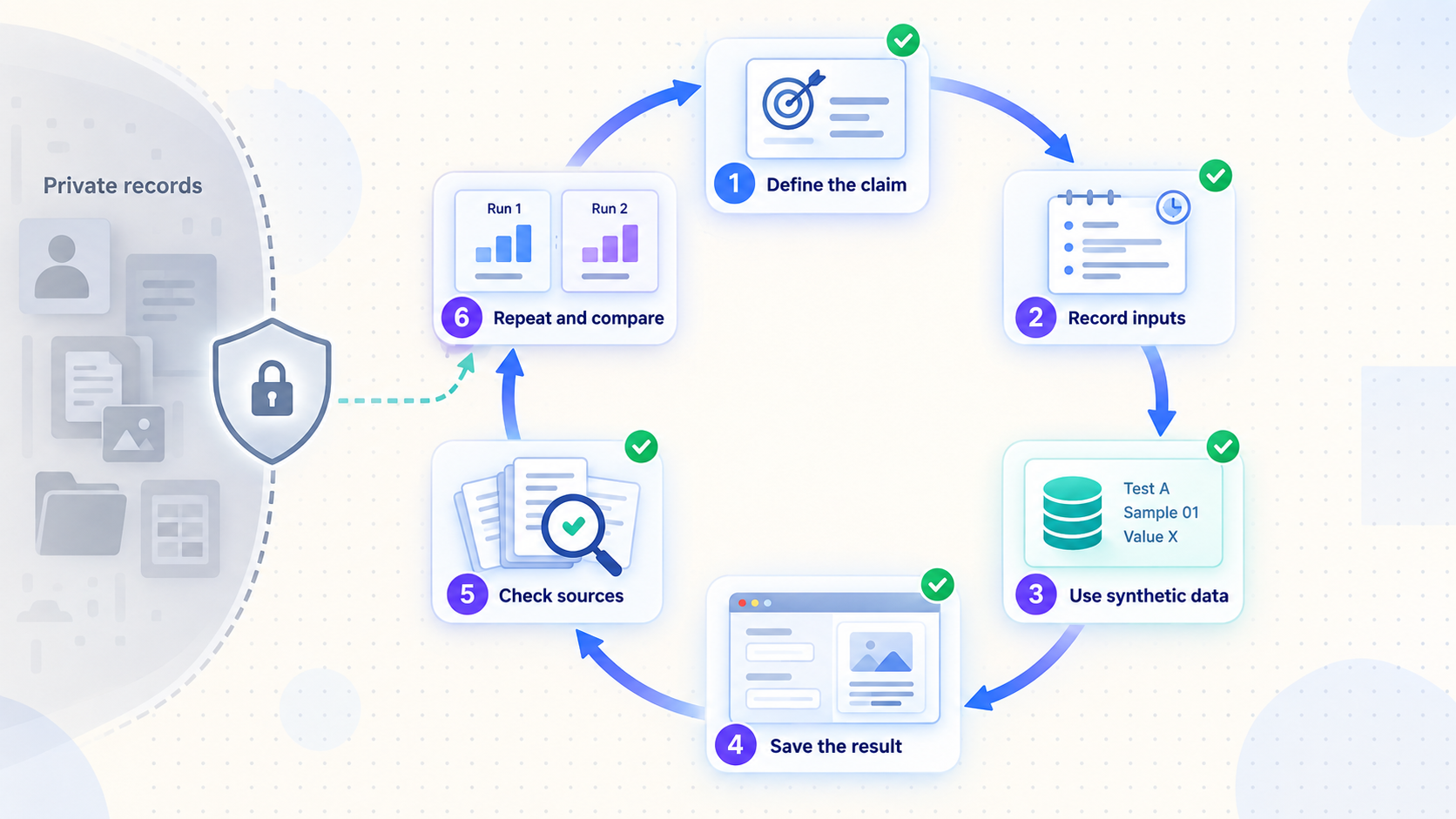
RoleFate's own Check your own job flow takes about a minute. Here's how to get the most out of it and how to sanity-check what comes back, whether you enter your real occupation or a sample role first.
Search or browse to your occupation
Use the search bar on rolefate.com or the Rankings page to find your ISCO-08 occupation. If you'd rather not use your exact title yet, start with a close, non-identifying match - RoleFate's catalogue of 6,406 roles is granular enough that most job titles map closely.
Run the 60-second personal check
Open Check your own job, tick the tasks that actually fill your week, and select your AI usage level and, if relevant, your country. RoleFate's privacy page confirms an assessment stores the occupation, country, selected tasks, task weights, AI usage level, score, and language - not a résumé or employer name - unless you're signed in and choose to save it to your account.
Read the four sub-scores, not just the headline number
On the results page, open the technical capability, market adoption, policy & regulation, and labor supply breakdown. A high headline score driven mostly by "capability" with low "adoption" reads very differently than one where employers are already deploying the technology at scale.
Check the confidence label and open the evidence
Every occupation page shows a High, Medium, or Low confidence badge and links the dated evidence records behind it. Click through to a few sources - each is tagged Official Statistic, Established Outlet, or Blog/Forum, so you can judge the score's foundation yourself rather than trusting a bare number.
Look at the five-year range, not a single forecast
Each occupation page shows a conditional 1/3/5-year exposure range along with the stated assumptions and the conditions that would move the score up or down. Read those assumptions - they tell you what would have to be true for the high or low end to play out.
Cross-check against independent sources
Compare the result with O*NET task data, the BLS Occupational Outlook Handbook, or your national statistics agency. Since RoleFate cites many of the same official sources directly, this is often a matter of following the links already on the occupation page.
Follow the occupation for updates, if useful
Scores are revised on a rolling basis as new evidence is ingested. Creating a free account lets you follow an occupation and set alert thresholds so you're notified when the picture actually changes, instead of manually rechecking.
Compare before you conclude
Use Compare to place your occupation next to an adjacent one, and use Changes to see which roles shifted most at the last review. Because every score revision is stored immutably with a model/configuration identifier, RoleFate's own Data & API page and citation tool make it straightforward to reference the exact version of a number you used, which matters if a score is later revised.
How to interpret and validate a career prediction
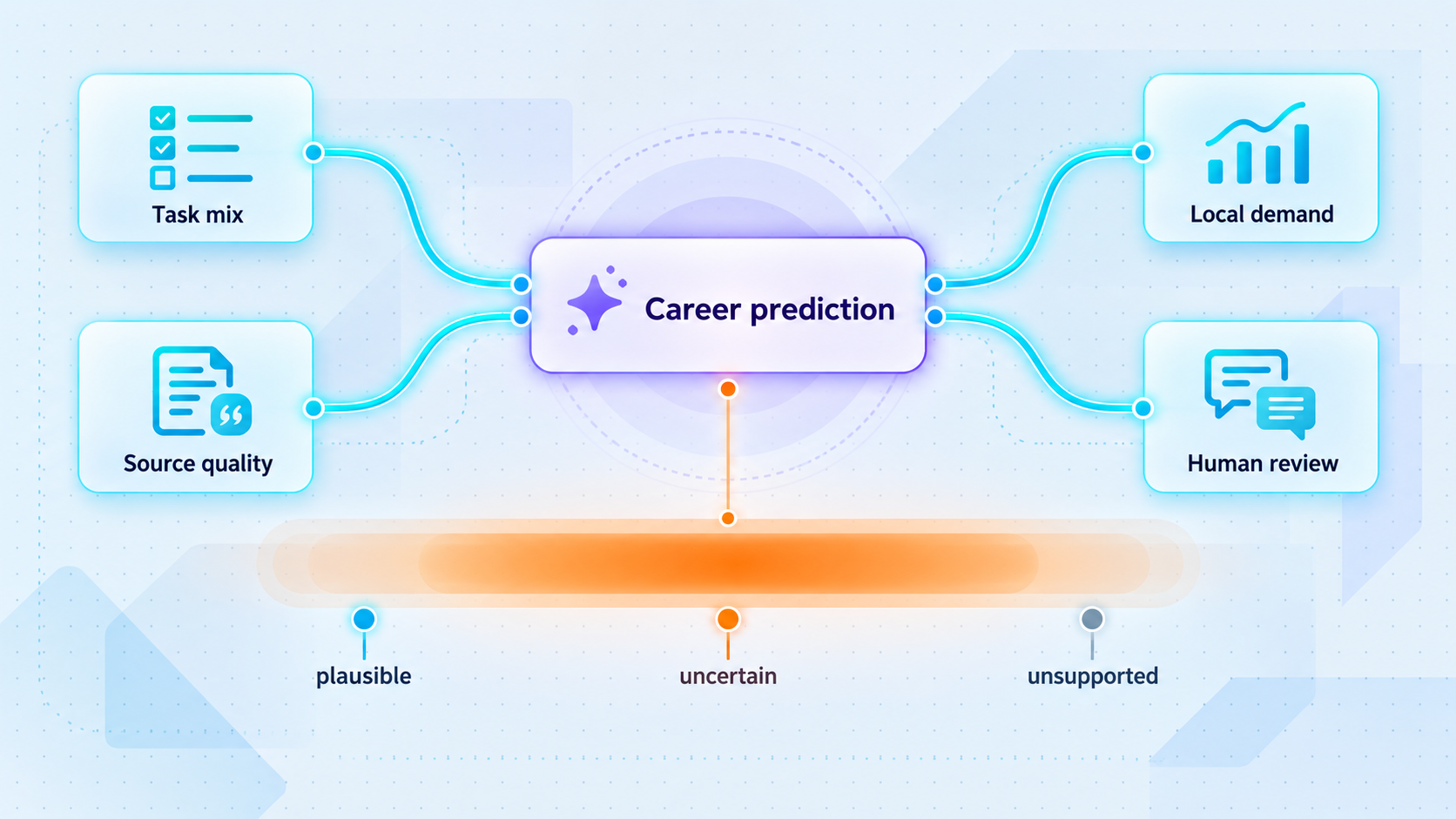
Begin with the result’s defined target. A score labeled “AI impact,” “risk,” “exposure,” or “future-proof” may sound self-explanatory, but those labels can refer to very different constructs. Look for a plain-language definition, time horizon, geographic scope, data date, and explanation of uncertainty.
If no definition is available, treat the result as an opinion-generating prompt rather than a measurement. Do not convert a score into a probability. For example, an exposure score of 70 out of 100 does not automatically mean that 70 percent of the role will be automated, that employment will fall by 70 percent, or that a worker has a 70 percent chance of displacement.
RoleFate's methodology page is a useful reference case for what a defined target looks like: it states explicitly that its 0-24/25-49/50-74/75-100 exposure bands describe task-mix overlap with current AI capability, that employment ranges are a separate, independently modeled forecast rather than "100 minus exposure," and that a midpoint in a projection range is "a sorting aid, not the most likely outcome." Look for this level of specificity in any tool before treating its number as meaningful.
Break the result into claims
A useful review separates the output into individual statements:
- AI can draft routine customer replies.
- AI can identify the probable category of a support request.
- Human workers will handle escalations and accountability.
- Demand for support specialists will decline.
- Workers should learn a particular tool.
The first two are capability claims and can be tested with representative cases. The third is a workflow claim that depends on organizational design. The fourth is a labor-demand forecast requiring economic evidence. The fifth is career advice that should be checked against current vacancies and the durability of the underlying skill.
| Result element | Reasonable interpretation | Validation method |
|---|---|---|
| Task exposure | A current AI system may assist with part of the activity | Test representative cases and review task databases |
| Automation claim | The task may be performed with reduced routine intervention under stated conditions | Check quality, exception handling, integration, cost, and accountability |
| Employment forecast | Labor demand may change over a defined period and market | Compare official projections, vacancies, industry reports, and regional data |
| Skill recommendation | A skill may complement changing workflows | Review job advertisements and speak with practitioners or hiring managers |
| Single risk score | A summary of an underlying model, if documented | Inspect definitions, variables, source data, calibration, and uncertainty |
Use multiple independent checks
No single source provides a complete answer. O*NET can show whether the task description fits the occupation. BLS can provide a broader employment outlook for the United States. Job postings can reveal what employers currently request, although postings represent advertised demand rather than the entire market. Conversations with people doing the work can identify tacit tasks that databases miss.
Your own workplace data is especially important. Measure where time is spent, which errors are costly, how often exceptions occur, and which steps require approval. A task that looks repetitive from the outside may depend on context that has never been documented. Conversely, employees may spend many hours reformatting or retrieving information that could be assisted without changing the core purpose of the role.
Look for entry-level effects
Even when an occupation remains, its pathway can change. Junior workers often learn by performing routine tasks. If those tasks are automated, organizations need a new way to develop judgment and domain knowledge. A prediction that focuses only on total job counts may miss this change in career progression.
Workers and managers should ask who will verify automated output, how novices will learn, and whether experienced employees are taking on more exception handling without additional time or support. These questions address job quality as well as job quantity.
Protect your privacy before entering career data
Career information can reveal more than a job title. A résumé may contain a person’s name, email address, phone number, location, employment history, education, professional memberships, and links to other profiles. Detailed task descriptions can expose internal processes, customer relationships, security controls, product plans, or regulated information.
Before using any external prediction service, determine what is genuinely necessary. A general occupational analysis should usually be possible with a role description and a sanitized task list. If a service requests a complete résumé, ask whether the additional personalization is worth the additional disclosure.
Do not enter customer data, private source code, access credentials, internal incident details, unreleased plans, protected health information, legal advice, or proprietary procedures. Your employer’s policies may also restrict the use of external AI services.
Review the policy for concrete answers
A privacy notice should identify the organization responsible for processing, the categories of information collected, the purposes of collection, retention practices, service providers, international transfers where applicable, user rights, deletion procedures, and a contact method. General statements such as “we value privacy” do not answer those questions.
Check whether input is used to train or improve models. Determine whether deleting an account also deletes submitted content and generated results. Look for separate treatment of operational logs, backups, analytics, and payment records. If the service uses another AI provider, the policy should make clear how that relationship affects submitted information.
As a concrete example, RoleFate's privacy page spells out that using the free assessment doesn't require an account, and that an assessment itself stores only the selected occupation, country, tasks, task weights, AI usage level, score, and language. Creating an account additionally stores your email address, display name, a password hash, and account timestamps, tied to any occupations you follow and your alert/email preferences. Result pages get a unique share link, so treat that link like any other document you'd only send to people you want to see your score. The policy does not spell out a self-service account-deletion flow, so if you want data removed, that's worth confirming directly with RoleFate rather than assuming it happens automatically - a fair question to ask of any service, not a mark against this one specifically.
Use data minimization
- Use a generic occupational title instead of an employer-specific title.
- Describe tasks without naming customers, products, colleagues, or internal systems.
- Remove dates, addresses, identification numbers, and contact details.
- Do not include salary or performance information unless it is essential and the data practices are acceptable.
- Use fictional examples when evaluating the service rather than seeking personal advice.
- Save only the evidence needed for your review and protect any local copies.
If the tool requires an account, use a unique password and any available account-security controls. Do not reuse a workplace password. If you are evaluating the service on behalf of an employer, complete the organization’s vendor, privacy, security, and legal review before submitting employee data.
Suitable and unsuitable uses for prediction tools
A career prediction can be valuable when it prompts better questions. It becomes risky when a simplified output is used as a verdict about a person, occupation, or future.
| Use | Suitability | Reason |
|---|---|---|
| Identifying tasks worth investigating | Suitable with validation | Creates a focused list for experiments and research |
| Starting a career-development discussion | Suitable with context | Can help workers and managers discuss workflow changes and training needs |
| Comparing scenarios for one role | Potentially suitable | Useful if assumptions, definitions, and uncertainty are visible |
| Choosing a course or project | Suitable as one input | Should also reflect actual vacancies, interests, experience, and cost |
| Deciding whom to dismiss or not hire | Unsuitable | A generalized prediction is not an adequate assessment of an individual or workplace |
| Making an irreversible career decision | Unsuitable as the sole basis | The result may omit local demand, personal constraints, and methodological uncertainty |
| Evaluating legal eligibility or professional competence | Unsuitable | These decisions require applicable rules and qualified assessment |
| Predicting an exact replacement date | Unsuitable | Technology and labor-market forecasts do not support personal certainty at that level |
Employers should be particularly cautious. A tool designed for personal exploration should not be repurposed for hiring, promotion, redundancy, performance management, or workforce surveillance without a documented, lawful, and independently reviewed process. Workers also deserve to know when automated systems materially influence employment decisions.
Turn uncertainty into a practical action plan
The most useful response to AI-driven change is neither panic nor complacency. It is a short cycle of observation, testing, learning, and review. Focus on changes you can detect and skills that remain useful across specific tools.
1. Build your task inventory
List the activities you perform in a normal month. Avoid broad labels such as “administration” or “analysis.” Use observable verbs: classify requests, reconcile records, interview stakeholders, draft specifications, inspect equipment, negotiate terms, review exceptions, or approve payments.
For each task, record frequency, time spent, consequence of error, required data, amount of judgment, and whether a person must remain accountable. Mark tasks that are repetitive and digital, but also mark those involving trust, physical presence, regulated decisions, or unusual cases.
2. Test assistance before assuming automation
Select one low-risk task and define a small experiment. Remove confidential data, create representative examples, establish quality criteria, and compare the assisted process with the existing one. Measure correction time as well as generation time. An output produced in seconds is not a productivity gain if an expert needs longer to find subtle errors.
Keep human approval for consequential decisions. Record recurring failure modes and stop using the workflow if the risks cannot be controlled. A successful experiment should produce evidence about a specific task, not a sweeping conclusion about an occupation.
3. Strengthen complementary skills
Complementary skills help a person define problems, supply context, judge quality, and act on results. Depending on the role, these may include domain expertise, data literacy, process mapping, statistical reasoning, communication, security awareness, customer research, or change management.
Learn how to verify outputs, not just how to request them. A durable skill is the ability to define acceptance criteria, identify missing evidence, test edge cases, and explain why a result is appropriate. Familiarity with one interface may be useful, but the underlying evaluation discipline transfers more readily when tools change.
4. Watch real demand
Review job advertisements for your current role and two adjacent roles every few months. Track recurring skills rather than isolated buzzwords. Compare what employers request with what people in those roles actually do. Professional associations, practitioners, managers, and recruiters can provide context that a prediction service cannot.
If entry-level tasks are changing, seek projects that still develop foundational judgment. This may mean reviewing AI output, shadowing complex cases, documenting decisions, or rotating through customer-facing work rather than relying only on routine production.
5. Create three scenarios
- Assistance scenario: AI speeds up selected tasks while responsibilities remain broadly similar.
- Redesign scenario: routine work shrinks, exception handling grows, and performance expectations change.
- Disruption scenario: demand for the current role declines and adjacent skills become necessary.
Give each scenario observable indicators. These might include changes in job advertisements, new internal tools, revised staffing plans, altered performance metrics, or regulatory developments. Review the indicators periodically. Scenario planning is useful because it supports preparation without pretending to know which future is certain.
6. Keep evidence of your value
Document improvements you make to quality, speed, customer outcomes, safety, revenue, or risk reduction. Record how you supervise automated processes, resolve exceptions, and improve procedures. This creates concrete evidence of adaptation and helps prevent your contribution from being reduced to the number of outputs produced.
Troubleshooting an external career prediction
Most of these situations resolve quickly on RoleFate specifically, because the site documents its own scoring and evidence. The general advice below still applies to any similar tool you use.
| Problem | Safe response | What to avoid |
|---|---|---|
| A score seems unexplained | Open the occupation page's four sub-scores and its linked evidence records - RoleFate publishes both | Inferring that the score is a probability of job loss |
| The result changes after a small input edit | Repeat the check with only the task list changed and compare; on RoleFate, sub-scores make it clear which driver moved | Selecting whichever result confirms your prior belief |
| You'd rather not enter personal details yet | The free assessment doesn't require an account or a résumé - use a close occupation match and general tasks first | Uploading a real résumé merely to test the service |
| The page fails to load or submit | Refresh and retry; RoleFate's scoring runs on a rolling schedule, so a busy moment does not affect stored data | Repeatedly submitting personal details without knowing whether earlier requests succeeded |
| You want your data removed | Use the profile/email preference controls, or contact RoleFate directly, since a self-service deletion flow isn't documented | Assuming closing a browser session deletes stored information |
| A score for your occupation looks thin | Check the confidence badge - RoleFate marks occupations with fewer than five evidence records as placeholders | Using presentation quality as evidence of predictive accuracy |
If a result causes distress, step back from the score and discuss the underlying work changes with a manager, mentor, career adviser, union representative, or qualified counselor as appropriate. A prediction interface does not know your complete circumstances and should not be allowed to create false certainty.
If you are building an AI career tool
Developers creating career exploration applications should make uncertainty visible. Define every score, document the data date, distinguish technical capability from labor demand, and show which user inputs materially affect the result. Users should be able to inspect evidence and correct a mismatched occupational classification.
Test the application with fictional profiles before using real career data. Include cases where two workers share a title but perform different tasks. Evaluate whether the system changes its reasoning appropriately, whether citations support each claim, and whether unsafe conclusions are rejected.
When a prototype runs locally, a secure tunnel can help a limited group review the web interface without a full cloud deployment. With Localtonet, the client establishes an outbound connection to our relay and provides a public URL for the selected local HTTP service. The tunnel remains available only while the selected device is connected and the tunnel is running. Protect the application with appropriate authentication and never expose real employee data merely for convenience.
Developers working with local AI-agent endpoints can also review our guide to the MCP Gateway tunnel workflow. An exposed endpoint still requires application-level authorization, least-privilege access, safe secret handling, and careful treatment of untrusted input.
Frequently asked questions
Does high AI exposure mean my job will disappear?
No. Exposure means that AI is relevant to some of the occupation’s tasks. Employment outcomes also depend on reliability, cost, adoption, regulation, demand, workflow design, and whether people remain necessary for judgment, relationships, physical work, or accountability.
Can this article vouch for a specific RoleFate score being correct?
No single article can vouch for one occupation's exact number - scores are revised as new evidence comes in. What we can confirm is that RoleFate publishes a documented methodology, dated evidence sources, and confidence levels for every score, which is what lets you check a result yourself instead of taking it on faith. Cross-check important claims with occupational databases, official labor statistics, and current vacancies, the same way you would with any labor-market estimate.
Should I upload my résumé to an AI career prediction site?
Generally, only if a specific feature genuinely needs it and you've reviewed the service's privacy, retention, deletion, and third-party processing terms first. RoleFate's own assessment tool is a useful contrast here: it works from a selected occupation and a checklist of tasks, not an uploaded résumé, so you can get a personal score without handing over your name, employer, or work history. Prefer that kind of task-based input whenever a service offers it, and never include confidential employer or customer information regardless of the tool.
What should I do if a tool says my occupation is at risk?
Break the role into tasks, check how the tool defines risk, compare the claim with independent evidence, and identify what is changing in your actual workplace. Then choose a small action such as testing one low-risk workflow, strengthening a complementary skill, or exploring an adjacent role. Do not make an irreversible decision from one score.
Which skills are most useful when AI changes a workflow?
The best combination depends on the occupation, but domain knowledge, problem definition, evidence evaluation, quality assurance, data literacy, communication, security awareness, and exception handling are broadly useful. Check current vacancies and real workplace needs before investing heavily in one product-specific skill.
How often should I reassess AI’s impact on my work?
Reassess when your responsibilities, workplace tools, industry rules, or local hiring market materially change. A periodic task inventory is more informative than repeatedly checking a prediction score because it shows how your real work is evolving.
Is this article an endorsement of RoleFate?
We feature RoleFate on its merits: a documented, publicly available methodology, dated and sourced evidence, transparent confidence levels, and a free assessment tool that doesn't require a résumé. No sponsorship, affiliate arrangement, or payment is associated with this coverage. As with any labor-market tool, treat a RoleFate score as a well-sourced starting point rather than a final word on your career.
Share a local AI prototype with Localtonet
If you are testing an AI-assisted workflow or career application on your own machine, Localtonet can expose the appropriate local HTTP service through a public URL without inbound router port forwarding. Use non-sensitive test data, add application-level access controls, and stop the tunnel when the review is complete.
Get Started Free →