

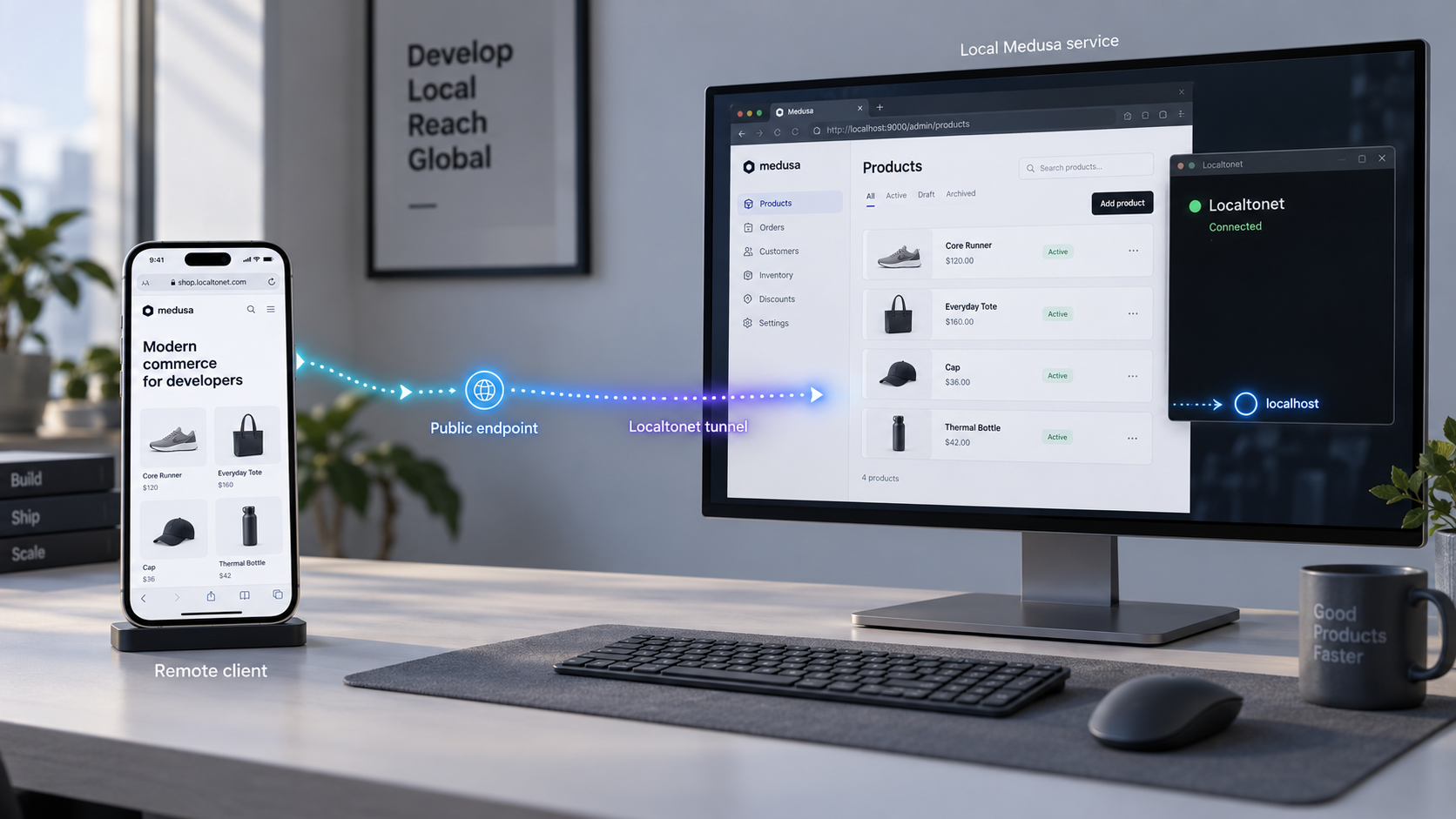
Build your commerce application locally, verify it on the host, and only then make it remotely reachable
Medusa provides an open-source commerce platform and a framework for building customized commerce applications. This guide explains how to approach a local Medusa setup without guessing version-sensitive commands, ports, database requirements, or environment variables that are not established by the available project evidence. We will define a reliable local verification process and then connect the working HTTP service to Localtonet. The result is a public address for a Medusa service that continues running on your own development machine.
📋 What's in this guide
Understand what you are installing
Medusa is a commerce platform with a framework and modules for building custom commerce applications. Its core commerce modules are open source and available through npm, while Enterprise Edition materials are identified separately by the project. The platform is intended for applications such as direct-to-consumer stores, B2B commerce, marketplaces, distributor platforms, point-of-sale systems, and other services that need reusable commerce primitives.
A local Medusa installation and a public tunnel solve different problems. Medusa supplies the commerce application and its local HTTP service. Localtonet supplies the route from a public address to that service. Installing Localtonet does not install, configure, or start Medusa, and creating a tunnel does not repair an application that is unavailable locally.
Keep those responsibilities separate throughout the workflow. First, install Medusa using instructions that match the selected Medusa release. Next, start the application and identify the exact address and port it reports. Test that address from the device that will run our client. Only after those checks pass should you configure the HTTP tunnel.
Remote access works only while both sides of the workflow are active. The Medusa service must be running and reachable by the Localtonet client, and the selected Localtonet device must be connected with the tunnel started.
Prepare the local host and installation plan
Installation requirements for actively maintained JavaScript applications can change between releases. The supplied Medusa repository evidence directs local users to the project's Documentation learning section, but it does not establish the exact runtime version, package manager command, database setup, operating-system support matrix, default credentials, default port, or startup command for a new local application. We therefore will not invent any of those values.
Before entering installation commands, choose the Medusa release or documentation version you intend to use. The supplied evidence includes release v2.21.2, but that does not mean it will remain the newest release. A reproducible setup should use instructions compatible with the version selected for the project rather than combining commands from unrelated releases.
Information to confirm in the current Medusa documentation
- The supported operating systems and any platform-specific restrictions.
- The required JavaScript runtime and its supported version range.
- The package manager and project creation command recommended for the selected release.
- Any database or external service required by the local application.
- Required environment variables and the format of their values.
- The documented development startup command.
- Whether the generated project contains more than one independently started web service.
- The address, port, and path that should be used for the first health check.
Use an ordinary, non-administrative development account where the operating system permits it. Make sure the account can create project files and install the documented dependencies. Also confirm that the host has enough free storage for source files, dependencies, build output, and any local data services required by the selected setup.
Decide where the application will live before generating it. Avoid placing the project in a temporary directory or a synchronized folder unless the Medusa documentation explicitly supports that workflow. Record the chosen application directory because startup and maintenance commands will normally need to run in the correct project context.
| Item | Why it matters | Safe source of the value |
|---|---|---|
| Medusa version | Commands and configuration can differ between releases. | The selected release and its matching documentation |
| Runtime version | An unsupported runtime can prevent dependency installation or startup. | Current Medusa requirements for the selected release |
| Database requirements | The application may not initialize or remain healthy without its required data service. | The official local setup instructions |
| Environment variables | Incorrect or missing values can affect startup, security, and external integrations. | The generated project and current Medusa documentation |
| Startup command | The correct development process must be active before a tunnel can reach it. | The selected Medusa installation guide or generated project files |
| Local address and port | These become the target of the Localtonet HTTP tunnel. | The running application's verified output |
Package names, runtime requirements, scaffolding options, ports, and environment variables are operational facts, not interchangeable examples. Follow the current Medusa Documentation link provided by the project's repository for the selected release. If its instructions conflict with an older tutorial, use the version-matched official instructions.
Install Medusa using version-matched instructions
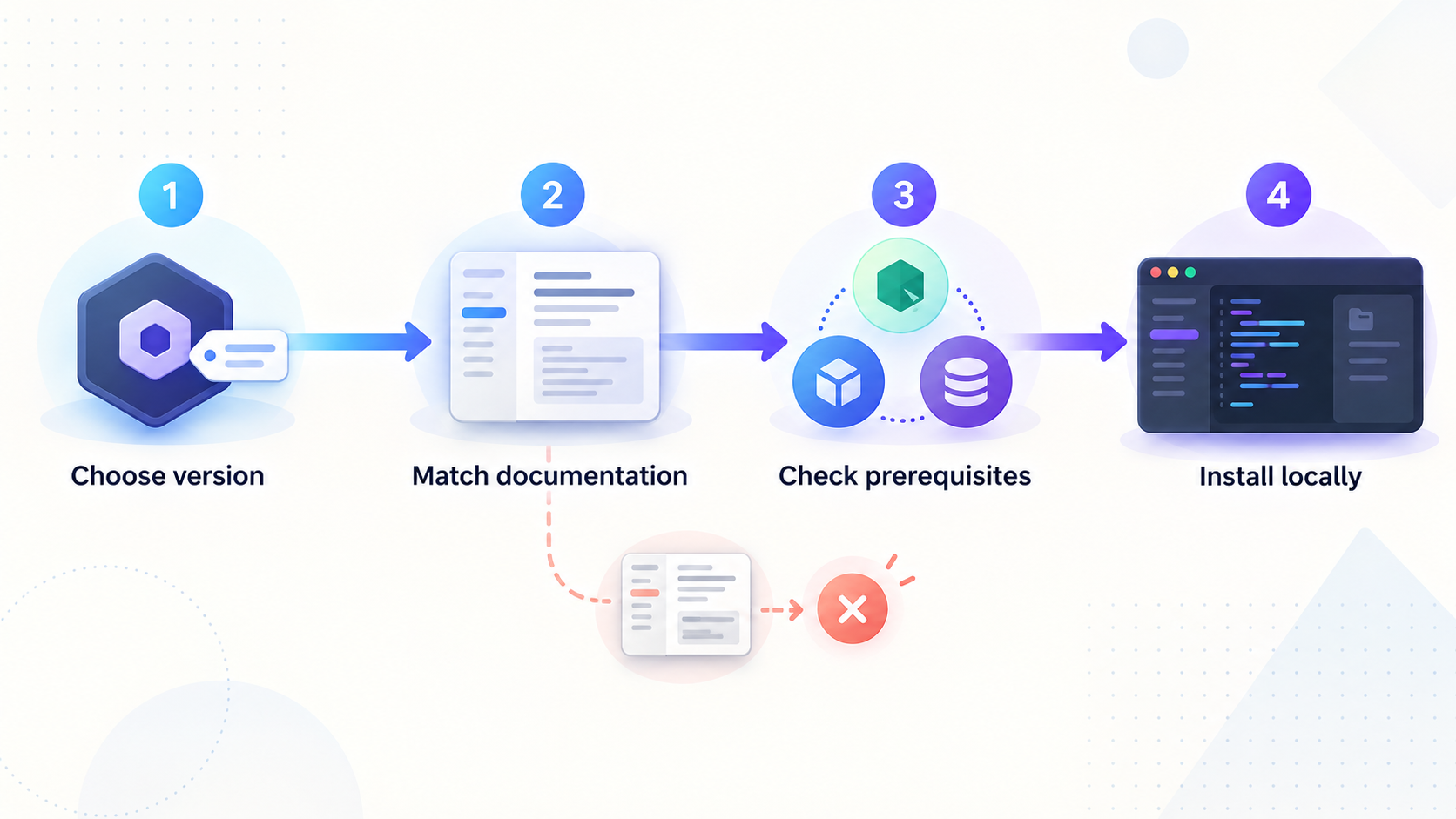
Begin with the local setup path in Medusa's current documentation. The repository explicitly sends developers there to set up a Medusa application locally. Follow that documented sequence without substituting package-manager commands from memory or from an older Medusa generation.
The exact command sequence is intentionally not reproduced here because it is absent from the supplied project evidence. That evidence also does not establish whether the current setup wizard installs every dependency, creates a database, asks interactive questions, or starts multiple services. Supplying plausible commands would make this guide look complete while creating a meaningful risk of giving you an invalid or unsafe installation.
Capture the installation result
While following the current setup instructions, record the details that will matter later:
- The full path to the generated project.
- The Medusa version selected or installed.
- The runtime and package-manager versions actually used.
- The names of required local supporting services.
- The documented command for starting the application in development mode.
- Whether an administrative interface, backend service, or storefront starts separately.
- The local URLs printed after startup.
Preserve the package lockfile created by the selected package manager. It records the resolved dependency graph and helps other developers reproduce the environment. Do not casually delete or regenerate it while diagnosing an unrelated networking issue.
Distinguish a project checkout from an application installation
Medusa's source repository contains the platform code, packages, tests, scripts, and contribution resources. Cloning that repository is not necessarily the same workflow as creating a local commerce application. If your goal is to build a store or evaluate Medusa, use the application's documented learning or setup path. Use the repository contribution workflow only when your goal is to work on Medusa itself and the project explicitly instructs you to do so.
This distinction matters because repository development may require a different dependency layout, additional tooling, integration tests, or contributor-specific startup procedures. Localtonet can expose any reachable HTTP process, but it cannot determine whether you started the correct Medusa project type.
Configure the Medusa application before exposing it
Complete the configuration required by the selected Medusa installation guide before thinking about public access. A tunnel transports requests to an existing listener. It does not supply missing database connectivity, generate application secrets, initialize commerce data, or select appropriate production settings.
Keep sensitive values out of committed source files. If the documented Medusa workflow uses environment files, secret stores, or runtime environment variables, follow that mechanism exactly. Do not paste Medusa credentials, database passwords, Localtonet device tokens, or private endpoints into screenshots, issue reports, shell history examples, or public repositories.
Identify the service that should be shared
A commerce development environment can contain multiple web-facing components. Do not assume that every locally printed URL should be made public. Decide whether the remote user needs the backend API, a storefront, an administrative interface, or another application generated alongside Medusa. Each independently listening service has its own local address and port and may require a separate tunnel.
The evidence available for this article does not identify Medusa's current default local port or a guaranteed health-check endpoint. Obtain the real values from the running application's terminal output and the current Medusa documentation. This prevents a common failure in which a correctly configured tunnel points at the wrong local service.
A development admin interface can control products, inventory, orders, customers, configuration, or other sensitive commerce data. Do not expose it merely because it is available locally. Confirm its authentication behavior, use strong credentials, apply least privilege, and stop the tunnel when remote access is no longer required.
Start and verify Medusa locally
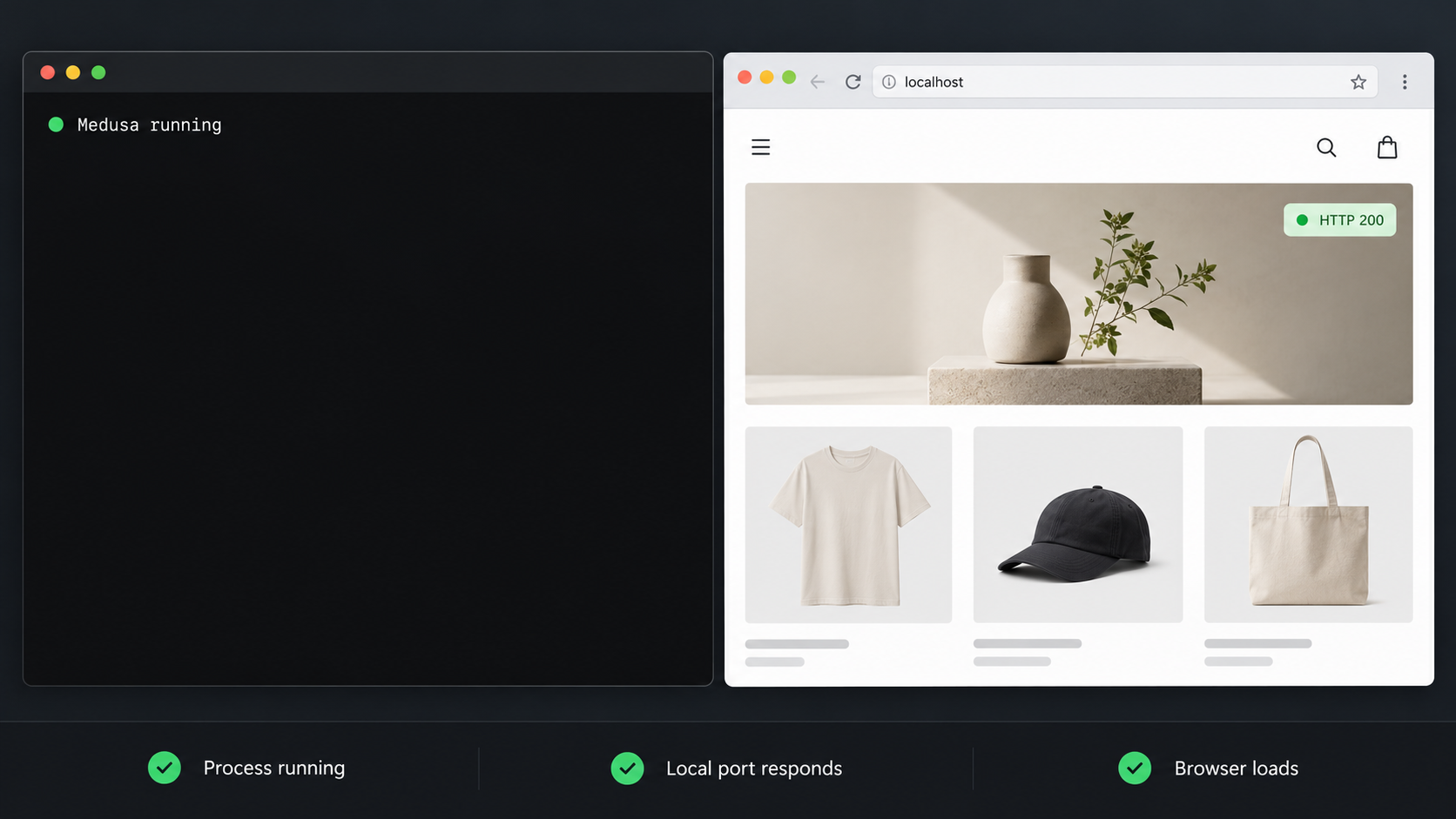
Run the documented Medusa startup command from the correct project directory. Keep the terminal visible during the first launch so that you can inspect startup messages rather than assuming the process is ready. If the application reports a migration, database, dependency, or configuration error, resolve that error before configuring Localtonet.
Record the authoritative local endpoint
When startup succeeds, copy the address and port reported by the application. Do not replace them with a remembered default. For example, if the application reports a loopback address, record that exact host and port. If it reports a LAN address or wildcard binding, determine which concrete address the Localtonet client can use.
Test the documented page or endpoint in a browser on the same device. A successful verification should demonstrate more than an open port. Confirm that the response belongs to the intended Medusa component, that expected assets load, and that the terminal does not begin reporting repeated server-side failures.
Test from the Localtonet client's network context
The easiest arrangement is to run our client on the same device as Medusa. In that case, a loopback listener can normally be targeted from that device. If our client runs on another machine, container host, virtual machine, or subsystem, a service bound only to the Medusa host's loopback interface will not automatically be reachable from the client device.
For a separate client device, verify local network reachability before creating the tunnel. Use an address that belongs to the Medusa host and that is reachable from the Localtonet client. Adjusting a service's listening interface or host firewall can expand who can reach it, so make those changes only when the project's documentation and your network policy permit them.
Share the working Medusa service with Localtonet
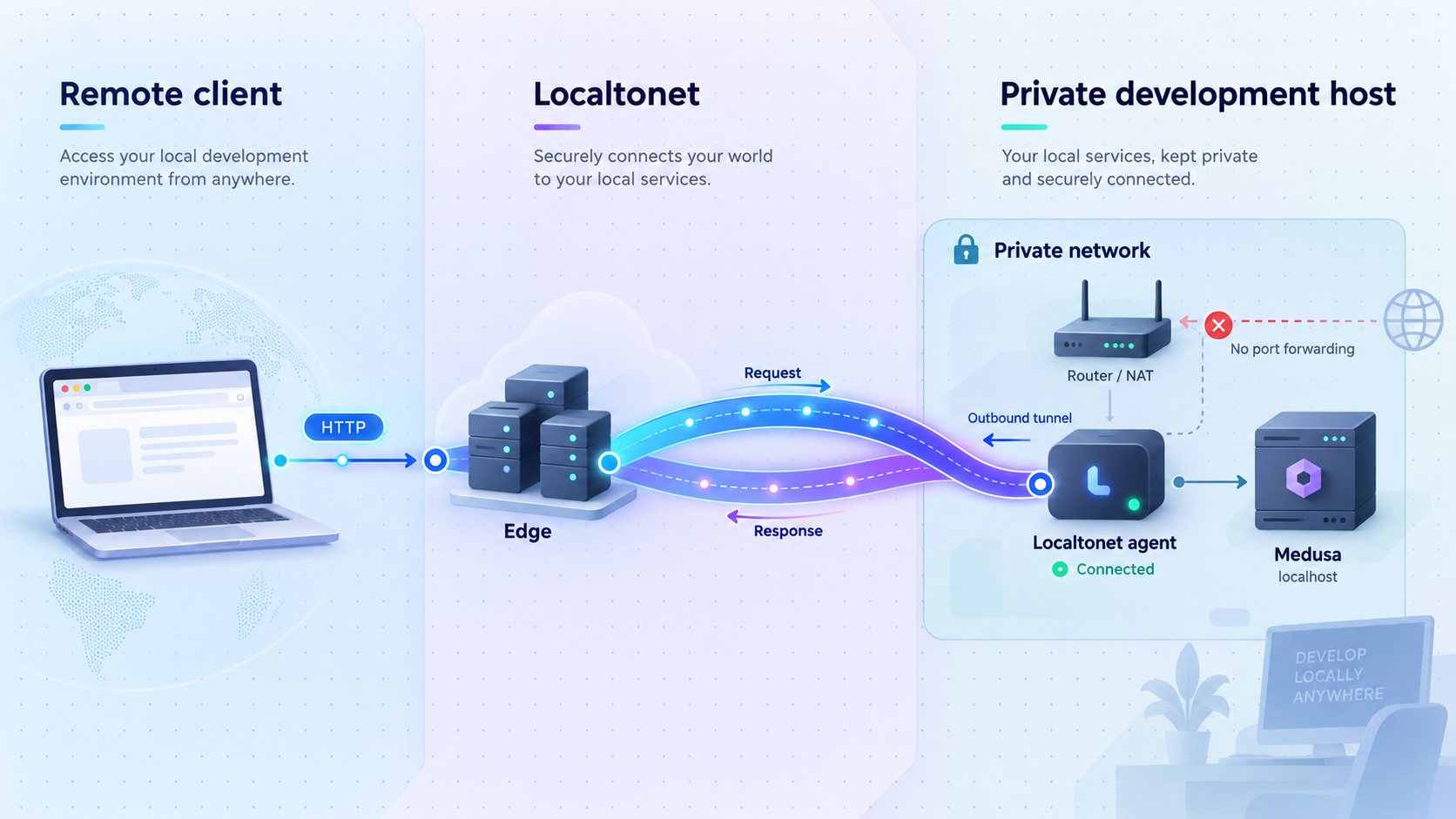
Once the required Medusa component works from the Localtonet client's device, use an HTTP tunnel for that web service. Our client establishes an outbound connection to a Localtonet relay server, so you do not need inbound router port forwarding, a public IP address, firewall port-opening rules, or VPN setup for this tunnel workflow.
HTTP tunnels point to a local IP address and port. HTTP process types include Random Sub Domain, Custom Sub Domain, and Custom Domain, and each serves the configured content at a public HTTPS address. Availability of particular options, servers, regions, or capabilities can vary, so use the choices currently shown in your dashboard rather than relying on a hardcoded server code.
Install and run the Localtonet client
Install our client for the operating system on the device that can reach Medusa. Start the client and keep it running. If Medusa is on another device, first confirm that this client device can reach the recorded local address and port.
Authenticate or select the client device
Use the device-specific authentication token through the supported client workflow, then select that connected device when configuring the tunnel. Treat the token as a secret and never place it in application code, screenshots, or public terminal output.
Select an available relay server
Choose a server or region from the values currently offered in the Localtonet dashboard. Do not copy a server code from an unrelated tutorial because availability may vary by account, plan, client version, region, or current product configuration.
Create the HTTP tunnel configuration
Select the HTTP tunnel type and enter the exact local IP address and port confirmed during local testing. Choose the appropriate available process type. A generated random subdomain is the simplest choice when you do not need a particular hostname. Check current documentation before attempting custom-domain DNS configuration.
Start the tunnel
Creating the configuration does not make it active. Use the Start button and confirm that the selected client remains connected and the tunnel is running.
Open and verify the assigned public address
Use the public address assigned to the running HTTP tunnel. Test it from a separate browser session or another network, confirm that it reaches the intended Medusa service, and inspect both Medusa and Localtonet status information if the request fails.
For the current interface and configuration details, consult our HTTP tunnel documentation. The local target must still come from your own verified Medusa process rather than from an example value.
A saved Localtonet tunnel is not necessarily running. The selected device must be connected and the tunnel must be started. Stopping our client, stopping the tunnel, or shutting down the Medusa process makes the public service unavailable.
Secure the public development endpoint
A local development listener is normally available to a limited network context. Publishing it changes the exposure boundary because anyone who can reach the assigned public address can send requests to the application. Treat the public URL as an internet-facing endpoint even if you intend to share it with only one collaborator.
Keep Medusa's own authorization controls enabled. A tunnel provides connectivity, not application-level identity, role enforcement, or permission design. Use strong credentials and least-privilege accounts for any interface that supports authentication. Never assume that an obscure URL is an access-control mechanism.
Expose only the necessary component
If a collaborator needs a storefront preview, do not automatically expose a separate admin service. If an integration needs one API, review whether publishing the entire development interface is appropriate. Separate services can be given separate lifecycle decisions, and an unnecessary tunnel should remain stopped.
Protect secrets and private data
Development commerce databases may contain test customer records, tokens, order information, email addresses, integration credentials, or copied production data. Use synthetic data whenever possible. Do not use a public development tunnel to expose a database port, secret-management service, internal dashboard, or unrestricted debugging endpoint.
Do not publish Localtonet device tokens. Tokens identify client devices and must not be guessed, embedded into a Medusa repository, or included in support screenshots. If a token is exposed, handle it through the relevant account controls rather than continuing to treat it as private.
Understand the HTTPS boundary
HTTP process types provide a public HTTPS address. This should not be described as proof that every part of the application architecture uses end-to-end encryption. The local target remains the IP address and port you configured, and its transport depends on the local service and selected tunnel configuration. Do not make unsupported security or compliance assumptions based only on the public URL.
Start the tunnel when a remote test, webhook demonstration, or collaboration session requires it. Stop or delete the tunnel when the session ends. Review the application logs after testing and avoid exposing unfinished administrative or debugging functions.
Operate the local application and tunnel
During routine use, think of Medusa and Localtonet as two independently managed processes. Start Medusa first and verify its local URL. Then start our client and the tunnel. This order makes failures easier to diagnose because you establish that the target works before adding remote routing.
When ending a session, stop the tunnel if the endpoint should no longer be public. Then stop the local development process according to the project's documented procedure. Deleting a tunnel is appropriate when you no longer need its configuration, while stopping it preserves the configuration for later use.
Restart sequence
- Start any supporting services required by the documented Medusa setup.
- Start the intended Medusa component with its documented command.
- Verify the recorded local URL and check the application output.
- Start or confirm the Localtonet client connection.
- Start the HTTP tunnel.
- Test the assigned public address.
If Medusa starts on a different port after a configuration change, update the tunnel target before testing again. A previously working public URL cannot route correctly when its configured local destination no longer matches the active listener.
Upgrading Medusa
Follow Medusa's release notes when updating the project. Review runtime requirements, configuration changes, data migrations, and integration compatibility before upgrading. Preserve a recoverable copy of important development data and configuration according to the project's guidance.
After an upgrade, repeat local verification before restarting public access. Do not use a successful tunnel connection as proof that the upgraded application is healthy. A tunnel can be active while its target returns errors or serves the wrong component.
Troubleshoot local and remote access
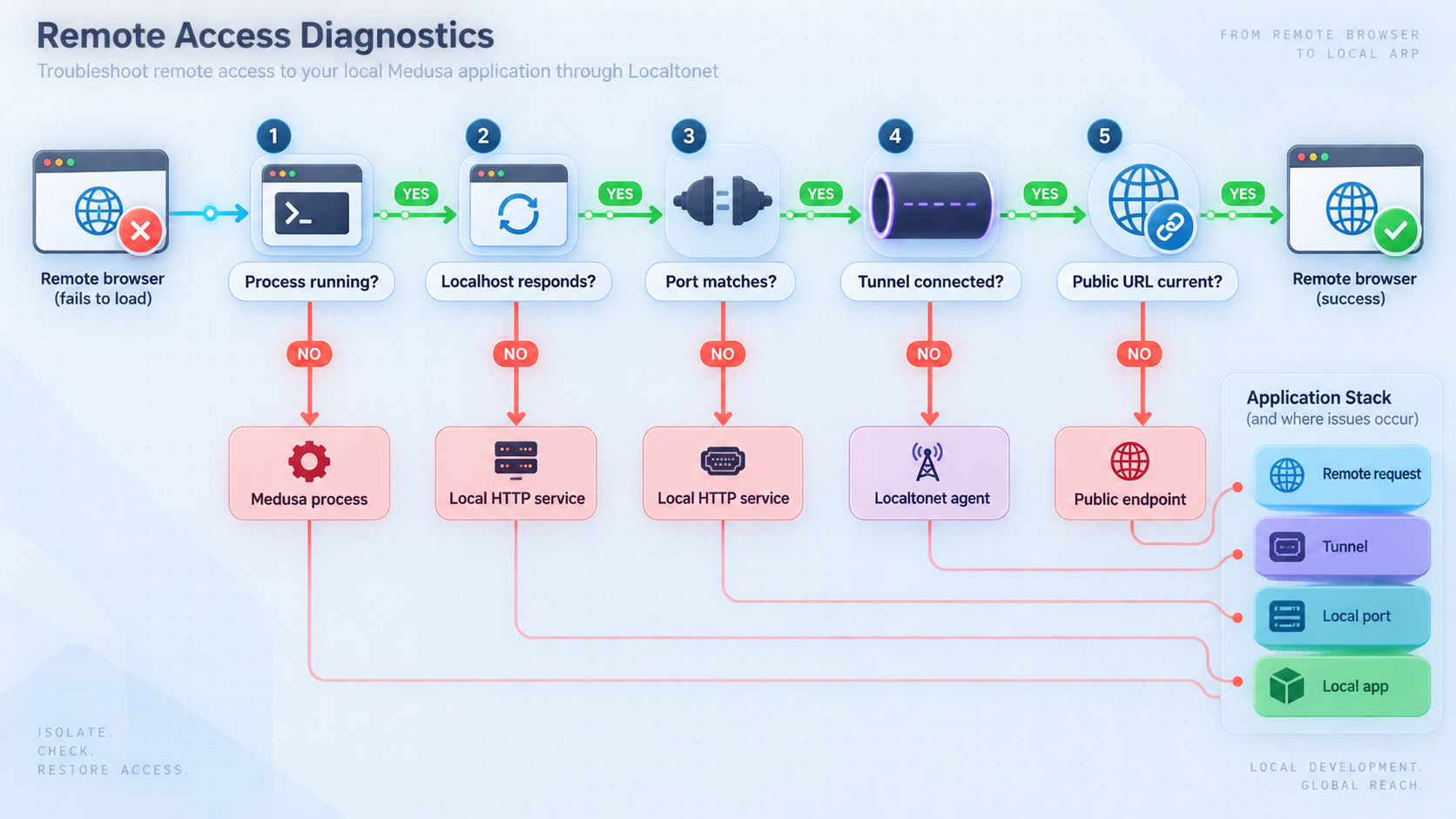
Diagnose problems from the inside out. Start with the Medusa process, then test the local endpoint, then confirm reachability from the Localtonet client, and finally inspect tunnel state and the public request. This sequence prevents a local application failure from being misdiagnosed as a tunneling issue.
| Symptom | Likely area | What to check |
|---|---|---|
| Medusa exits during startup | Application installation or configuration | Read the first relevant error, confirm version-matched prerequisites, required services, environment values, and the correct project directory. |
| The local URL does not open | Local service | Confirm that the process remains active and use the exact address, port, and path reported by the current installation. |
| Local access works only on the Medusa host | Binding or network reachability | If Localtonet runs elsewhere, determine whether Medusa listens only on loopback and whether the client device can reach the host under your network policy. |
| The tunnel exists but the public address is unavailable | Tunnel lifecycle | Confirm that the selected Localtonet device is connected and that the tunnel was explicitly started. |
| The public address reaches the wrong application | Incorrect local target | Compare the tunnel IP address and port with the verified Medusa component. Check for another local process using the expected port. |
| The page opens but assets or API calls fail | Application URL behavior | Inspect browser developer tools and Medusa logs. Review the project's documented origin, public URL, cookie, callback, and cross-origin settings without inventing values. |
| Access stops after a reboot or terminal closure | Process availability | Restart Medusa, the Localtonet client, and the tunnel. A development process normally does not remain available after it has been stopped. |
| A custom domain does not resolve correctly | DNS or domain configuration | Use the current Localtonet custom-domain instructions. Do not infer DNS records from random-subdomain behavior or from an older guide. |
Separate HTTP errors from connectivity errors
An application-generated HTTP error means the request reached some web server. Check the Medusa logs, requested path, authentication state, and application configuration. A connection failure usually points earlier in the chain, such as a stopped process, wrong port, unreachable bind address, disconnected client, or stopped tunnel.
Check browser-dependent behavior
If the basic public page loads but interactive behavior fails, inspect the browser's network and console output. Absolute URLs, allowed origins, cookies, callbacks, and secure-context expectations can affect applications accessed through a new public hostname. The correct setting names and values are Medusa-version-specific, so take them from the current project documentation rather than adding guessed environment variables.
Do not solve application errors by widening exposure
Disabling authentication, exposing additional internal ports, or binding every service to all interfaces can hide the original diagnosis while creating new risks. Keep the tunnel target narrow and repair the failing application dependency or configuration directly.
Frequently asked questions
What is the exact Medusa installation command?
The supplied project evidence does not establish a current installation command, runtime version, package-manager choice, or database sequence. Medusa's repository directs local users to its Documentation learning section. Use the setup instructions matching your selected Medusa release rather than relying on an unverified command.
Which Medusa port should I enter in Localtonet?
Enter the port reported by the Medusa component you started and successfully tested. A guaranteed default port is not established by the evidence for this guide, and different components or configurations may use different listeners.
Should I use an HTTP or TCP tunnel for Medusa?
Use an HTTP tunnel for the verified Medusa web service described in this workflow. It maps a public web address to the local IP address and port. Raw TCP tunneling is intended for services that need direct TCP forwarding rather than ordinary browser-based HTTP access.
Does Localtonet need to run on the same device as Medusa?
No. Our client can run on a device that can reach the Medusa service. Running both on the same device is usually simpler because a loopback listener is available locally. When they run on different devices, verify network reachability and use a permitted address that the client can access.
Does creating a Localtonet tunnel start Medusa?
No. Medusa must be installed, configured, started, and locally reachable independently. Creating a tunnel also does not start the tunnel automatically. The selected client must be connected and you must use the Start button for the tunnel.
Do I need router port forwarding or a public IP address?
No. The Localtonet client establishes an outbound connection to our relay server. This workflow does not require inbound router port forwarding, a public IP address, firewall port-opening changes, or VPN setup.
Can I expose multiple Medusa components?
If multiple components listen on separate local ports, each target requires an appropriate tunnel configuration. Expose only the components required for the task. Do not automatically publish an administrative interface alongside a storefront or API.
Will the public URL remain available after I close my terminal?
Only if the required processes remain active. The Medusa service, Localtonet client, and tunnel must all continue running. Closing a terminal that owns the Medusa development process may stop the application, and disconnecting our client makes the tunnel unavailable.
Share your verified Medusa application with Localtonet
After Medusa works on the client device, create an HTTP tunnel, point it to the confirmed local address and port, and start remote testing without configuring inbound router port forwarding.
Get Started Free →

