

Trace sensitive data before making an AI endpoint remotely reachable
A healthcare AI service is rarely a single API. Clinical records, prompts, model responses, callbacks, logs, databases, administrative tools, and vendors can cross different trust boundaries. This guide shows how to map those paths, distinguish PHI from electronic PHI, connect the exercise to security risk analysis, and choose between local-only, private-mesh, and public access. It also explains where the Localtonet client, relay, public endpoint, local target, application dependencies, and storage systems belong on the map without treating tunneling as proof of HIPAA compliance.
📋 What's in this guide
Define PHI, ePHI, and the scope of the review
Before drawing a network diagram, define what the team means by protected health information. Under the HIPAA Privacy Rule, PHI is individually identifiable health information held or transmitted by a covered entity or its business associate, in any form or medium, subject to the rule's exclusions. Electronic protected health information, commonly abbreviated as ePHI, is PHI transmitted by or maintained in electronic media. This distinction matters because a healthcare AI data-path map usually focuses on electronic systems and therefore on potential ePHI.
Not every piece of health-related data is automatically PHI under HIPAA. Applicability depends on facts such as who creates, receives, maintains, or transmits the information, the role of each party, the activity being performed, and whether an exclusion applies. A developer should not decide that HIPAA applies or does not apply merely from the presence of a diagnosis, patient-like record, or healthcare customer. The responsible privacy and legal teams should evaluate the parties, data, purpose, and contractual relationships.
The U.S. Department of Health and Human Services provides an overview of the HIPAA Privacy Rule and protected health information. Use that guidance with your organization's counsel and privacy program rather than treating this tutorial as a legal classification.
Do not transmit ePHI through Localtonet or any other relay service until qualified security, privacy, legal, and compliance reviewers have determined that the service is permitted for the specific workflow. The review must address whether a Business Associate Agreement or another contract is required, which organizations and subprocessors receive or maintain the data, where encryption starts and ends, what access controls apply, what is stored or logged, how long records are retained, how incidents are handled, and whether the documented safeguards satisfy the organization's obligations. If those questions are unresolved, keep the endpoint local and use non-production data.
HIPAA applicability is about relationships and activities
A data-flow review should identify whether each organization is acting as a covered entity, business associate, subcontractor, or in another capacity relevant to the workflow. The answer can affect contractual and operational requirements. HHS explains business-associate relationships and written arrangements in its business associate guidance. A diagram cannot settle that legal analysis, but it can reveal every party that needs to be evaluated.
Do not limit the party inventory to the obvious AI provider. Include relay services, cloud storage, observability platforms, identity providers, support tools, notification systems, backup destinations, model APIs, and vendors receiving error reports. A processor that sees only failed requests, logs, or encrypted records may still require analysis based on the actual arrangement and its access to information.
Use the recognized HIPAA de-identification methods
The HIPAA Privacy Rule describes two methods for de-identifying PHI: Safe Harbor and Expert Determination. HHS explains both in its de-identification guidance.
- Safe Harbor: the specified identifiers concerning the individual and certain related persons must be removed, and the covered entity must not have actual knowledge that the remaining information could identify the individual.
- Expert Determination: a person with appropriate knowledge of and experience with generally accepted statistical and scientific principles and methods determines that the risk is very small that the information could be used, alone or with other reasonably available information, to identify an individual. The methods and results must be documented.
“Engineering approval,” removal of names, tokenization, masking, or a team member's informal judgment is not a third HIPAA de-identification method. Those techniques can be parts of a broader process, but the organization should record whether Safe Harbor or Expert Determination is being used and preserve the required evidence.
De-identification also does not answer every security question. A dataset may remain confidential, commercially sensitive, contractually restricted, or vulnerable to model memorization and linkage. Free text, medical images, filenames, dates, geographic details, device identifiers, and metadata deserve particular attention.
Connect the map to Security Rule risk analysis
HHS describes risk analysis as foundational to Security Rule compliance and explains that organizations should identify where ePHI is stored, received, maintained, or transmitted, identify threats and vulnerabilities, assess current security measures, determine likelihood and impact, assign risk levels, and document the analysis. See the HHS Security Rule risk-analysis guidance.
The data-path map supports that work by making assets, flows, actors, storage points, trust boundaries, and dependencies visible. It is not a complete risk analysis by itself. Organizations still need to evaluate threats, vulnerabilities, existing controls, likelihood, impact, risk disposition, and ongoing review.
For implementation-oriented guidance, consult NIST Special Publication 800-66 Revision 2, which provides guidance for implementing the HIPAA Security Rule. NIST guidance helps organizations translate regulatory requirements into a security program, but it does not replace HHS rules, organizational counsel, or a workflow-specific assessment.
The map and register help qualified reviewers understand a proposed architecture. They do not determine whether an organization is a covered entity or business associate, whether a contract is sufficient, whether data has been de-identified, or whether a deployment complies with HIPAA.
Why healthcare AI connectivity starts with a data-path map
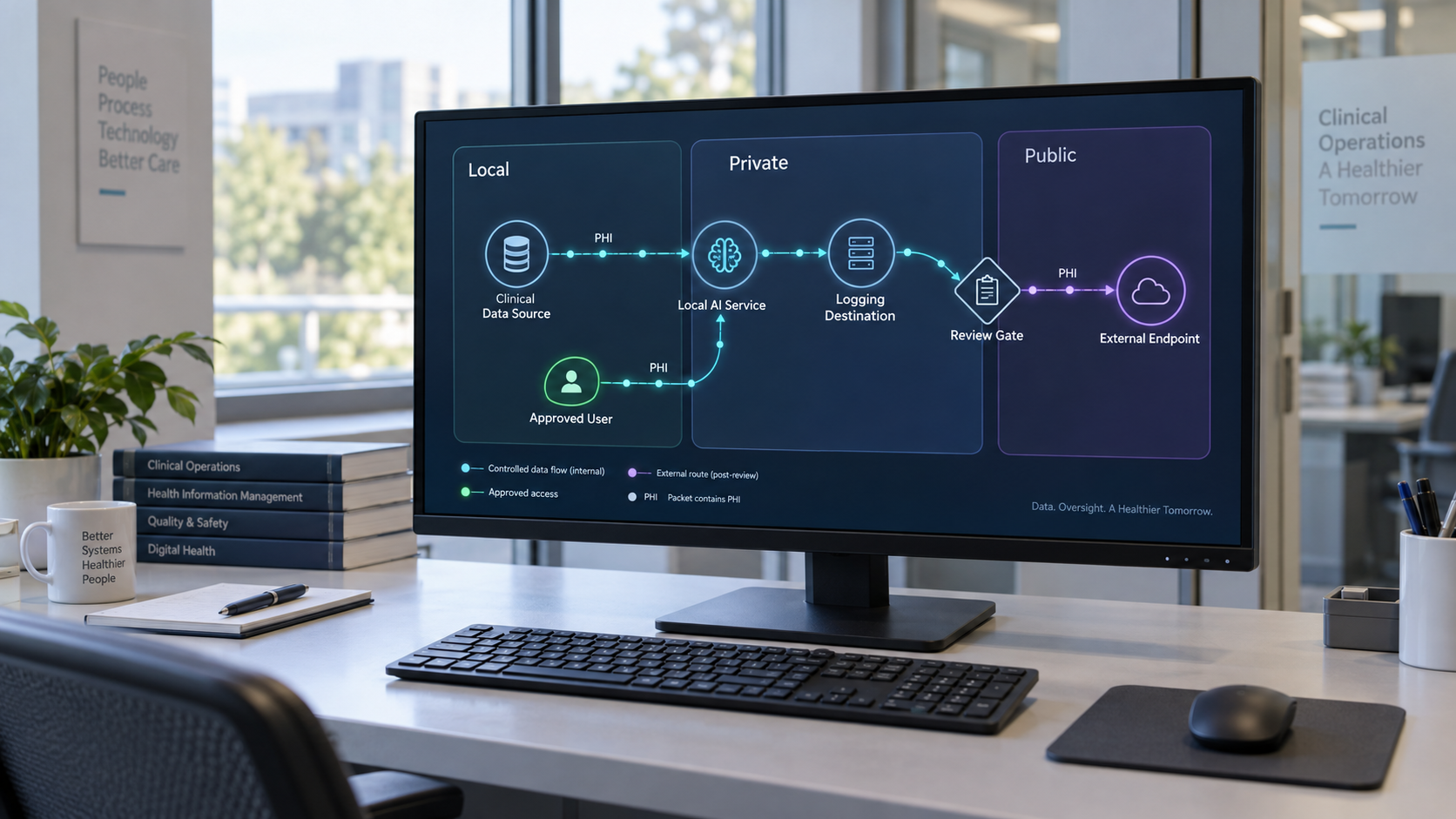
Teams often begin with a narrow question such as, “How can a remote developer reach this local AI API?” That question matters, but it arrives too late in the architecture process. Before selecting a tunnel or private network, the team needs to know what the endpoint receives, what it returns, which dependencies it contacts, what it records, who can reach it, and what happens when something fails.
A model-facing API can appear harmless in isolation. Its request may include patient identifiers, clinical notes, images, laboratory results, appointment details, audio, or other sensitive information. Its response may reproduce source material, generate a clinical summary, reveal retrieved records, or include debugging details. Headers, URLs, filenames, traces, callback payloads, and timing data can also disclose information.
The useful unit of analysis is the complete transaction path. It begins with the initiating person or system and continues through the public endpoint, relay, Localtonet client, target application, retrieval components, model runtime, data stores, observability tools, administrative interfaces, outbound integrations, and retention systems. Every change in system, network, identity, organization, or operational ownership should be visible.
This work must happen before an endpoint is made remotely reachable. A network path increases accessibility, but it does not establish permission to process data. It also does not provide the complete set of contractual, administrative, physical, and technical safeguards a regulated deployment may require.
Build an endpoint inventory and reusable mapping register
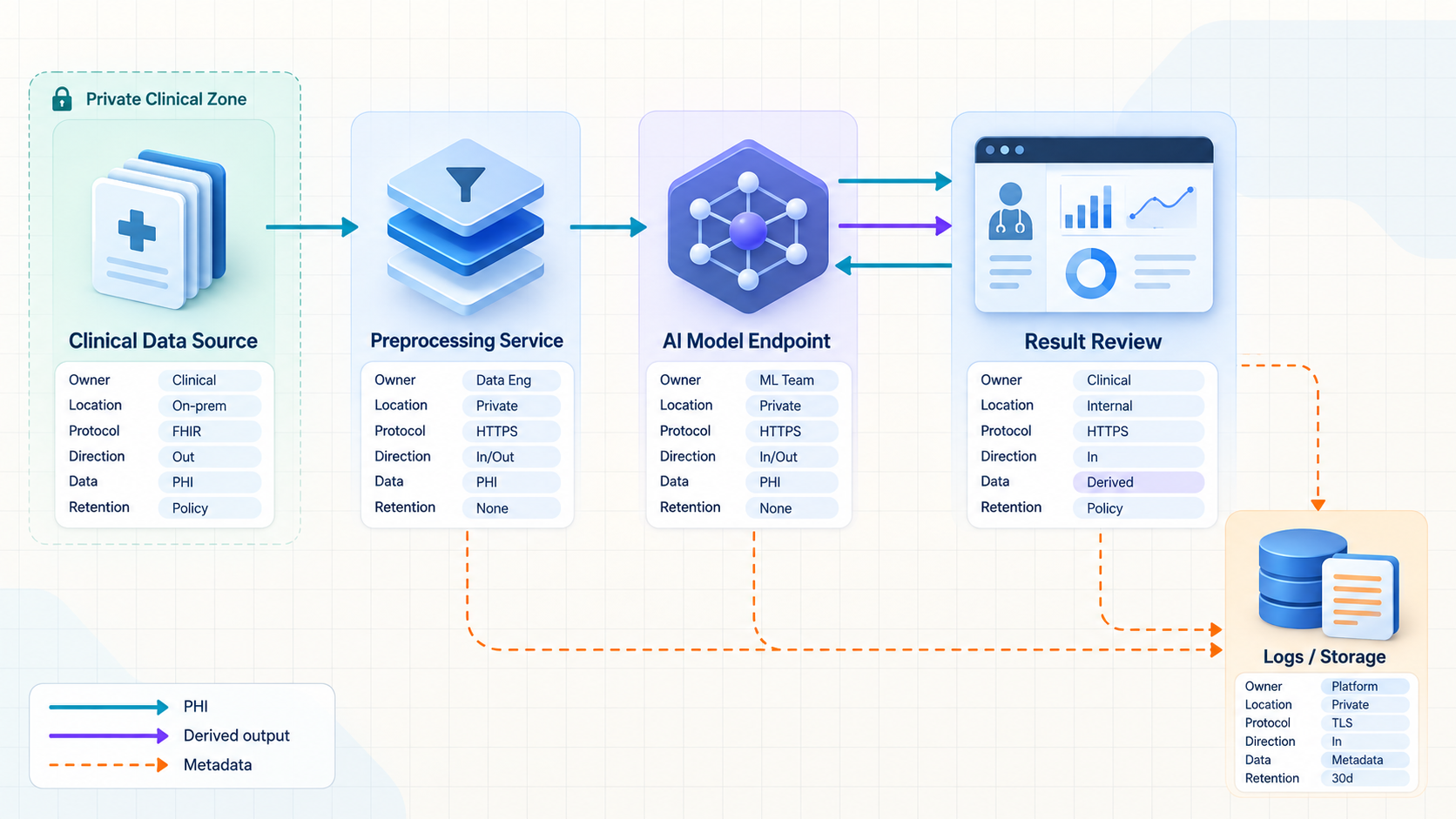
Start with a system diagram, but do not stop at boxes and arrows. Every arrow should become a register entry with a business purpose, owner, approval state, and shutdown condition. If the team cannot explain what crosses a connection and why it is necessary, that path is not ready for remote exposure.
Separate interfaces by purpose
A prediction API is not equivalent to an administrative dashboard. A callback receiver is not equivalent to a detailed health endpoint. A model service processing synthetic cases is not equivalent to a retrieval component connected to live clinical records.
Document interfaces separately even when they share one process or port. If the application cannot separate them technically, record that coupling as a risk. Exposing one listener can make every route on that listener reachable through the same network path.
| Interface | Questions to answer | Exposure concern |
|---|---|---|
| Inference API | What enters prompts or files, and can responses reproduce source data? | Requests and responses may contain sensitive clinical information. |
| Clinical connector | Which records can it read or write, and under whose identity? | A compromised service may provide access to a broader data store. |
| Administration | Can users change models, prompts, tools, permissions, or destinations? | Administrative functions can expand access or redirect information. |
| Callback receiver | Who sends callbacks, how are they authenticated, and can they be replayed? | A public receiver accepts unsolicited traffic unless the application rejects it. |
| Diagnostics | Do logs, traces, errors, or metrics include payloads or identifiers? | Diagnostic systems can disclose data outside the primary application. |
| Development tools | Do they expose files, stack traces, interactive controls, or environment details? | Development conveniences are often unsafe to publish. |
| Vendor integration | What leaves the environment, who receives it, and what agreement applies? | Organizational and contractual responsibilities may change. |
Use a mapping register that supports approval and shutdown
The register should be detailed enough for a reviewer to reconstruct the flow without guessing. Use one row for each distinct transfer. Split a flow when its data, caller, authorization, processor, storage, or retention behavior changes.
| Register field | What to record | Why it matters |
|---|---|---|
| Path ID and purpose | A stable identifier and the exact business operation. | Connects diagrams, approvals, tests, incidents, and changes. |
| Data elements | Payload fields, metadata, files, headers, identifiers, and derivatives. | Supports classification, minimization, and de-identification review. |
| Origin and destination | The initiating system and every receiving system or endpoint. | Reveals network and organizational boundary crossings. |
| Caller identity | User, service account, device, application, or unauthenticated caller. | Shows who initiates the transfer and how accountability is established. |
| Authorization | The rule limiting routes, records, operations, and data scope. | Separates reachability from permission to act. |
| Processor or vendor | Every organization or service that receives, maintains, or can access data. | Supports role, contract, subprocessor, and risk review. |
| Transport boundary | Protocol, public or private scope, and verified TLS or encryption endpoints. | Prevents unsupported assumptions about end-to-end protection. |
| Storage and logging | Databases, caches, temporary files, logs, traces, queues, and backups. | Finds copies outside the primary record system. |
| Retention and deletion | Retention period, deletion trigger, backup behavior, and accountable system. | Tests whether actual handling matches policy and contracts. |
| Owner | Technical owner and accountable business or data owner. | Creates responsibility for review, operation, and incident response. |
| Approval | Reviewer, decision, conditions, date, evidence, and next review. | Prevents an informal test from becoming an undocumented production path. |
| Shutdown criteria | Expiry, incident triggers, scope changes, and exact disabling action. | Makes access reversible and gives responders a clear stop condition. |
Record normal, error, and administrative paths
Include what happens when the model times out, a database rejects a query, a callback fails, or an integration returns malformed data. Error handlers may send payload fragments to logs or external monitoring tools. Retries can duplicate messages. Dead-letter queues and temporary directories may preserve data longer than the primary workflow.
Record derivative data such as embeddings, summaries, labels, thumbnails, extracted entities, cached responses, and search indexes. A changed representation is not automatically non-sensitive or de-identified. Whether a derivative can be linked to an individual depends on its content, surrounding information, and reasonably available data.
Mark trust, transport, encryption, and retention boundaries
A trust boundary exists wherever assumptions about control, identity, data handling, or accountability change. The boundary may be technical, organizational, or operational. Mark it directly on the diagram and reference the relevant mapping-register rows.
Represent the Localtonet path explicitly
For a public tunnel, draw the complete sequence rather than one generic “internet” arrow:
- The remote caller and its identity or lack of identity.
- The assigned public URL or public host and port.
- The Localtonet relay selected from currently available product options.
- The outbound connection established by the Localtonet client.
- The client device and its device-specific authentication token.
- The configured local IP address and port.
- The target healthcare AI application and all routes on its listener.
- Downstream model runtimes, databases, retrieval systems, identity services, and vendor APIs.
- Logs, traces, queues, backups, alerting systems, and other retention destinations.
Annotate each segment with only the protection that has been verified. Localtonet HTTP and File Server process types serve content at a public HTTPS address, and File Server documentation states that TLS is terminated at the tunnel edge. That product-specific fact must not be generalized into an unsupported claim that every hop of every tunnel type provides end-to-end application encryption. Record where TLS terminates, how traffic continues to the local target, and whether the application adds its own verified transport protection.
An HTTPS address establishes a TLS-protected client-facing connection only to the verified termination point. Reviewers must document every subsequent segment, including relay behavior, the client connection, local target transport, downstream APIs, and storage. If the available product or application documentation does not establish a boundary, mark it as unknown and resolve it before permitting ePHI.
Evaluate authorization separately from transport
Reachability, encryption, authentication, and authorization solve different problems. A protected transport does not decide which patient records a caller may access. A login does not prove that a user may invoke every route. A private mesh does not authorize every participant to use every reachable service.
For each endpoint, record how callers authenticate, whether identities are individual or shared, how authorization limits operations and records, how credentials are stored and rotated, and how access is removed. Apply least privilege at both the network and application layers when the architecture supports it.
Choose between local-only, private mesh, and public access
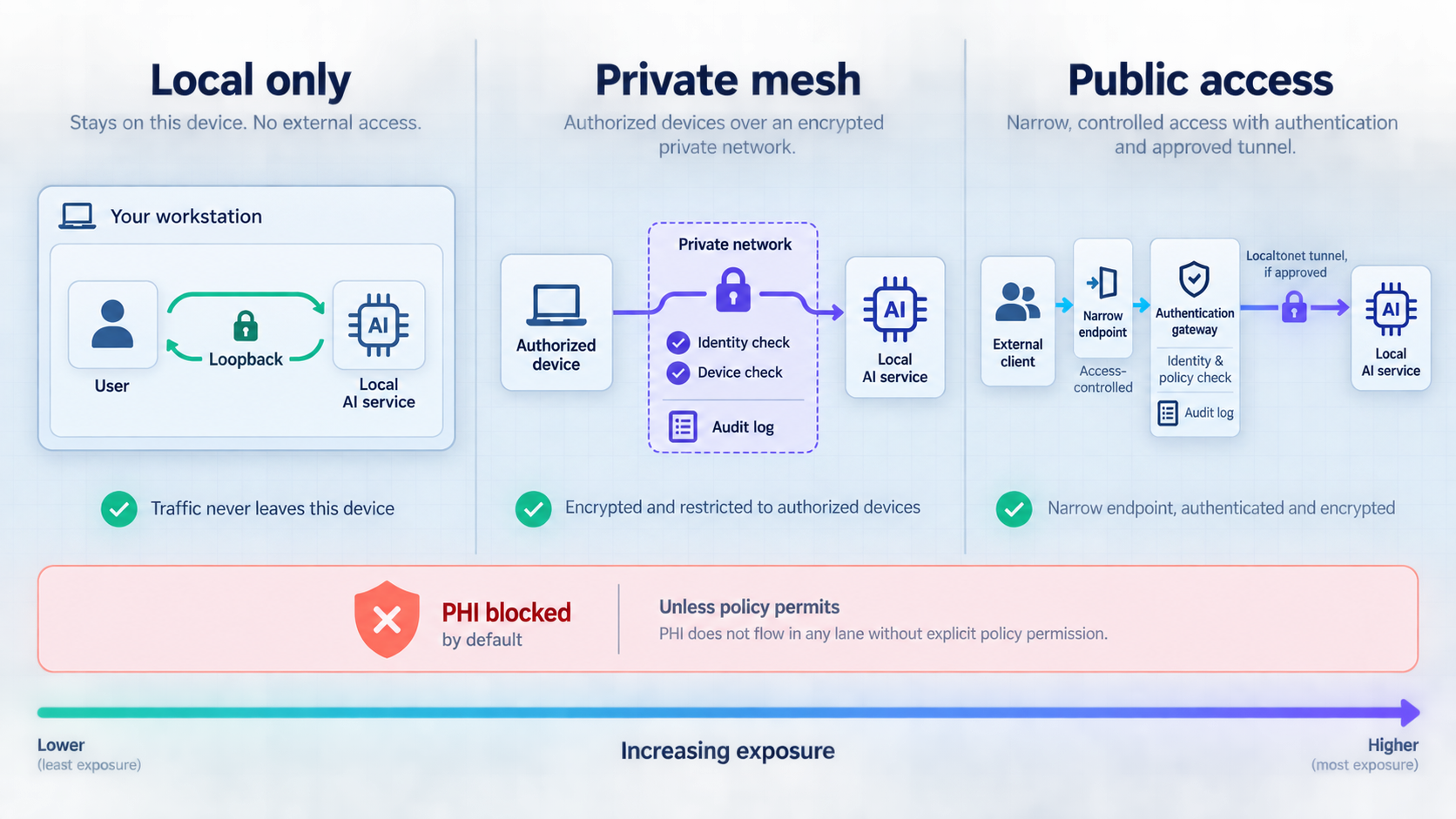
Assign an exposure scope only after the inventory is complete. The safe default for an unreviewed interface is local-only. Remote reachability should exist because a documented user or integration needs it, not simply because it is convenient.
| Access model | Appropriate starting point | Required decision |
|---|---|---|
| Local-only | Debuggers, administrative tools, unfinished APIs, sensitive connectors, and endpoints with no remote requirement | Confirm whether the work can remain on the host or use synthetic test inputs. |
| Private mesh | Known devices or LANs requiring private connectivity without a public endpoint | Define participants, destinations, ports, firewall rules, ownership, and offboarding. |
| Public HTTP tunnel | A reviewed web application, API, or callback receiver requiring internet-originated HTTP traffic | Verify route scope, authentication, authorization, input handling, logging, and hostile-traffic behavior. |
| Public raw-port tunnel | A reviewed non-HTTP service requiring TCP, UDP, combined UDP/TCP, or an applicable TLS workflow | Verify that the protocol and service are suitable for internet exposure and enforce adequate controls. |
Keep unresolved and administrative interfaces local
Keep an endpoint local when its data classification is unresolved, remote access has no documented requirement, authentication is absent, administrative and user routes cannot be separated, or the team cannot explain its logs and dependencies. Local-only is also appropriate during early development while security behavior changes frequently.
Use private mesh access for a controlled device audience
Localtonet VPN Manager provides a free private mesh VPN with granular firewall rules and can bridge local LANs. It may fit a workflow where known devices or networks need private connectivity and arbitrary internet clients do not need to initiate requests.
Private mesh access still requires an explicit design. Define participants, destinations, permitted ports, application authorization, administrative ownership, offboarding, and firewall rules. Standard HTTP, TCP, UDP, combined UDP/TCP, TLS, and File Server tunnels are not VPN functionality. VPN Manager is our private mesh feature.
Use public access only for a reviewed public requirement
A public HTTP tunnel may fit a reviewed development API, demonstration, callback receiver, or web application that must receive internet-originated traffic. Begin with synthetic data or data de-identified through a documented Safe Harbor or Expert Determination process. The application still needs suitable authentication, authorization, validation, safe error handling, and data minimization.
Select a raw TCP, UDP, combined UDP/TCP, or TLS tunnel only when the application protocol requires it. Do not assume HTTP-layer protections exist for a raw port. Before exposing a database, message broker, model runtime, vector store, or management protocol directly, consider whether a narrow application API can provide the required operation with less access.
A tunnel targets a local service, not a security interpretation of individual routes. Separate a public callback or inference route from administrative, diagnostic, file, metrics, and internal routes before exposure. Otherwise, unexpectedly reachable routes are a no-go condition.
Worked example: remote review of an AI summarization API
Consider a local AI service that summarizes clinical notes for a developer demonstration. It exposes an inference route, an administration page, API documentation, and a health route on one local listener. The model uses a local runtime, while application logs record request bodies for debugging.
The initial request is to let a remote product reviewer test the service. The example below deliberately uses synthetic records. It does not authorize ePHI and does not claim that the architecture is appropriate for production.
| Register field | Worked entry |
|---|---|
| Purpose | Allow one remote reviewer to evaluate summary formatting during a time-limited demonstration. |
| Data elements | Synthetic patient name, synthetic encounter text, generated summary, request ID, and timestamps. |
| Origin and destination | Reviewer browser to public endpoint, relay, Localtonet client, local web API, local model runtime, and application log. |
| Caller identity | Named reviewer using the application's approved individual identity mechanism. |
| Authorization | Reviewer may invoke only the demonstration inference operation and may not use administration or debugging functions. |
| Processor or vendor | List every organization operating the public path or receiving logs. Any unresolved party remains an approval blocker. |
| Storage and logging | Application currently logs request bodies, so payload logging must be disabled or redesigned before the demonstration. |
| Retention | Document the approved retention and deletion behavior for application records and test artifacts. Do not guess a period. |
| Owner and approval | Application owner, security reviewer, and privacy reviewer record the synthetic-data-only scope and expiry. |
| Shutdown criteria | Stop the tunnel after the demonstration or immediately if an unexpected route, identity failure, sensitive record, or unknown data destination appears. |
Decision for the example
The first decision is local-only because the inference, administration, documentation, and health routes share one listener, and request-body logging creates an unnecessary copy. The team separates the demonstration API onto a dedicated listener, removes payload logging from the approved path, verifies authentication and authorization, and tests with synthetic records.
After those changes, the team considers the audience. If the reviewer can join an approved set of private devices, a private-mesh design may provide the narrower network scope. If the reviewer cannot join that mesh and public HTTPS access is a documented requirement, a public HTTP tunnel may be approved for the dedicated demonstration listener.
The decision record states that production records and ePHI are prohibited. A future request to connect an electronic health record, use real clinical notes, add an external model provider, or enable payload logging triggers a new risk, privacy, contract, and architecture review. The synthetic demonstration approval cannot be reused for that expanded workflow.
Run a pre-exposure healthcare AI review
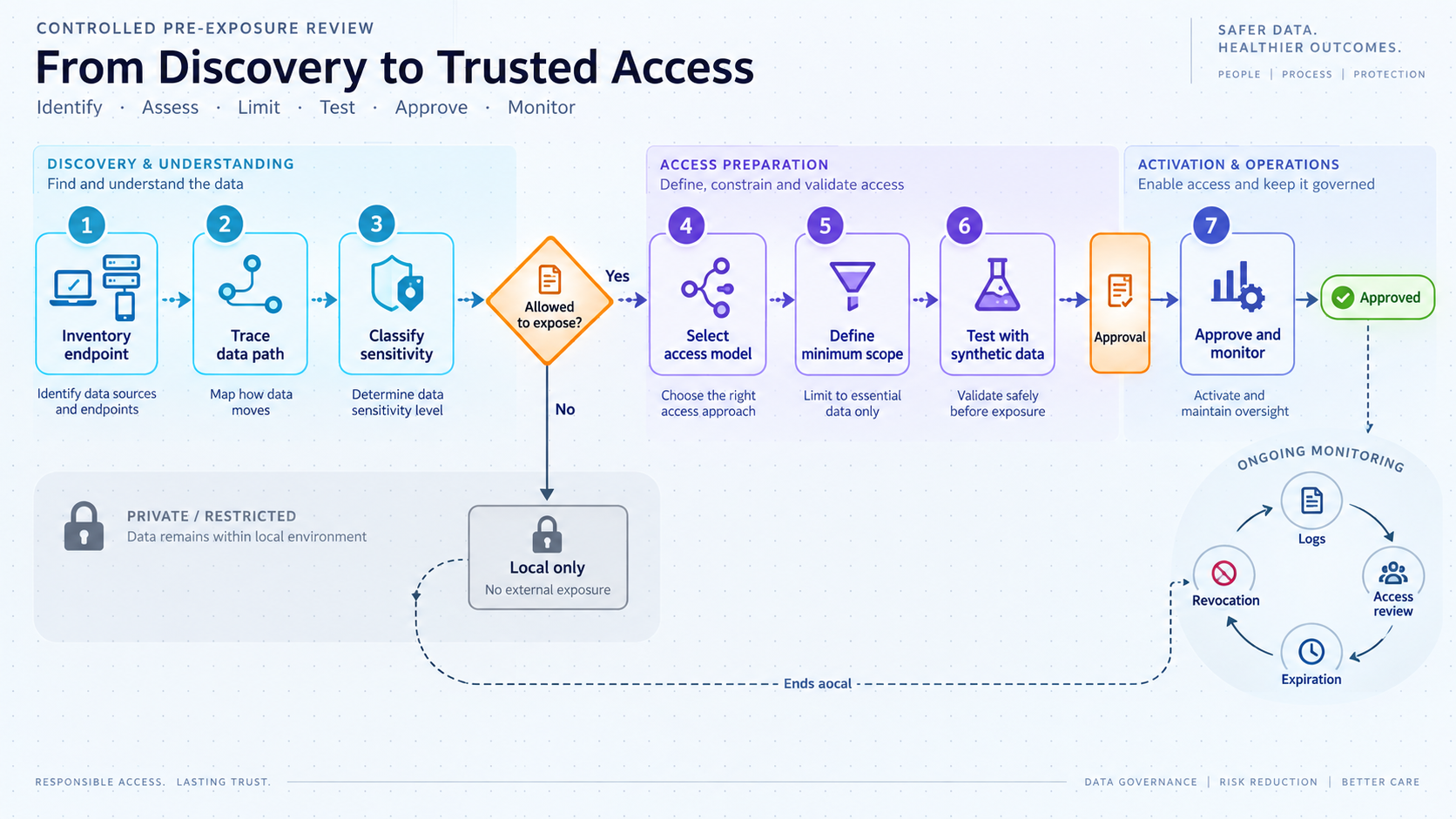
This workflow is an architecture and risk-review aid, not a regulatory validation. Adapt approvals and evidence requirements to your organization.
Define the remote-access use case
Name the person or system needing access, the exact operation, expected duration, data class, and reason local execution is insufficient.
Enumerate listeners, routes, and dependencies
List network listeners, web routes, administration, callbacks, model runtimes, databases, queues, identity providers, storage, monitoring, and vendor integrations.
Complete the mapping register
Record data elements, origin, destination, caller, authorization, processors, encryption boundaries, persistence, retention, owners, approvals, and shutdown criteria.
Classify data and assess HIPAA scope
Have qualified reviewers determine whether PHI or ePHI is involved, which parties and activities fall within scope, and whether claimed de-identification uses Safe Harbor or Expert Determination.
Identify threats, vulnerabilities, and existing controls
Connect the map to the organization's risk-analysis process. Evaluate likely misuse, exposed routes, credentials, dependencies, logging, retention, incidents, and the effectiveness of current safeguards.
Choose the narrowest viable access model
Select local-only, private mesh, or public access based on the actual audience and protocol. Separate unnecessary routes before creating connectivity.
Resolve contracts and operational responsibilities
Determine whether a Business Associate Agreement or another contract is required and document data handling, retention, audit, incident response, support access, and shutdown responsibilities.
Test locally with non-production data
Verify the listener, application version, route scope, identity failures, authorization boundaries, errors, logging, storage, and downstream calls before enabling remote access.
Obtain documented approval
Record the approved endpoint, audience, data, protocol, controls, owner, duration, evidence, and conditions. Unresolved questions produce a no-go decision.
Verify remotely and monitor for scope change
Test from the intended audience's position, confirm only approved routes are reachable, and trigger re-review when data, callers, routes, models, dependencies, vendors, or environments change.
Map Localtonet only after selecting the access model
With Localtonet, the client runs on a device that can reach the selected local service. It establishes an outbound connection to a Localtonet relay, so inbound router port forwarding, firewall changes, a public IP address, or separate VPN setup are not required for a standard tunnel. Depending on the tunnel type, the result is a public URL or a public host and port.
This solves a connectivity problem. It does not decide whether an endpoint should be public, whether ePHI may cross it, whether the application's authorization is sufficient, whether contracts are required, or whether the complete workflow meets healthcare obligations.
Public HTTP access for a reviewed web endpoint
For an approved public web service, an HTTP tunnel points to the reviewed local IP address and port. HTTP tunnels support Random Sub Domain, Custom Sub Domain, and Custom Domain process types, all serving content at a public HTTPS address. Check current documentation before configuring custom-domain DNS because exact requirements are not established here.
Ensure the target listener contains only the routes intended for the public audience. If inference, administration, debugging, metrics, and documentation share a listener, separate them before exposure.
Private access through VPN Manager
When the intended audience is a controlled set of devices or connected LANs, VPN Manager may be the better design. It provides a private mesh VPN with granular firewall rules and can bridge local LANs. Application authentication and authorization remain necessary.
High-level Localtonet tunnel lifecycle
The following is a conceptual lifecycle common to standard tunnels, not an exact protocol-specific dashboard procedure. Fields differ by tunnel family and current product version. Use the current Localtonet documentation for the chosen protocol and obtain server or region values from the dashboard rather than copying old values.
Install and run the Localtonet client
Run it on the device hosting the reviewed service or on a device that can reach that service through an approved local path.
Authenticate or select the device
Use the device-specific token through the supported product workflow. Never place the token in source code, screenshots, tickets, or documentation.
Select an available relay server
Choose from values currently available in the dashboard. Availability can vary, so do not hardcode a server code from another environment.
Create the appropriate configuration
Choose the approved tunnel family and configure the local IP address and port that identify only the intended target.
Start the tunnel
Creating a tunnel does not mean it is running. Use the Start button, then test the assigned public URL or host and port with non-production data.
Stop or delete access
The tunnel is available only while the selected client is connected and the tunnel is running. Stop temporary access and delete a path that should not be reused.
Protocols, options, relay regions, and capabilities can vary by plan, client version, or current product availability. Confirm those details before a production change.
A Localtonet device token identifies the client device and must remain secret. The assigned public endpoint is network addressing information, not an authentication credential. The target application must enforce the approved identity and authorization controls.
Verify, troubleshoot, and stop on unexpected behavior
Verification must prove both connectivity and containment. A successful response confirms only that a path exists. The important question is whether the path exposes exactly what was approved and rejects every unauthorized or out-of-scope request.
Verify the local target before starting remote access
Test from the Localtonet client device. Confirm that the configured local IP address and port respond, the expected application version is running, and the listener contains only approved routes. Exercise successful and denied requests with synthetic data. Inspect responses, application output, logs, traces, caches, queues, temporary files, and downstream calls.
Verify from the intended remote audience
Start the approved tunnel or private-mesh path and test from a representative remote device. Confirm the expected protocol and endpoint. Test missing identity, invalid credentials, insufficient permission, malformed input, unsupported methods, missing headers, and invalid callback signatures where relevant.
Enumerate reachable routes rather than checking only the intended path. Confirm that administration, framework diagnostics, API documentation, file browsers, metrics, detailed health information, and unrelated virtual hosts are not reachable. For raw-port access, verify that the selected port belongs to the expected service.
| Problem | Likely check | Safe response |
|---|---|---|
| Local listener is unreachable | Confirm the application is running and responds on the configured local IP address and port from the client device. | Do not change exposure scope to work around the issue. Fix local reachability first. |
| Tunnel was created but does not respond | Confirm that the Start button was used. Creation alone does not start a tunnel. | Start only after local verification and approval are complete. |
| Client is disconnected | Confirm that the selected Localtonet client or device is running and connected. | Restore the approved client rather than selecting an unreviewed device. |
| Authentication or authorization fails | Check the application's identity mechanism, permissions, credential state, and expected caller. | Do not disable security controls merely to prove connectivity. |
| Wrong application responds | Recheck the local target IP, port, process, protocol, and environment. | Stop the tunnel until the target matches the approved register entry. |
| Unexpected routes are reachable | Inventory every route on the target listener and check virtual-host or framework defaults. | Stop exposure and separate the approved interface onto a dedicated listener. |
| Unexpected data appears in logs | Inspect application, proxy, monitoring, alerting, queue, and error-handling records. | Stop the test, preserve required evidence, and resolve logging and retention before continuing. |
Use explicit pass and stop conditions
| Area | Pass condition | Stop condition |
|---|---|---|
| Target scope | Only the reviewed service and routes are reachable. | Administrative, debug, storage, or unrelated routes are visible. |
| Authentication | Missing or invalid identity is rejected without sensitive detail. | Network reachability alone grants application access. |
| Authorization | Each identity can perform only approved operations on approved data. | A lower-privilege identity reaches broader records or functions. |
| Data handling | Test data follows the mapped storage, logging, and retention design. | Unexpected copies appear in logs, traces, caches, files, or integrations. |
| Encryption boundaries | Every segment and termination point is documented from verified evidence. | The team relies on an unsupported assumption of end-to-end encryption. |
| Lifecycle | The path stops when the tunnel stops or the selected client disconnects. | The team cannot identify, disable, or remove the access path. |
A Localtonet tunnel is available only while the selected client is connected and the tunnel is running. Confirm behavior when the client disconnects, reconnects, and when the tunnel is stopped. Confirm again that creating a configuration does not start it.
Operate the approved path without expanding its scope
Treat the map and register as operational records, not one-time design artifacts. An approved endpoint can become unsafe when its application, data, audience, model, or dependencies change.
Assign ownership, expiry, and re-review triggers
Assign an owner to every tunnel, private-mesh rule, public endpoint, application credential, log destination, and vendor integration. Record why it exists and when it expires or must be reviewed. Stop or delete temporary access when the demonstration, test, or integration ends.
Re-run the review when a service adds routes, accepts new files, starts processing production data, connects to a clinical system, changes model providers, introduces retrieval or tools, adds monitoring, or moves between environments. A synthetic-data demonstration approval must not silently become authorization for live clinical use.
Plan investigation and shutdown
Define who can stop the tunnel, disable application credentials, isolate the host, preserve evidence, contact vendors, and notify internal responders. Shutdown criteria should include unexpected ePHI, unapproved callers, unknown destinations, exposed administrative routes, failed authorization, unresolved encryption boundaries, or behavior outside the approved register.
Localtonet provides platform-wide Token/Tunnel webhooks that report Connected or Disconnected changes for a token or tunnel in a selected Token Group. The request contains an identifier, action date, type, and status. These connection-state events are distinct from File Server file-event webhooks and must not be presented as healthcare audit logs, request logs, or records of patient-data access.
Connected and Disconnected events do not establish who viewed a record, what an AI endpoint processed, which application action occurred, or why access was authorized. Define application, identity, record-access, retention, and incident evidence separately.
Frequently asked questions
Does using Localtonet make a healthcare AI endpoint HIPAA compliant?
No. A tunnel or private network is one connectivity component. The supplied product information does not establish a Localtonet Business Associate Agreement, HIPAA certification, healthcare-specific audit logging, or plan-specific compliance controls. Qualified reviewers must evaluate the complete workflow, parties, contracts, safeguards, data handling, encryption boundaries, retention, auditing, and incident procedures before ePHI is transmitted.
What is the difference between PHI and ePHI?
PHI is individually identifiable health information protected by the HIPAA Privacy Rule when held or transmitted by covered entities or business associates, subject to applicable exclusions. ePHI is PHI transmitted by or maintained in electronic media. Whether information is PHI depends on the parties, information, and activity, not only on whether the content appears medical.
What are the two HIPAA de-identification methods?
They are Safe Harbor and Expert Determination. Safe Harbor requires removal of specified identifiers and no actual knowledge that the remaining information could identify an individual. Expert Determination requires an appropriately qualified expert to determine and document that the identification risk is very small. Removing names or obtaining informal engineering approval is not a separate HIPAA method.
Can we send ePHI through Localtonet while the legal review is pending?
No. Keep the endpoint local and use synthetic data while the review is unresolved. Do not transmit ePHI until qualified reviewers approve the service, required contracts, participating parties, encryption boundaries, access controls, data handling, retention, audit design, incident response, and other required safeguards for that workflow.
When should we use VPN Manager instead of an HTTP tunnel?
Consider VPN Manager when access should be limited to participating devices or connected LANs. It provides a private mesh VPN with granular firewall rules. Use a public HTTP tunnel only when a reviewed web service must receive internet-originated requests from clients that cannot use the private mesh. Application authentication and authorization remain necessary in either model.
Does a public HTTPS URL prove end-to-end encryption?
No. It shows that HTTPS is used for the verified client-facing connection and termination point. Reviewers must document every remaining segment, including the relay, Localtonet client connection, local target, downstream dependencies, and storage. Do not claim end-to-end encryption unless the complete path is established by verified product and application evidence.
Is synthetic test data enough to secure an endpoint?
No. Synthetic data reduces the consequence of exposing real records during testing, but the endpoint still needs authentication, authorization, input validation, safe error handling, dependency controls, secret management, route containment, and a shutdown process. Confirm that the synthetic-data process did not import sensitive production examples.
What should trigger a new connectivity review?
Re-review the design when routes, listeners, data fields, users, identities, models, tools, vendors, logs, storage, retention, contracts, or environments change. Moving from synthetic development data to production records is a major scope change and requires a new decision.
Map the path first, then create only the access you approved
Keep unresolved healthcare AI services local. After qualified reviewers have classified the data, assessed the parties and risks, approved the required contracts and safeguards, and selected the correct exposure scope, use Localtonet to connect only the reviewed local service.
Get Started Free →