

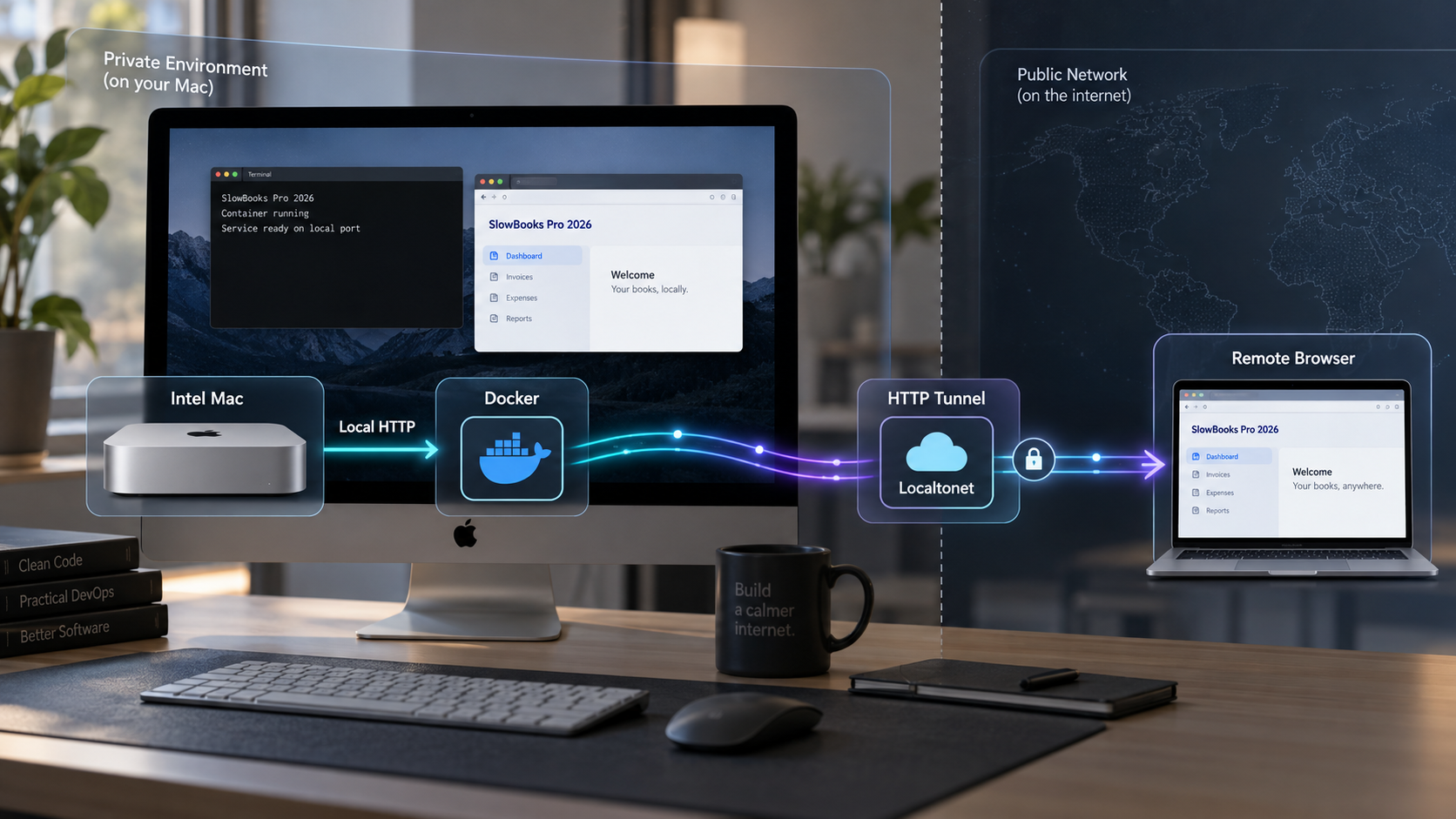
Run your accounting application locally on an Intel Mac, verify it with Docker Compose, and add remote access only when you are ready
SlowBooks Pro 2026 provides an optional Docker deployment path for Linux servers and Intel Macs. In this guide, we install the source-available accounting application from its repository, start its Docker Compose stack, verify the documented local service at http://localhost:3001, and cover essential container operations and troubleshooting. After the local installation is working, we configure a separate Localtonet HTTP tunnel so authorized users can reach the service remotely without inbound router port forwarding, firewall changes, VPN setup, or a public IP address.
📋 What's in this guide
Understand the SlowBooks Pro deployment
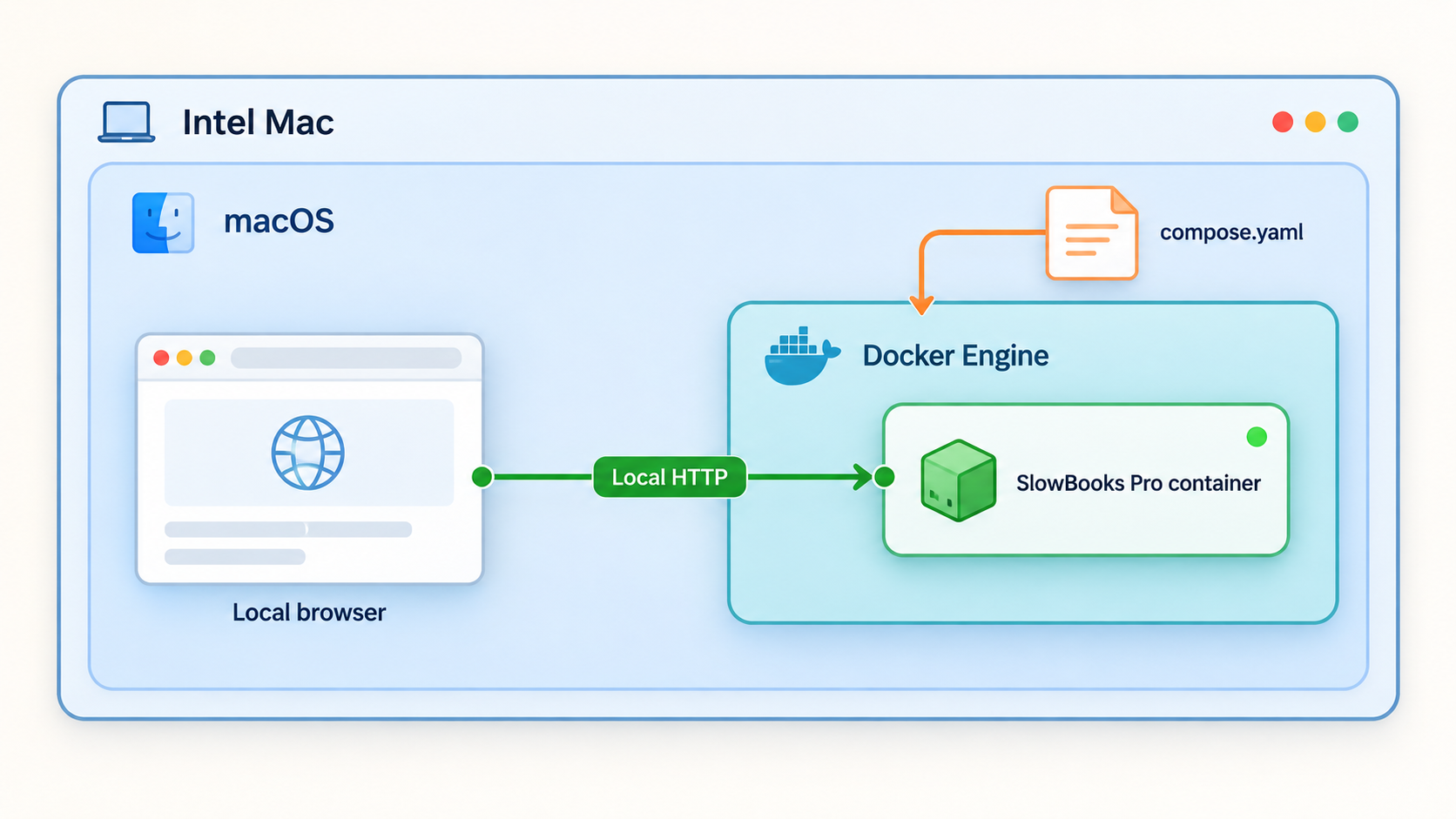
SlowBooks Pro 2026 is a source-available accounting and bookkeeping application designed to keep company records on hardware controlled by the operator. Its documented feature set includes double-entry bookkeeping, invoicing, accounts receivable, accounts payable, inventory, bank feeds, reporting, payroll-related workflows, imports and exports, and a local REST API. The application is not described by its maintainers as conventional open-source software, so review its license before redistributing it, modifying it for distribution, or incorporating it into another product.
The project offers several installation shapes. There is a signed Windows installer, a signed and notarized macOS package for Apple Silicon, a Windows Server Edition, and an optional Docker deployment for Linux servers and Intel Macs. This article is specifically about the Docker path on an Intel Mac. It does not apply the Apple Silicon desktop package instructions to an Intel processor, and it does not assume that the Windows Server Edition uses the same port or local URL as the Docker deployment.
The Docker procedure uses the project repository and Docker Compose. After the stack starts successfully, the documented application address is http://localhost:3001. That loopback address is intentionally local. A browser on the same Mac can use it, but a remote user cannot normally reach it directly.
Remote access is a separate layer. With Localtonet, our client on the Mac establishes an outbound connection to a Localtonet relay server. An HTTP tunnel can then forward its public address to the application listening locally on port 3001. The tunnel remains available only while the selected device is connected and the tunnel is running.
http://localhost:3001 as the application endpoint to test before any remote-access integration.
Choose the correct installation path
| Installation path | Documented target | Relevance to this guide |
|---|---|---|
| Docker Compose | Linux servers and Intel Macs | This is the path used throughout the guide. |
| macOS DMG | Apple Silicon Macs | Use the signed and notarized desktop package documentation instead of applying this Intel Mac workflow. |
| Windows installer | Windows desktop installation | Not applicable to an Intel Mac Docker host. |
| Windows Server Edition | Multi-user browser access from a Windows office PC | Its listening port and local URL are not established by the evidence for this guide, so we do not assume port 3001 applies to it. |
This guide uses the documented Docker endpoint and repository structure available for SlowBooks Pro 2026. Exact Docker Desktop system requirements, minimum RAM, minimum disk capacity, and supported macOS releases are not established by the supplied project evidence. Check Docker Desktop's current requirements for your particular Intel Mac before installation rather than relying on an invented minimum.
Prepare the Intel Mac
Complete the prerequisites before cloning the repository. A container deployment is easier to diagnose when Docker, Compose, Git, local storage, and network access have each been checked independently.
Intel processor and supported macOS environment
Confirm that the Mac uses an Intel processor. In macOS, open the system information interface and inspect the processor or chip entry. If the computer reports an Apple chip such as an M-series processor, this Intel-specific tutorial is not the appropriate installation path. SlowBooks Pro provides a separate macOS DMG for Apple Silicon.
The project evidence does not define a minimum supported macOS version for the Docker path. Docker Desktop's own current compatibility rules determine whether it can run on the Mac. Resolve that prerequisite before working on the accounting application.
Docker Desktop and Docker Compose
Install a current Docker Desktop build that supports the Mac and its Intel architecture. Start Docker Desktop and wait until its engine reports that it is running. Modern Docker Desktop installations normally expose Compose through the docker compose command.
Open Terminal and verify both the Docker engine and Compose command:
docker version
docker compose version
The first command should show client and server information. If it shows only client information or says it cannot connect to the Docker daemon, Docker Desktop has not finished starting or the current terminal cannot reach its engine. The second command should return a Compose version rather than an unknown-command error.
Git and repository access
Git is required to clone the SlowBooks Pro repository. Verify that it is available:
git --versionIf macOS offers to install command-line developer tools, complete that installation and run the version check again. You also need outbound HTTPS access to retrieve the repository and any container images or build dependencies referenced by the Compose project.
Storage, backups, and host availability
Accounting systems accumulate records, attachments, generated reports, and database data. Ensure the Mac has adequate free storage, but do not rely on an arbitrary capacity estimate because the project evidence does not publish one for this deployment. The required amount depends on the company data and retained files.
The host must remain awake, powered on, and connected whenever browser users need the service. Docker containers cannot answer requests while the Mac is shut down or sleeping. The same condition applies to remote access: a Localtonet tunnel works only while the selected client is connected and the tunnel is running.
SlowBooks Pro uses PostgreSQL for its ledger. Before entering production accounting data, identify where the Compose project persists database and application data, document a backup procedure, and test restoration. Never remove Docker volumes casually. In particular, do not add volume-removal options to a shutdown command unless you have confirmed exactly what will be deleted and have a verified backup.
Install SlowBooks Pro 2026 with Docker Compose
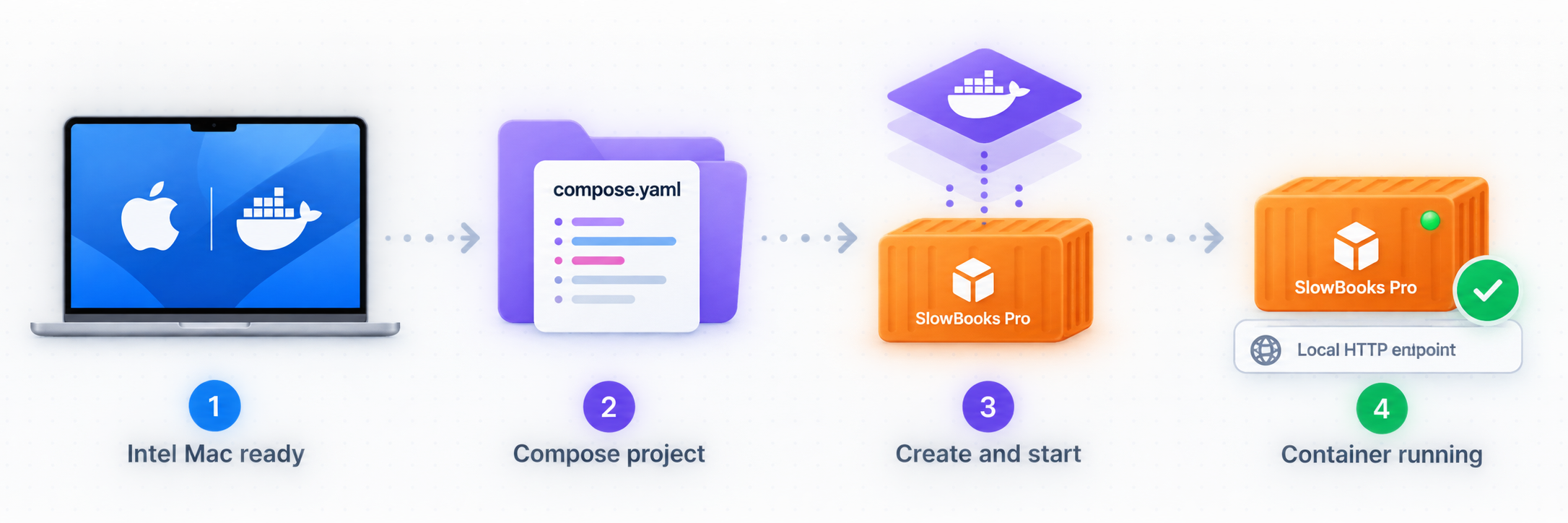
The installation begins with the official repository. The repository contains the application source, a Dockerfile, docker-compose.yml, a production Compose file, migration files, an example environment file, and supporting scripts. This tutorial uses the default Compose workflow documented for the Docker installation.
Choose an installation directory
Open Terminal and move to a parent directory where you want to keep the repository. Use a location owned by your macOS account and avoid a temporary folder that may be cleaned automatically.
Clone the official repository
Clone the SlowBooks Pro 2026 repository over HTTPS, then enter the new project directory.
git clone https://github.com/VonHoltenCodes/SlowBooks-Pro-2026.git
cd SlowBooks-Pro-2026Review the checked-out version and Compose definition
Record the current revision and ask Docker Compose to render its configuration. The configuration command detects many syntax and interpolation problems without starting the application.
git status
git log -1 --oneline
docker compose configStart the Compose project
Build or retrieve the required container artifacts and start the services in detached mode. Keep Docker Desktop running while Compose completes the operation.
docker compose up -dCheck container state
Display the services in the current Compose project. A container that repeatedly restarts or exits requires log inspection before you continue.
docker compose psOpen the local application
On the same Intel Mac, open http://localhost:3001 in a browser. Complete any application-level first-run workflow shown by SlowBooks Pro before considering remote publication.
Optionally select the verified release tag
The supplied release evidence identifies v2.23.3 as a published SlowBooks Pro release. If you need a reproducible review of that specific release instead of the repository's current branch, select the tag before starting Compose:
git fetch --tags
git checkout v2.23.3
docker compose config
docker compose up -d
A tag checkout places Git in a detached state, which is normal when running a fixed release. Do not combine changes from a moving development branch with production accounting data unless you have reviewed the changes and prepared a rollback plan.
The repository contains an .env.example file, but the supplied evidence does not establish which values are mandatory for this exact Compose workflow or what valid production values should be. We therefore do not invent environment variables, passwords, database names, or secret-generation commands. If Compose reports a missing value, inspect the checked-out release's example file and installation instructions, supply a unique value appropriate to that documented field, and never commit the resulting secret file to Git.
Why the local check comes before Localtonet
A tunnel cannot repair an application that did not start. It only transports traffic to a target that must already be reachable from the machine running our client. Separating the checks gives you a clear fault boundary:
- If
http://localhost:3001fails, investigate Docker and SlowBooks Pro. - If the local URL works but the public URL fails, investigate the Localtonet client, tunnel state, selected device, relay selection, and local target.
- If both URLs load but an accounting action fails, investigate the application, database, permissions, or request logs rather than the network path alone.
Verify the local service before exposing it
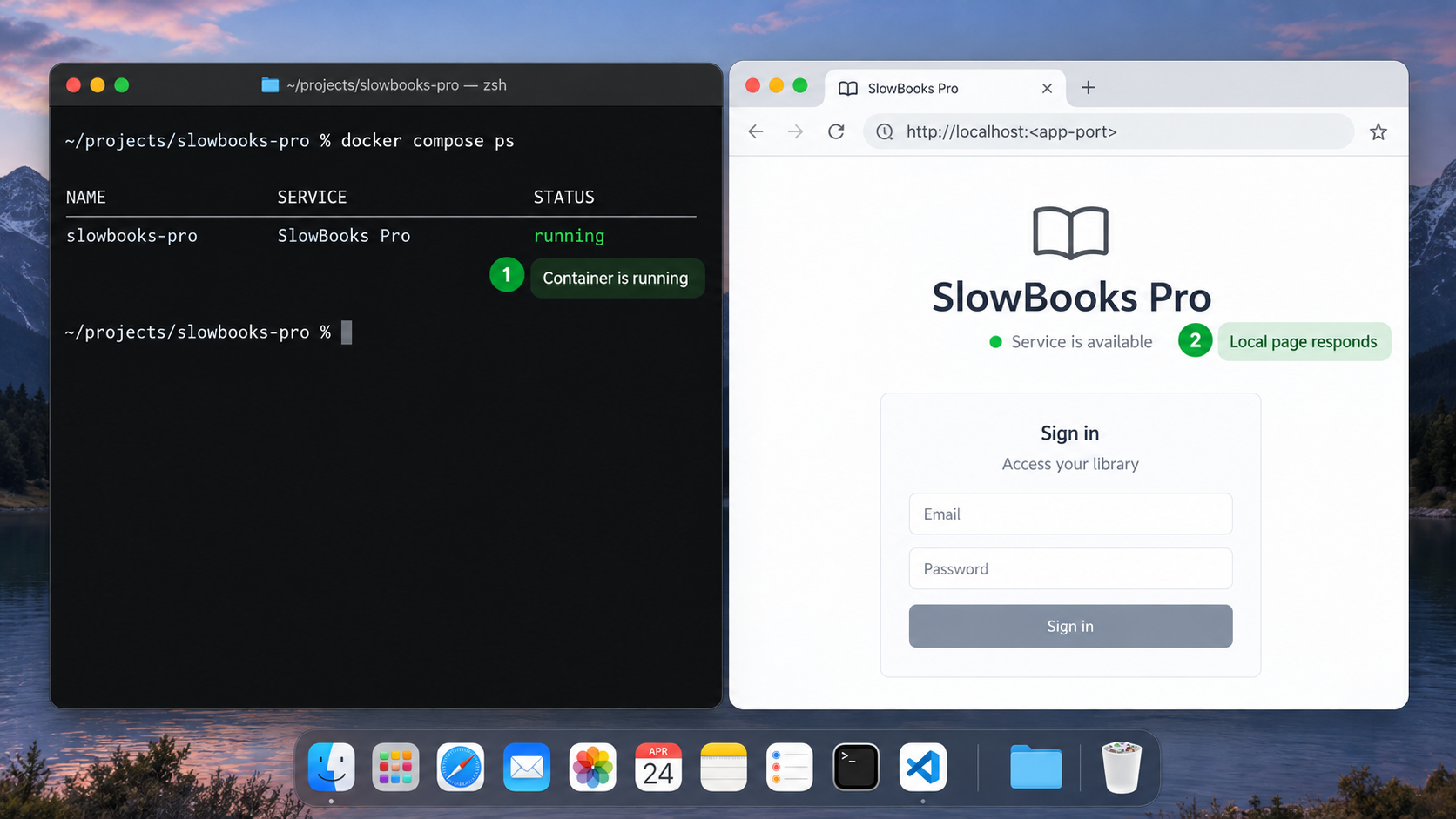
A successful docker compose up -d command means Docker accepted the request. It does not by itself prove that every container remained healthy, that migrations completed, or that the application is usable. Perform container, HTTP, browser, and persistence checks before adding remote access.
Inspect the Compose service state
docker compose ps
docker compose logs --tail=200
Look for services that are running rather than repeatedly restarting or exiting. In the logs, distinguish ordinary startup messages from persistent exceptions. Database initialization and application startup may take time on the first run, particularly if Docker must build images or download dependencies.
The exact service names and health-check behavior are controlled by the checked-out Compose file. Do not assume names such as app, web, or db. Use the names displayed by docker compose ps when narrowing a command to one service.
Test the documented HTTP endpoint
Open this address in a browser on the Docker host:
http://localhost:3001You can also inspect the HTTP exchange from Terminal:
curl -i http://localhost:3001/A browser is the more useful functional test because it loads the user interface and related assets. A command-line response confirms that a process answered on the port, but an unexpected status code or partial page still requires log inspection. Do not consider the deployment ready merely because a TCP connection can be opened.
Complete a cautious functional test
Follow the first-run interface presented by the installed release. The supplied evidence does not establish universal default credentials, a fixed administrator username, or a standard password, so this guide does not guess them. If the application asks you to create an initial user, use a unique password and store it in an appropriate password manager.
Before entering real records, use non-sensitive test data to confirm that the interface remains available across page navigation. If the installation presents user or role controls, establish least-privilege accounts for future users instead of sharing an administrator login. SlowBooks Pro's documented server capabilities include administrator, bookkeeper, and read-only roles, but verify how the Docker release exposes those controls before relying on them.
Check persistence without deleting anything
After the initial setup and a non-sensitive test record, restart the Compose services:
docker compose restart
Reload http://localhost:3001 and confirm that the expected state remains. This is a basic persistence check, not a restore test and not proof that backups work. A proper recovery test requires a separately retained backup and a documented restoration procedure.
Do not place real payroll records, bank details, tax identifiers, customer data, or production credentials into an installation that has not yet passed persistence, access-control, backup, and restore checks. Accounting information is sensitive even when the application is running only on localhost.
Operate the Docker deployment safely
Run Compose commands from the cloned repository directory so Docker can locate the expected project definition. If you run them from an unrelated folder, Compose may report that it cannot find a configuration file or may act on a different project.
| Task | Command | Operational effect |
|---|---|---|
| Show service status | docker compose ps |
Lists the current Compose services, state, and published port information. |
| Read recent logs | docker compose logs --tail=200 |
Shows recent output from the project without assuming a service name. |
| Follow new logs | docker compose logs -f |
Streams new output until you stop the terminal command. |
| Stop containers | docker compose stop |
Stops the project's containers without intentionally removing them. |
| Start stopped containers | docker compose start |
Starts containers previously created for the project. |
| Restart services | docker compose restart |
Restarts the existing project services. |
| Remove project containers | docker compose down |
Stops and removes project containers and networks. Do not add volume-removal options unless deletion is intentional and backed up. |
| Render effective configuration | docker compose config |
Validates and displays the effective Compose configuration after interpolation. |
Start and stop behavior
To pause the application while preserving the existing containers, use:
docker compose stopResume it with:
docker compose startWhen SlowBooks Pro is stopped, the local endpoint will be unavailable. A Localtonet HTTP tunnel may still appear configured, but it cannot serve a working application when its local target is down. For a planned maintenance window, stop the tunnel as well so remote users do not encounter an unexplained application failure.
Updating requires a controlled plan
Do not update a production accounting application simply by pulling arbitrary repository changes. First identify the installed revision, read the target release notes, back up persistent data, and determine whether the target includes migrations or configuration changes. The supplied evidence confirms that release v2.23.3 exists, but it does not define a universal upgrade and rollback procedure for every earlier release.
A safe operational policy should include a maintenance window, a known source revision, a verified backup, a restoration test, post-update log inspection, and functional checks at the local URL. Only restore remote access after the application has passed those checks.
Understand what must remain running
Four layers participate in the final remote workflow:
- The Intel Mac must be powered on, awake, and connected.
- Docker Desktop and the required SlowBooks Pro containers must be running.
- The Localtonet client must be connected using the intended device token.
- The selected HTTP tunnel must be started.
Failure at any layer interrupts remote access. Local browser access tests the first two layers. The public tunnel URL tests all four.
Expose SlowBooks Pro with a Localtonet HTTP tunnel
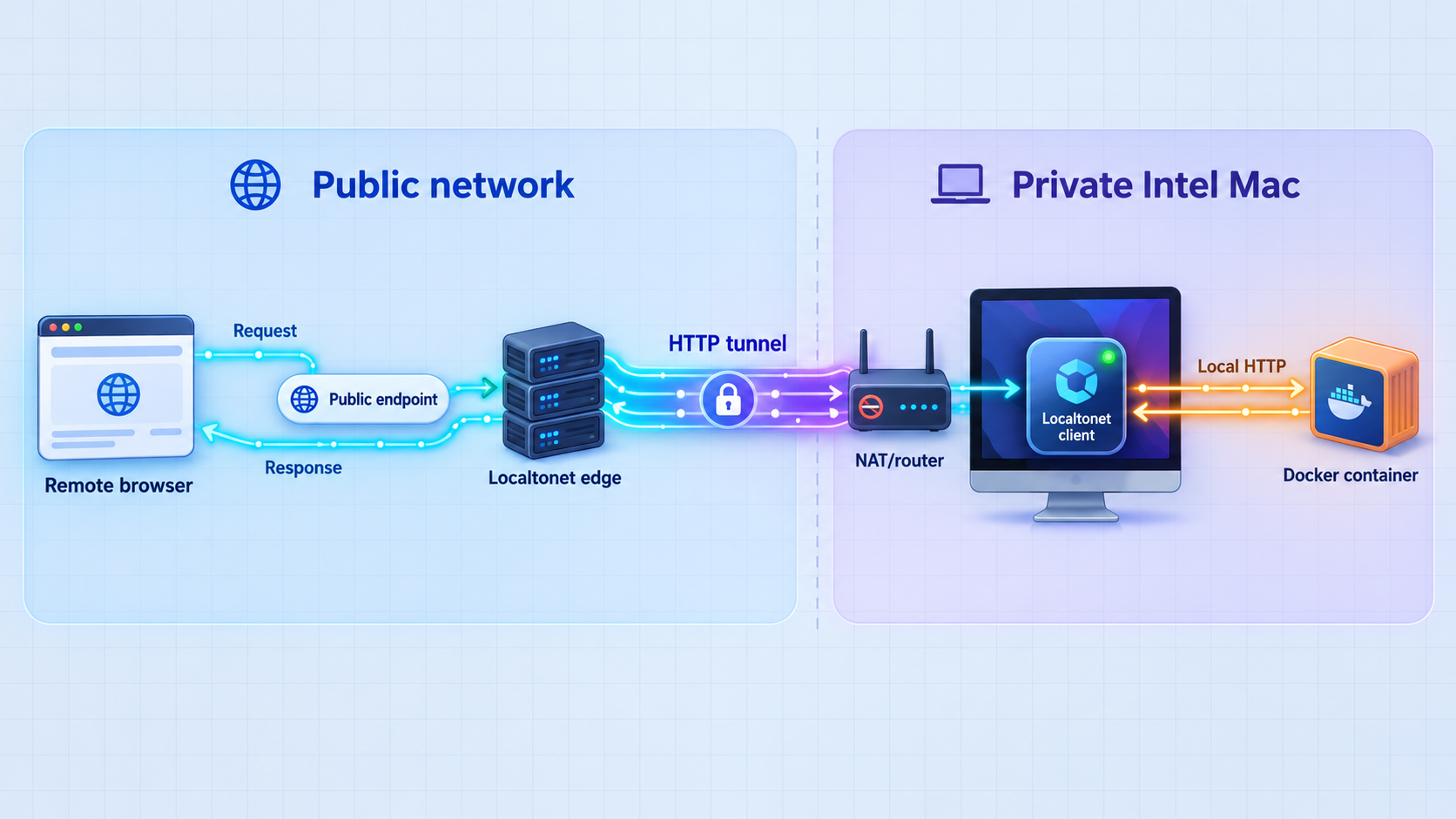
Configure Localtonet only after http://localhost:3001 works on the Intel Mac. Our HTTP tunnel points to the existing local service and provides a public HTTPS address according to the selected HTTP process type. The Localtonet client initiates the relay connection outbound, so this workflow does not require inbound router port forwarding, firewall changes, VPN setup, or a public IP address.
The device token identifies the client device that runs the tunnel. Treat it as a secret. Relay server or region values can vary and must be selected from the current dashboard rather than copied from an old guide or hardcoded into automation.
Install and run the Localtonet client on the Intel Mac
Install our client on the same Mac that can open http://localhost:3001, then run it. Keeping the client on the Docker host makes the local HTTP target straightforward and avoids depending on access from another LAN device.
Authenticate and select the intended device
Use the device-specific authentication token assigned through Localtonet and confirm that the correct client appears connected. Never paste the token into screenshots, article text, shell history intended for sharing, or public configuration repositories.
Select an available relay server
Choose a currently available server or region from the dashboard. Do not rely on a server code copied from another account or an older tutorial because available values can change by plan, deployment, and current product configuration.
Create an HTTP tunnel for the local service
Select the HTTP tunnel family and set the local target to the Mac's loopback service on port 3001. Use 127.0.0.1 as the local IP address and 3001 as the local port when the Localtonet client runs directly on the same Mac as Docker.
Choose the HTTP process type
Choose Random Sub Domain, Custom Sub Domain, or Custom Domain according to the options available in the current dashboard. All three process types serve the target at a public HTTPS address. If you choose a custom domain, follow the current dashboard and documentation for its DNS requirements rather than guessing records from this article.
Start the tunnel and test the assigned address
Creating the tunnel does not start it. Press Start, wait for the tunnel to report that it is running, and open the assigned public URL from a separate browser session or another network. Confirm both page loading and an authorized application workflow.
For the current dashboard workflow, consult our Localtonet documentation alongside the fields visible in your account. Product options can vary, so the dashboard is authoritative for available relay servers, process types, and account-specific choices.
Do not start the tunnel until application authentication, user roles, backups, and host security have been reviewed. A generated address is not a substitute for authorization. Use strong unique credentials, grant the least privilege required, remove unused accounts, and stop the tunnel when remote access is no longer needed.
Test from outside the Mac
Testing the public URL only from the host browser can miss session and network differences. Open it from a private browser window or another authorized device. Confirm that unauthenticated visitors do not gain access to accounting records and that an authorized user can sign in and complete the intended operation.
Keep the local and public tests distinct. If the public URL fails, immediately retest http://localhost:3001 on the Mac. This determines whether to inspect Docker or the tunnel layer first.
Secure accounting access and data
Accounting deployments contain information with operational, financial, and privacy consequences. Remote access should therefore be designed around explicit authorization rather than convenience alone. Localtonet removes the need to expose an inbound router port, but it does not replace application authentication, host maintenance, database backups, or user governance.
Apply least privilege
Give each person an individual account when the installed SlowBooks Pro mode supports it. Use read-only access for users who only need reports, bookkeeping access for users who enter transactions, and administrative privileges only for people who manage the system. Avoid a shared administrator password because it weakens accountability and makes offboarding difficult.
Protect the Mac
Enable appropriate macOS account security, protect the device with a strong login credential, install operating-system security updates, and restrict physical access. Docker Desktop, Git, the browser, and the Localtonet client should also be maintained. Do not run unrelated untrusted containers on a host that processes sensitive accounting data.
Protect secrets
Device tokens, application credentials, database credentials, AI-provider keys, payment credentials, and other integration secrets must not be committed to the repository. Keep secret-bearing files out of screenshots and support bundles. If a token or password is exposed, replace it rather than assuming deletion from a public location is sufficient.
SlowBooks Pro documents optional AI integrations and a local REST API. If those features are enabled, understand what data each configured provider receives. A cloud-backed model can receive figures supplied to it under that provider's terms. Only a locally operated model that has been checked for outbound behavior can be treated as keeping all processing local.
Build a real backup process
A backup policy should identify all persistent application and PostgreSQL data, define retention, store copies separately from the Mac, and include restoration testing. A copy that has never been restored is not yet a proven recovery mechanism. Protect backup files because they may contain the same sensitive records as the live system.
The exact supported SlowBooks Pro backup and restoration commands are not established by the supplied installation evidence, so we do not invent database dump commands, container paths, volume names, or application backup locations. Determine those details from the installed release and test them with non-production data before relying on them.
Stop access when it is not required
A Localtonet tunnel can be stopped without deleting its configuration. Stop it during maintenance, incident investigation, or extended periods when no remote user needs access. Delete obsolete tunnels and retire device tokens that are no longer associated with an approved host.
Creating an HTTP tunnel does not mean it is running. It must be started, and it can later be stopped or deleted. The public address remains usable only while the selected Localtonet client is connected, the tunnel is running, and the SlowBooks Pro target is responding.
Troubleshoot the installation and tunnel
Docker commands cannot connect to the daemon
Start Docker Desktop and wait for its engine to become ready. Run docker version again. If the server portion is still unavailable, resolve Docker Desktop before retrying Compose. Re-cloning SlowBooks Pro will not repair an unavailable Docker engine.
Compose reports that no configuration file exists
Confirm that Terminal is in the cloned repository directory:
pwd
ls
git status
The listing should show the repository files, including docker-compose.yml. If git status says the directory is not a Git repository, navigate back to the cloned SlowBooks-Pro-2026 directory.
Compose reports an invalid or missing variable
Run:
docker compose config
Read the complete error and compare it with the checked-out release's .env.example and installation documentation. Do not solve the error with arbitrary credentials or values from an unrelated release. Keep any completed environment file out of version control.
A container exits or continuously restarts
Inspect status and recent logs:
docker compose ps
docker compose logs --tail=300
Look at the earliest meaningful error, not only the final restart message. Common categories include a failed dependency, database initialization problem, migration failure, unavailable storage, configuration error, or port conflict. The exact remedy depends on the emitted error and the service identified by Compose.
Port 3001 is already in use
Another host process or container may already be bound to the documented port. Identify the owner before changing anything:
lsof -nP -iTCP:3001 -sTCP:LISTEN
Stop the conflicting service only if you recognize it and understand its role. The supplied project evidence documents port 3001 for this Docker endpoint but does not establish a supported alternate-port procedure, so this guide does not invent a Compose override. If an alternate binding is required, follow the configuration supported by the exact SlowBooks Pro release.
The browser cannot open localhost:3001
First run docker compose ps. If the services are not running, inspect logs. If they are running, verify that the displayed port mapping includes the expected host port. Test with curl -i http://localhost:3001/. A refusal usually means no process is accepting the connection, while an HTTP response with an application error indicates that the port is reachable and the next investigation belongs in the application logs.
The local URL works but the Localtonet URL does not
Confirm that the Localtonet client is connected on the correct device, the intended HTTP tunnel is started, an available relay was selected, and the target is 127.0.0.1 on port 3001. Remember that saving or creating the tunnel is not the same as starting it.
If the Localtonet client is running on another machine, 127.0.0.1 points to that other machine, not to the Intel Mac. For the workflow documented here, run our client directly on the Docker host.
The public page loads but application actions fail
Reproduce the same action through http://localhost:3001. If it fails locally too, inspect SlowBooks Pro and Compose logs. If it fails only through the public address, record the browser error, HTTP status, time, and exact operation, then examine the tunnel state and application logs without exposing sensitive request data.
The service disappears when the Mac is unattended
Check whether the Mac entered sleep, Docker Desktop stopped, the containers exited, the Localtonet client disconnected, or the tunnel was stopped. Remote availability requires every layer to remain active. Choose host sleep and maintenance settings that match your security policy, energy requirements, and expected access schedule.
Frequently asked questions
Can I install SlowBooks Pro 2026 on an Intel Mac?
Yes. The project's documented optional Docker path covers Intel Macs and Linux servers. The separately distributed macOS DMG is identified for Apple Silicon, so Intel Mac users should follow the Docker workflow described here unless the project's current documentation provides another compatible package.
What local URL does the Docker deployment use?
The documented Docker endpoint is http://localhost:3001. Verify that address on the Intel Mac before configuring remote access. This port should not be assumed to apply to the separate Windows Server Edition.
Is SlowBooks Pro open source?
The project describes itself as source-available rather than explicitly open source. Its published information says the license permits personal, internal, and enterprise use at no cost, but you should review the actual license for redistribution, modification, and other legal questions.
Does Localtonet require router port forwarding?
No. Our client establishes an outbound connection to a Localtonet relay server. This allows the local HTTP service to receive traffic through the tunnel without configuring an inbound router port, firewall change, VPN, or public IP address.
Should the Localtonet client run inside the SlowBooks Pro containers?
This guide runs our client directly on the Intel Mac. That arrangement lets the tunnel target 127.0.0.1:3001 on the same host and avoids inventing a container-network integration that the supplied SlowBooks Pro evidence does not document.
Does creating a Localtonet tunnel immediately make SlowBooks Pro public?
No. Creating a tunnel does not start it. You must use the Start action, and the selected Localtonet client must remain connected. The local SlowBooks Pro service must also continue responding on port 3001.
Can I use a custom domain for the accounting application?
HTTP tunnels can use Random Sub Domain, Custom Sub Domain, or Custom Domain process types where the option is available. Custom-domain DNS requirements should be taken from the current Localtonet dashboard and documentation because this guide does not have verified account-specific DNS values.
What happens if the Intel Mac sleeps or shuts down?
SlowBooks Pro and its local endpoint become unavailable when the host or required containers are not running. Remote access also stops when our client disconnects or the tunnel is not running. Keep the host awake only according to an intentional availability and security policy.
Can I delete the Docker volumes after creating an application backup?
Do not delete volumes merely because a backup file exists. First prove that the backup contains all required data and can be restored into a test environment. The supplied evidence does not establish the exact volume layout or complete restore procedure for every SlowBooks Pro release, so volume deletion should be treated as a potentially destructive operation.
Connect your verified SlowBooks Pro service with Localtonet
Once the Docker deployment works reliably at http://localhost:3001, create a Localtonet HTTP tunnel on the Intel Mac and give authorized users a public HTTPS address without opening an inbound router port.


