

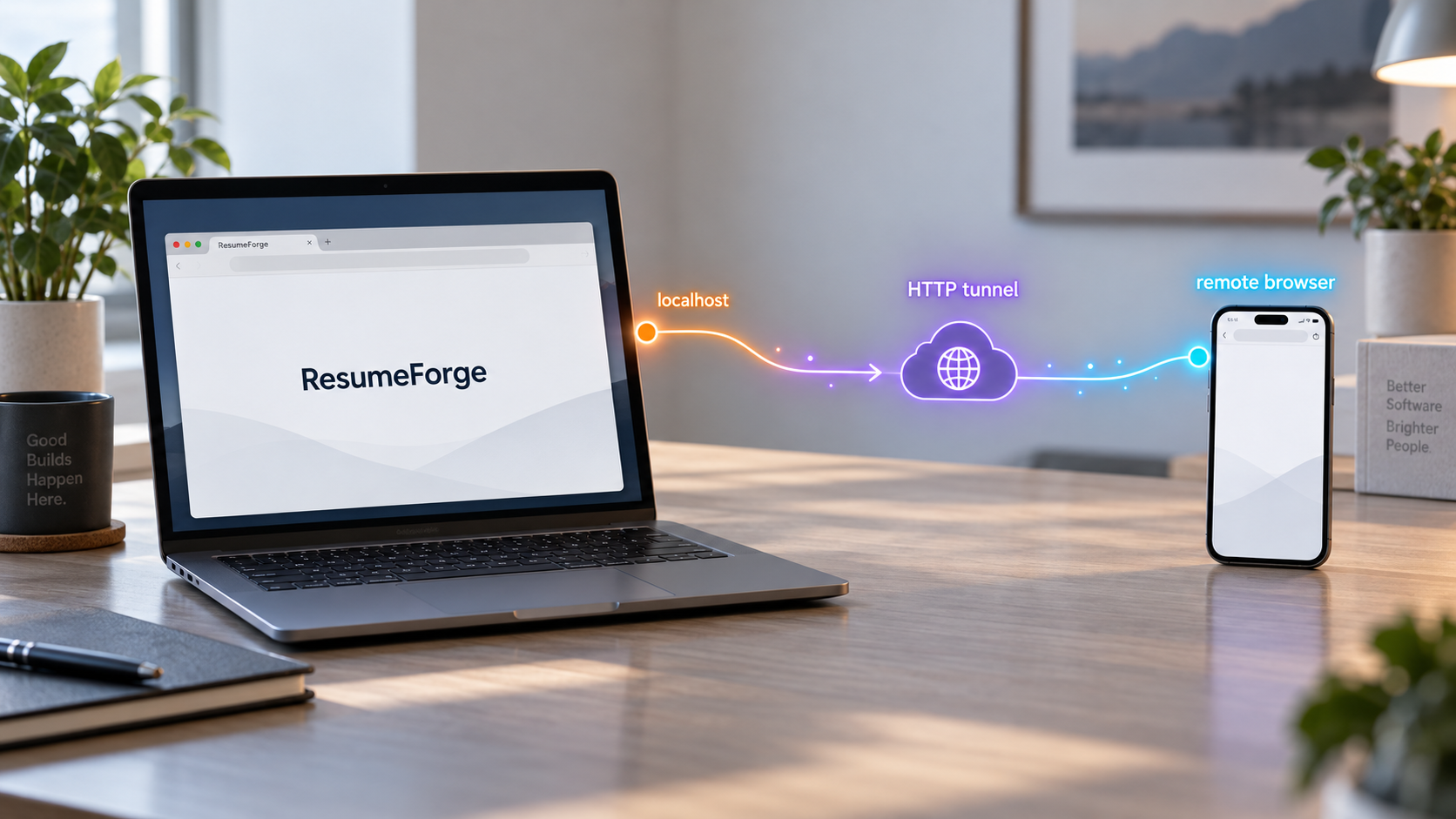
Run your local-first resume workspace on your own computer and reach it remotely when needed
ResumeForge is a local-first, open-source resume and job-search workspace built with FastAPI, React, and SQLite. This guide explains how to download the correct desktop archive, extract it, complete the automatic first-launch setup on Windows or macOS, identify the actual local web address, and verify the application before exposing anything. After the local installation works, we show how to point a Localtonet HTTP tunnel at that verified service. Because ResumeForge contains personal and employment information, the remote-access section also explains the security boundary created when a local-only interface becomes publicly reachable.
📋 What's in this guide
What ResumeForge is and what this setup accomplishes
ResumeForge is a Chinese-first, local-first workspace for managing resumes and the broader job-search process. Its documented architecture combines a FastAPI backend, a React interface, and SQLite storage. Instead of requiring a hosted account, the desktop installation runs on one computer and presents its interface as a local web application. You use that interface in a browser even though the application and its data remain on the machine running ResumeForge.
The project covers more than document formatting. Its workflow includes job management, a personal information library, multiple resume versions, interview preparation, application tracking, reminders, exports, and job-search statistics. It also separates confirmed facts from generated wording. Only confirmed material in its fact ledger participates in generation, and its checks are intended to identify claims that do not match the user's stored information. ResumeForge can export PDF, Word, Markdown, plain text, JSON, and HTML formats.
Several parsing, checking, preview, and export functions are documented as available offline. AI-backed operations can have separate model and connectivity requirements, so a successful local installation does not automatically mean every AI feature is configured. The installation objective in this guide is narrower and testable: start the application, open its real local interface, confirm that the backend and frontend are functioning, and preserve the exact local address reported by the launcher.
Remote access is deliberately a second phase. Localtonet does not install or repair ResumeForge. Our role begins after ResumeForge works locally. The Localtonet client creates an outbound connection to one of our relay servers, and an HTTP tunnel maps a public HTTPS address to the local IP address and port used by ResumeForge. This avoids inbound router port forwarding, public-IP requirements, VPN setup, and manual firewall changes for incoming internet traffic.
start.cmd on Windows or start.command on macOS. The first launch automatically installs the required application environment.
The supplied ResumeForge documentation identifies the launch files but does not establish a fixed local hostname, URL, or port for this tutorial. Record the address printed by your installed launcher's output or shown by the application. Do not substitute a guessed port from an unofficial tutorial, an older release, or another FastAPI project.
Prerequisites and preparation
Start with a supported desktop archive for the operating system you are actually using. The documented quick-start path covers Windows and macOS. The project repository contains backend and frontend source code, but this guide uses the packaged desktop workflow because it is the installation path explicitly described in the supplied project evidence. It does not attempt to invent a Linux desktop process, a Docker image, package-manager commands, or a manual Python and Node.js build procedure.
Obtain the archive from the project's GitHub Releases page or its official website. Release v0.18.0 is documented as a source package that can be extracted and launched with the platform-specific start file. Release assets include SHA-256 checksum files alongside the archives. When a checksum is available, validating the download against its accompanying checksum is a useful integrity check, but the exact archive names differ by release and are not hardcoded here.
Before proceeding, prepare a stable folder where the extracted application can remain. Running directly from inside an archive viewer is not equivalent to extracting the archive. The startup, update, stop, and data-management processes need access to a normal filesystem location. Avoid deleting or casually replacing that folder after you have started using the application.
The first launch automatically prepares the runtime environment. This means the first startup may take longer than later starts and may need network access for dependency installation. The supplied documentation does not specify an exact download size, disk-space requirement, supported Windows versions, supported macOS versions, or installation duration. Check the current release notes if your computer is managed, has limited storage, or applies restrictive execution policies.
| Requirement | What to prepare | Why it matters |
|---|---|---|
| Supported package | Download the archive intended for Windows or macOS from an official ResumeForge distribution location. | The launcher and platform behavior differ between the two operating systems. |
| Extracted folder | Fully extract the archive into a persistent, writable folder. | The startup files and automatically assembled environment must operate from normal files on disk. |
| First-launch connectivity | Allow the installer to obtain its runtime dependencies if requested. | The documented first launch automatically installs the environment. |
| Local browser | Use a browser on the same computer for the first verification. | Local verification separates ResumeForge problems from tunnel problems. |
| Local endpoint record | Copy the actual hostname or IP address and port shown during startup. | Localtonet must target the real listening endpoint rather than an assumed default. |
| Localtonet client | Install and run it only after the local interface works. | The client must be on a device that can reach the ResumeForge service. |
ResumeForge stores resumes, attachments, personal details, job records, and related material locally. Local-first storage gives you control, but it also means the computer and its backups are part of your data-protection strategy. Before updating, moving, or deleting an installation, identify and back up the application's actual data according to the current ResumeForge documentation. Do not assume that copying only exported resumes preserves the full workspace.
Install ResumeForge on Windows
The Windows desktop workflow uses the packaged archive and its included start.cmd launcher. No separate Python, Node.js, FastAPI, React, or SQLite installation command is supplied for this packaged path. The launcher handles initial environment assembly during the first run.
Download the Windows archive
Open the official ResumeForge distribution page or the project's GitHub Releases area and select the archive intended for Windows. Release filenames can change, so confirm the platform label instead of relying on an old filename copied from another guide. If the release provides an accompanying SHA-256 file, keep it with the downloaded archive while performing any integrity verification.
Extract the complete archive
Extract all files into a persistent folder that your user account can write to. Open that extracted folder and confirm that start.cmd is present. Do not launch the file while browsing the compressed archive itself, because the launcher needs the complete project layout around it.
Run the Windows launcher
Double-click start.cmd. On the first launch, ResumeForge automatically installs and prepares its environment. Keep the launcher window open while it works, respond only to prompts you understand, and do not treat the initial delay as a failure before reading the output.
Record the reported local address
When startup completes, note the exact local URL displayed by the launcher or opened by ResumeForge. Preserve both parts of the endpoint: the hostname or IP address and the numeric port. This observed value will be used for local testing and later for the Localtonet target.
Open and inspect the local interface
Open the reported URL in a browser on the same Windows computer. Confirm that the interface loads and that normal navigation works before installing or configuring remote access. Leave ResumeForge running during the verification process.
If Windows displays a protection or execution warning, pause and verify that the package came from the official project distribution and corresponds to the expected release. Security behavior varies by Windows configuration, organizational policy, and archive provenance, so this guide does not recommend bypassing a warning blindly. A managed computer may require administrator or IT approval even when the project itself does not request an account.
Install ResumeForge on macOS
The macOS workflow follows the same installation model but uses start.command. The first run also performs automatic environment setup. ResumeForge's supplied excerpt does not establish exact macOS version requirements or prescribe a universal workaround for Gatekeeper decisions, so use the current project guidance and your organization's security policy when macOS blocks execution.
Download the macOS archive
Obtain the macOS package from the official ResumeForge website or GitHub Releases page. Confirm that the selected asset is for macOS. If a SHA-256 checksum accompanies the release archive, it can be used to verify that the file was not changed during transfer.
Extract the archive into a stable folder
Fully extract the package, retain its internal directory structure, and open the extracted folder. Confirm that start.command is present before continuing. Keep the installation in a location where your macOS user can read and write its working files.
Run the macOS launcher
Double-click start.command. The first launch automatically assembles the environment. Keep the terminal window open so that you can see progress, warnings, and the eventual local service address. Do not close the terminal simply because the browser has not opened immediately.
Capture the exact endpoint
Copy the local URL printed by the running application or opened automatically. Record the hostname or IP address and port exactly as shown. The supplied evidence does not justify replacing this observed endpoint with a fixed example.
Verify the application in a local browser
Visit the reported address from a browser on the same Mac. Confirm that the interface loads completely and remains available while the launcher is running. Test local behavior before adding Localtonet so that later failures can be isolated correctly.
If macOS refuses to open the launcher, first confirm the package source and current project instructions. The appropriate action depends on the warning, the package, the macOS version, and any device-management policy. This article does not provide a generic quarantine-removal or permission command because the supplied official evidence does not establish one for this workflow.
Verify ResumeForge locally before tunneling it
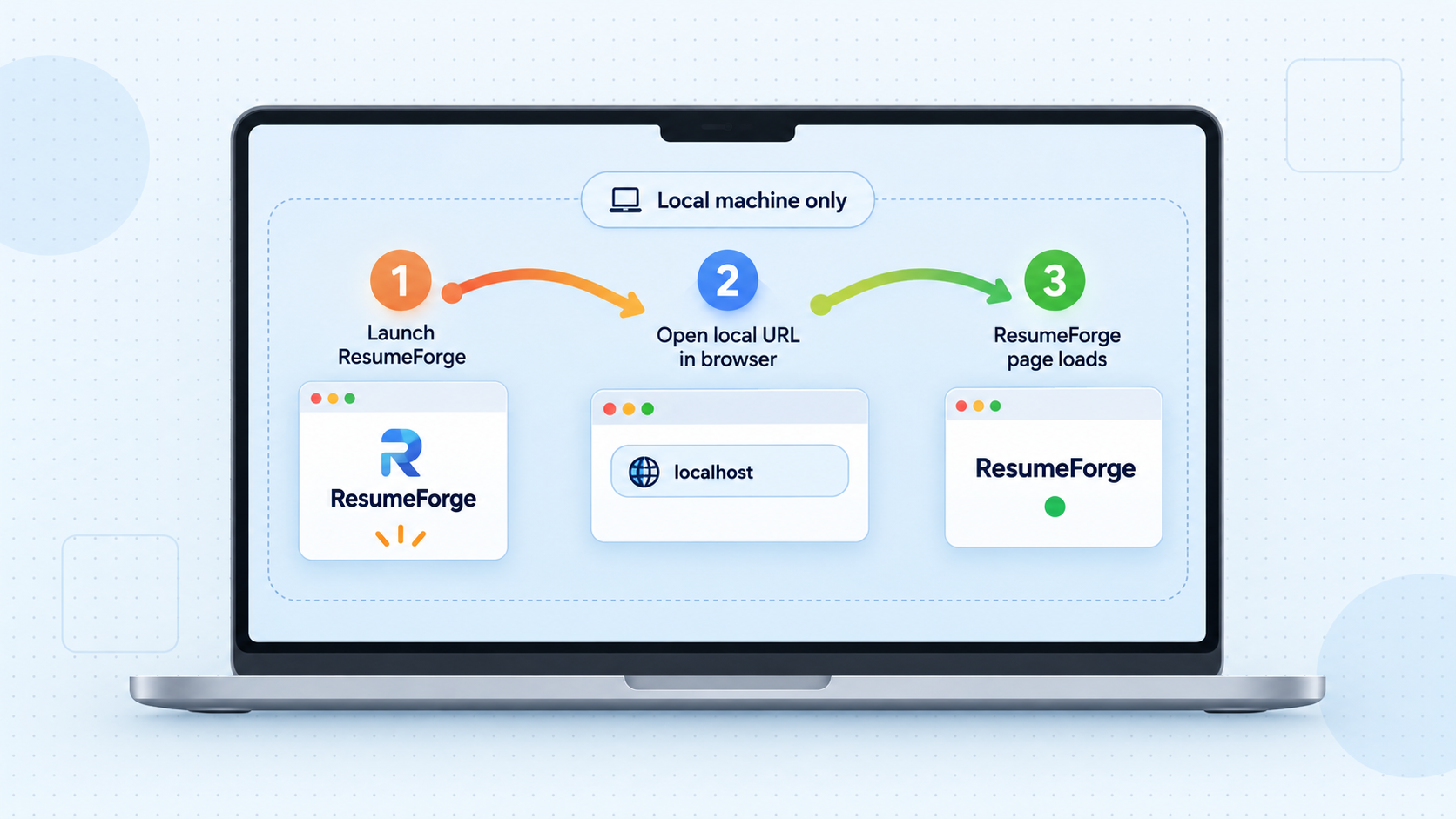
Local verification is the most important diagnostic boundary in the entire setup. A tunnel can only forward traffic to a service that is already listening and responding. If ResumeForge does not load on the host computer, changing relay servers, public URLs, or tunnel settings cannot repair the application.
Confirm the launcher remains active
Keep the launcher or terminal window open after startup. Review its most recent output for an explicit success message, local URL, or error. If the process exits immediately, the service is not available merely because a browser tab remains open. Restart through the appropriate platform launcher and read the first reported error rather than repeatedly refreshing the page.
Use the address reported by your installation
Enter the reported URL directly into a browser on the ResumeForge computer. Do not search for the address in a web search engine. The endpoint is local to your computer, and its port is part of the address. If the launcher reports a hostname such as a loopback name, Localtonet still needs the corresponding local IP target and numeric port when you configure the tunnel.
Test more than the first screen
A loaded page proves that some frontend content is reachable, but it does not always prove that the backend is healthy. Navigate between several areas, open settings, and perform a harmless read operation. If you already have data, confirm it appears as expected. Avoid entering sensitive real-world information until you are satisfied that the intended installation is running and that you understand where its data is stored.
Separate installation success from AI configuration
ResumeForge documents that much of its parsing, checking, preview, and export functionality can work offline and that much of the application can be used without configuring a model. An AI operation may still require a model configuration and network access. Therefore, a model-related failure does not necessarily mean the local FastAPI and React application failed to install. Verify basic navigation and non-AI operations independently.
| Check | Expected observation | If it fails |
|---|---|---|
| Launcher process | The startup window remains active without an unrecovered fatal error. | Read the earliest relevant error and retry only after addressing it. |
| Local URL | The exact URL reported by the application opens on the same computer. | Recheck the hostname, port, and whether the process is still running. |
| Interface assets | The application layout renders rather than showing an empty or partially loaded page. | Reload once, inspect launcher output, and confirm initial setup completed. |
| Backend interaction | Navigation and harmless data-reading actions respond normally. | Treat this as an application issue before introducing a tunnel. |
| Repeated local access | The page remains available while the launcher is running. | Check whether the process stopped or the endpoint changed after restart. |
For the Localtonet configuration, extract the local IP address and numeric port from ResumeForge's actual URL. Do not include a browser path, fragment, or query string as the port target. If the displayed URL contains additional path text after the port, first verify whether the base address also loads, then retain any necessary path for browser use after the public tunnel address has been assigned.
Start, stop, update, and maintain ResumeForge
A self-hosted desktop application needs a predictable operating routine. The release layout includes platform launch and stop files, and it also includes update files. On Windows, the repository lists start.cmd, stop.cmd, and update.cmd. On macOS, it lists start.command, stop.command, and update.command. Use the scripts supplied with your installed release rather than manually terminating database files or replacing selected program directories.
Starting the application
Run the same platform-specific start file used during installation. Wait for startup to complete and verify the reported local endpoint. Do not assume that a previous browser bookmark proves the new process is listening on the same endpoint. If the endpoint changes, update the Localtonet local target before expecting remote access to work.
Stopping the application cleanly
Use stop.cmd on Windows or stop.command on macOS when those files are present in your extracted release. A controlled stop is preferable to forcing the terminal closed while the application is writing data. After stopping ResumeForge, its local interface should no longer respond, and an active Localtonet tunnel will have no healthy service to forward to.
Updating without treating application files as data backups
The project includes update scripts and documents a migration and update process. Release v0.18.0 specifically reports repaired pre-update snapshots for its backend data, including the SQLite database, related sidecar files, and dataset directories, with the three most recent snapshots retained by that update mechanism. This is useful protection, but it should not be your only backup strategy. A snapshot created during an update is not the same as an independently tested backup stored away from the computer.
Before updating, stop remote exposure, finish any active edits, create a separate backup using current ResumeForge guidance, and read the release notes for the version you are installing. Use the update launcher supplied for your operating system rather than copying a few files from a newer archive into an active installation. After updating, start locally and repeat the verification checklist before restarting the Localtonet tunnel.
Handling sensitive exports and attachments
ResumeForge can contain identity details, employment history, education records, contact information, resume photos, application materials, and attachments. Its v0.18.0 release adds a file-copy library that keeps centralized copies of files stored through supported application areas and rebuilds them during dataset switching or migration. This convenience increases the importance of protecting the underlying computer account, backups, and any public access route.
ResumeForge also offers redacted export behavior for selected identity fields. Redaction is useful when preparing a shareable document, but it does not sanitize the entire live application. A person who can reach and use the full interface may be able to view more than a single redacted export contains.
Access the ResumeForge web interface with Localtonet
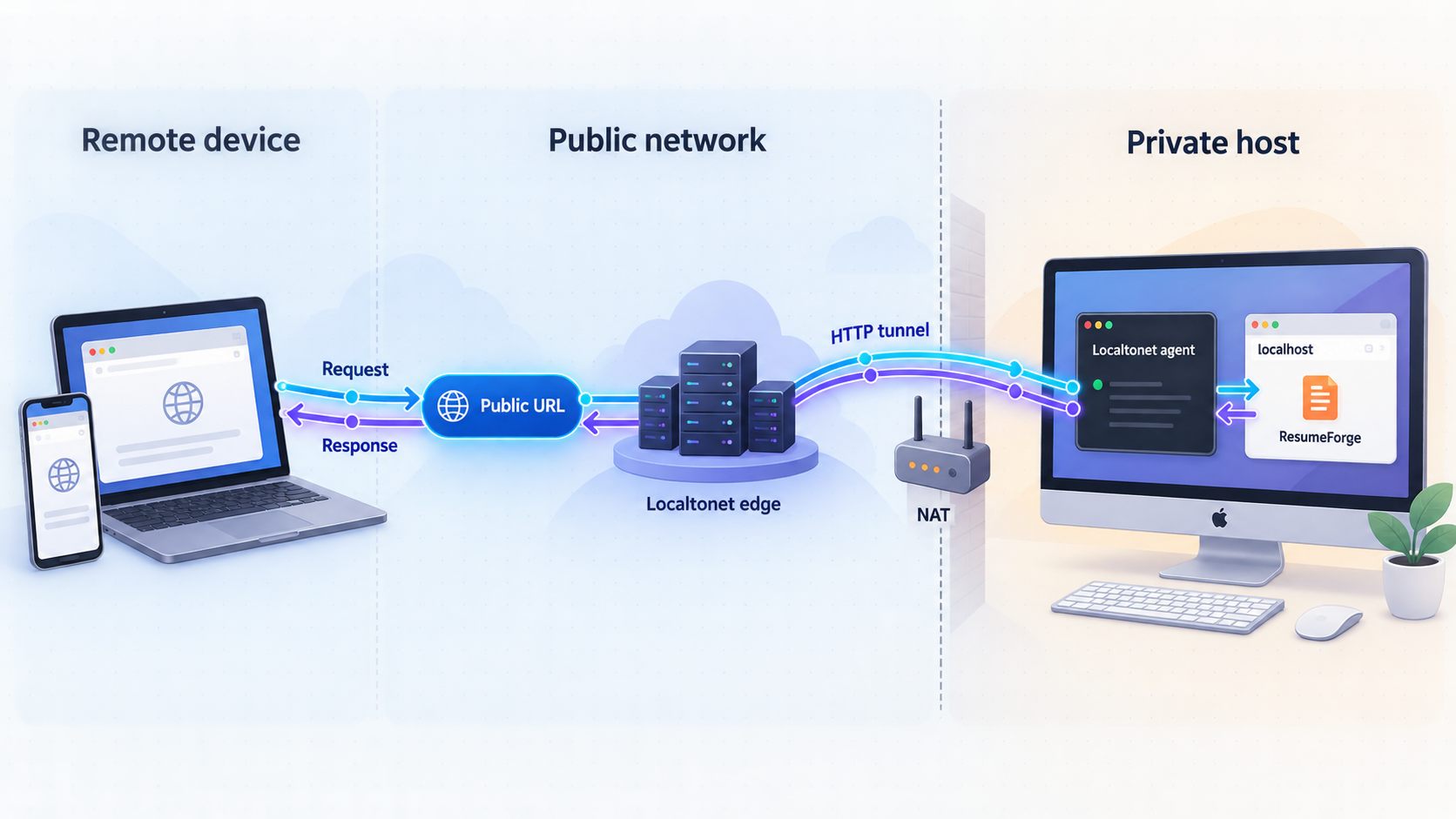
Begin this section only after ResumeForge works from a local browser. With Localtonet, the client running on the ResumeForge computer establishes an outbound connection to our relay server. An HTTP tunnel then forwards requests from its assigned public HTTPS address to the local IP address and port you observed during verification.
This workflow does not require opening an inbound router port, obtaining a public IP address, setting up a conventional VPN, or changing the router's forwarding rules. The tunnel is available only while the selected Localtonet client is connected and the tunnel is running.
The project's documented local workflow requires no ResumeForge registration or login. That is convenient on a trusted local computer, but it must not be mistaken for public-access authentication. Before exposing the interface, assume that anyone who can use the public tunnel address may reach the application unless you have independently confirmed and configured an appropriate access-control layer. Use the narrowest practical exposure window and never publish the URL in public messages, screenshots, repositories, or support logs.
The sequence below follows the verified Localtonet workflow available for an HTTP target. Dashboard labels and available relay choices may evolve, so select current values shown in your account rather than copying a server code or device token from an article.
Install and run the Localtonet client
Install the Localtonet application on the ResumeForge computer, or on another device that can actually reach the verified local service. Keep ResumeForge running. The Localtonet client must establish its outbound connection before a tunnel assigned to that device can serve traffic.
Select the connected device with its authentication token
In the Localtonet dashboard, choose the device that will run the tunnel. The authentication token identifies that specific client device. Treat it as a secret, never paste it into an article or screenshot, and do not substitute a made-up token.
Select an available relay server
Choose a currently available Localtonet server or region from the dashboard. Available values can vary, so use the live options presented to your account rather than hardcoding a server code from a tutorial.
Create an HTTP tunnel for the verified endpoint
Configure an HTTP tunnel and enter the local IP address and numeric port obtained from the ResumeForge launcher. HTTP is appropriate because ResumeForge presents a browser-based web application. Do not use File Server, raw TCP, UDP, Proxy Server, or VPN Manager merely because those are available for different use cases.
Choose the available HTTP process type
HTTP tunnels can use Random Sub Domain, Custom Sub Domain, or Custom Domain process types. They serve the target at a public HTTPS address. Availability can depend on current product configuration or plan, and custom-domain DNS requirements must be checked in current Localtonet documentation rather than inferred here.
Start the tunnel and test its assigned address
Creating the tunnel does not start it. Press the documented Start button, wait for the tunnel to run, and open the assigned public HTTPS address from a separate browser context or remote device. Confirm that the page is the expected ResumeForge instance, then stop the tunnel when remote access is no longer required.
For the current dashboard workflow, consult our Localtonet HTTP tunnel documentation while keeping the locally observed ResumeForge endpoint at hand. Documentation is especially important for current domain options because this article does not invent DNS records or claim that every option is available with every subscription.
How to translate the local URL into a tunnel target
Suppose your launcher prints a local URL. The exact value is intentionally not shown here because no default has been established by the supplied project evidence. Identify the host component and the number after the colon that represents the port. Enter the reachable local IP and that port into the HTTP tunnel configuration. If Localtonet runs on the same computer, a loopback address reported by the application may be reachable by the client. If Localtonet runs on a different device, loopback refers to that other device itself and will not point back to the ResumeForge computer.
Running the Localtonet client directly on the ResumeForge host is therefore the simplest arrangement. A separate tunnel device requires ResumeForge to listen on an address reachable over the local network, and that listening behavior is not established by the supplied ResumeForge excerpt. Do not change the application's bind address based on guesswork. Use current ResumeForge documentation if you need a multi-device local-network topology.
Verify both ends independently
Keep the local page open while testing the public URL. If the local page works and the public page does not, investigate the Localtonet device connection, local target, and tunnel lifecycle. If neither page works, return to ResumeForge startup. If the public page opens but a particular action fails, reproduce it locally to determine whether the problem belongs to the application or the tunnel path.
Security and privacy considerations for remote access
Local-first and remotely accessible describe two different operating states. In its normal desktop state, ResumeForge is intended to keep its workspace on your computer. An HTTP tunnel deliberately creates an internet-reachable route to its interface. The database does not move simply because a tunnel is active, but remote users can send requests to the local application and may be able to read or change information through its interface.
ResumeForge v0.18.0 added browser cross-site protections for state-changing backend requests. Its backend checks the request origin and the Sec-Fetch-Site header for POST, PUT, PATCH, and DELETE requests, rejecting malicious cross-site browser requests while allowing its same-origin frontend and local tools. This is a valuable defense against a category of browser attacks, but it is not a substitute for authenticating who can open the application. Cross-site request protection and access control solve different problems.
Exercise particular care around ResumeForge's application-assistance and automated-application features. The project documents that its application console accesses external recruitment sites only after explicit configuration and an explicit user action. It does not perform unattended operation, and final submission remains under user control. Remote access should not be used to weaken those safeguards or to leave an interactive application session exposed indefinitely.
The project also states that recruitment-site passwords, cookies, tokens, and verification codes are not stored. That behavior does not make every other item in the workspace non-sensitive. Personal profiles, employment history, school information, resume photographs, attachments, interview notes, referral details, and generated documents can still require strong protection.
Localtonet HTTP process types provide a public HTTPS address for the forwarded content. HTTPS protects the web connection in transit at the public edge, but it does not by itself decide who is authorized to use ResumeForge. Confirm the application's access controls for your deployment, apply least privilege, and avoid continuous public exposure when no verified authentication layer is present.
Troubleshooting installation and remote-access problems
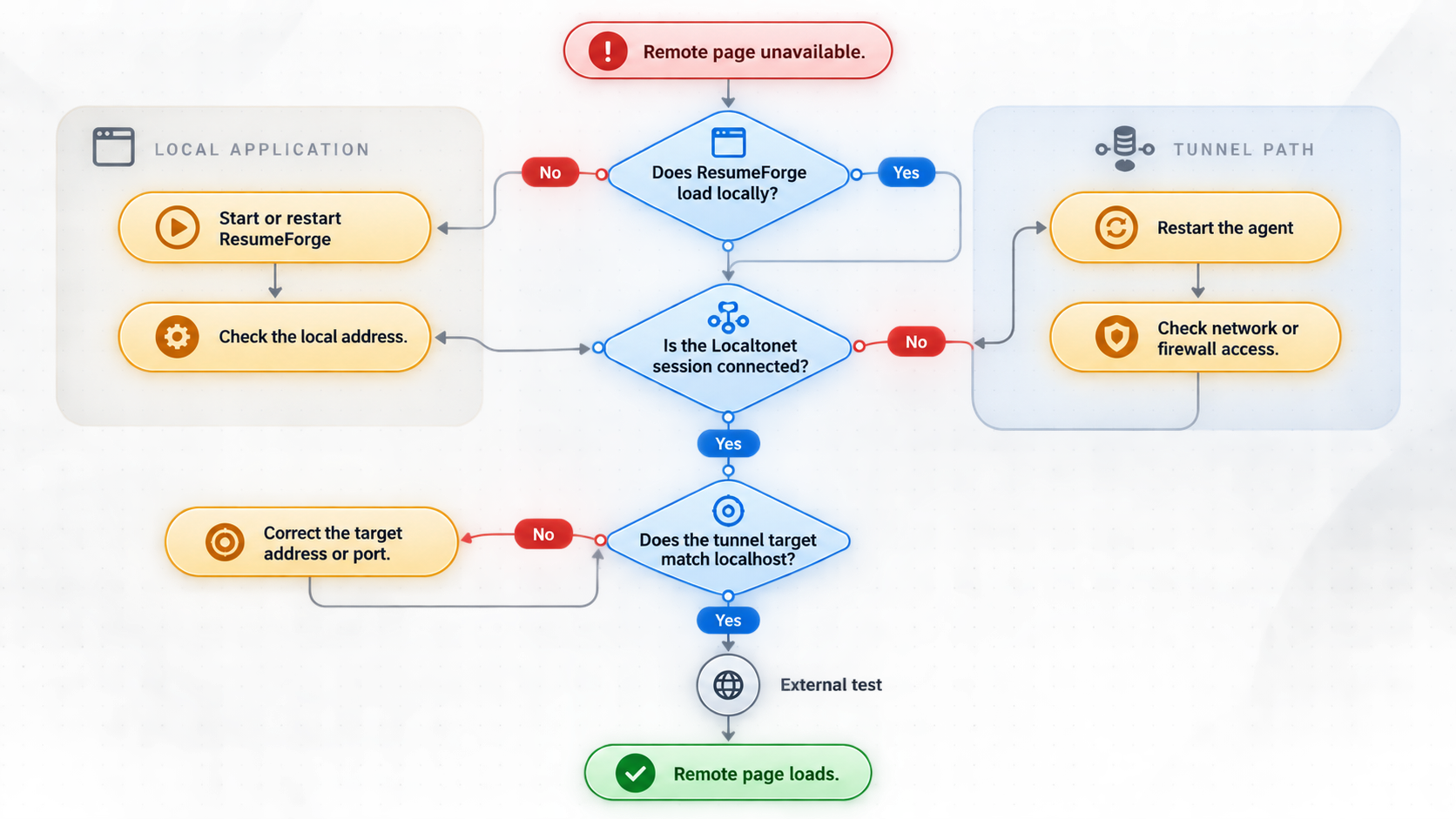
The first launch appears to be stuck
Initial startup performs automatic environment installation, so it can take longer than later runs. Keep the launcher window visible and inspect the latest output. Confirm that the archive was completely extracted and that the installation folder is writable. Network filtering may interfere with obtaining dependencies, but the supplied documentation does not provide a universal proxy command or list of package hosts. Avoid adding unsupported flags to the launcher.
The launcher opens and closes immediately
Reopen it in a way that lets you read its output, or review any diagnostic information the launcher provides. Common diagnostic questions are whether the package matches the operating system, whether all archive files were extracted, and whether the security system blocked execution. Do not assume the error is caused by a port conflict without seeing evidence in the output.
The browser cannot reach the local page
Verify that the ResumeForge process is still running and re-copy the exact address it reports. Check for transcription errors in the port. If startup has not reached a ready state, wait for it to finish. If the launcher reports a fatal error, resolve that error before touching Localtonet. Browser failure on the host computer establishes that the tunnel is not yet the relevant layer.
The page loads but AI actions fail
Separate application installation from model configuration. ResumeForge can perform many non-AI operations without a configured model, while AI-backed features can require separate settings and internet access. Confirm that navigation, local records, previews, checks, or exports function. Then inspect the application's current AI model settings rather than reinstalling the entire desktop package immediately.
The local page works but the public URL does not
Confirm that the Localtonet client shows as connected, that the selected token belongs to the intended device, and that the tunnel has actually been started. Then compare the configured local IP and port with the current ResumeForge launcher output. A tunnel that was configured for a previous endpoint will not automatically infer a changed port.
The public page shows a gateway or connection error
This generally means the public route exists but the selected Localtonet client cannot obtain a valid response from the configured local target. Check that ResumeForge has not been stopped, updated, or restarted on a different endpoint. Test the target locally from the device running Localtonet. If the tunnel client is on another computer, remember that its loopback address points to itself, not to the ResumeForge host.
The public interface opens but some actions behave differently
Reproduce the same action through the local URL. If it also fails locally, inspect ResumeForge rather than the tunnel. If it succeeds locally but fails remotely, record the exact action and visible error without including personal information, device tokens, model credentials, or the public tunnel URL in public reports. ResumeForge's cross-site request defenses may also make origin behavior relevant, but do not disable those protections as a first troubleshooting step.
The tunnel disappears after closing the client
This is expected lifecycle behavior. The public route is available only while the selected Localtonet device is connected and the tunnel is running. Restart the client, confirm it reconnects as the intended device, and start the tunnel if it is not already running.
An update completed but the endpoint changed
Stop the old tunnel configuration or leave it stopped, verify the updated application locally, and edit or recreate the HTTP target using the endpoint actually reported after the update. Do not keep probing old ports. Once the new local endpoint works, start the tunnel and repeat remote verification.
| Local result | Remote result | Most useful next action |
|---|---|---|
| Fails | Fails | Fix ResumeForge startup or its local endpoint first. |
| Works | Fails | Check the Localtonet client connection, target IP and port, and tunnel start state. |
| Works | Partially works | Reproduce the exact operation locally and compare application output. |
| Works | Works | Complete a limited security review, then stop the tunnel when the session ends. |
| Changed after update | Old public route fails | Verify the new endpoint and update the tunnel target before restarting it. |
Frequently asked questions
What port does ResumeForge use?
The supplied official excerpt does not establish a fixed hostname or port. Run start.cmd on Windows or start.command on macOS, then use the exact local URL reported by that installation. Copy its local IP address and numeric port into the Localtonet HTTP tunnel target rather than guessing a default.
Do I need to install Python, Node.js, React, FastAPI, or SQLite manually?
Not for the documented packaged desktop workflow described here. The first run of the platform launcher automatically installs the environment. A manual source-development setup may have different prerequisites, but those commands are outside the verified scope of this guide.
Can I install ResumeForge on Linux with these instructions?
No. The verified desktop quick-start evidence supplied for this article documents start.cmd for Windows and start.command for macOS. It does not establish a Linux archive, Linux launcher, Docker workflow, or manual production deployment. We do not invent an unsupported installation path.
Why should I use an HTTP tunnel instead of TCP or File Server?
ResumeForge presents a browser-based FastAPI and React interface, so an HTTP tunnel matches the application protocol and provides a public HTTPS address. A raw TCP tunnel is intended for generic port forwarding, while Localtonet File Server publishes a local folder rather than a running web application.
Does creating a Localtonet tunnel start it automatically?
No. Creating a tunnel does not mean it is running. Start it with the Start button after confirming the target. The public route also depends on the selected Localtonet client remaining connected. You can later stop or delete the tunnel.
Does the Localtonet HTTPS address add a ResumeForge login?
No such behavior is established for this workflow. ResumeForge documents that its local installation does not require registration or login. A public HTTPS address protects transport to the tunnel edge, but it must not be treated as proof that the application has user authentication. Keep the URL private, limit the exposure window, and use a verified access-control layer where appropriate.
Does tunneling move my ResumeForge database into Localtonet?
The tunnel forwards network traffic to the local service. It does not convert the SQLite workspace into hosted storage or replace your local backup process. However, remote users who can reach and operate the interface may be able to access data through the application, which is why public exposure requires careful access control.
Can ResumeForge work without an AI model?
The project documents that much of the application remains usable without a configured model and that parsing, checks, previews, and exports include offline-capable workflows. AI generation and other model-backed operations can require additional configuration and connectivity. Test ordinary local functionality separately from AI features.
Can I run Localtonet on a different computer from ResumeForge?
The Localtonet client can target a service reachable from its device, but a loopback ResumeForge address is reachable only on the ResumeForge host. A separate device would require ResumeForge to listen on a local-network address and appropriate local connectivity between the devices. That bind configuration is not established by the supplied ResumeForge evidence, so running both applications on the same computer is the documented-safe approach for this guide.
What should I do before updating ResumeForge?
Stop the public tunnel, finish active edits, create an independent backup using current ResumeForge guidance, review the release notes, and use the supplied update launcher for your operating system. After updating, verify the application locally and confirm its current endpoint before restarting remote access.
Connect your verified ResumeForge workspace with Localtonet
Once ResumeForge loads reliably on your computer, install our client, create an HTTP tunnel for the exact local IP address and port reported by the launcher, and start remote access only when you need it.
Get Started Free →

