
Google SSO Provider
This section explains how to configure Google as an SSO provider in Localtonet and make it available for your HTTP tunnels.
The setup consists of two main parts:
Creating OAuth credentials in Google Cloud
Adding the Google provider to Localtonet
Step 1: Create OAuth Credentials in Google Cloud
Before adding Google as an SSO provider in Localtonet, you must create OAuth credentials in Google Cloud.
Go to Google Cloud Console
Create a new project or select an existing one.
Navigate to: APIs & Services → Credentials
Click Create Credentials → OAuth client ID
If prompted, configure the OAuth consent screen:
User Type: External (recommended for most use cases)
Fill in required application details
Add scopes:
openidemailprofile
Create an OAuth Client ID:
Application type: Web application
Authorized redirect URI:
http://auth.localtonet.com/auth/callback
Save the configuration and copy:
Client ID
Client Secret
You will use these values in the next step.
Step 2: Add Google Provider in Localtonet
Open the SSO Providers setting in HTTP Tunnel page
Click Add Provider
Fill in the provider details:
Provider Name
Any descriptive name (e.g.Google,Company Google Login)Provider Type
Select GoogleClient ID
Paste the Client ID from Google CloudClient Secret
Paste the Client Secret from Google Cloud
The following endpoints are pre-filled automatically for Google and should not be changed unless you have a specific reason:
Authorization Endpoint
https://accounts.google.com/o/oauth2/v2/authToken Endpoint
https://oauth2.googleapis.com/tokenUserInfo Endpoint
https://openidconnect.googleapis.com/v1/userinfoCallback Path
/auth/callback/google
(Optional) Configure Allowed Email Domains
Enter one domain per line (e.g.
company.com)Only users with matching email domains will be allowed to authenticate
Toggle Active to enable the provider.
Click Save.
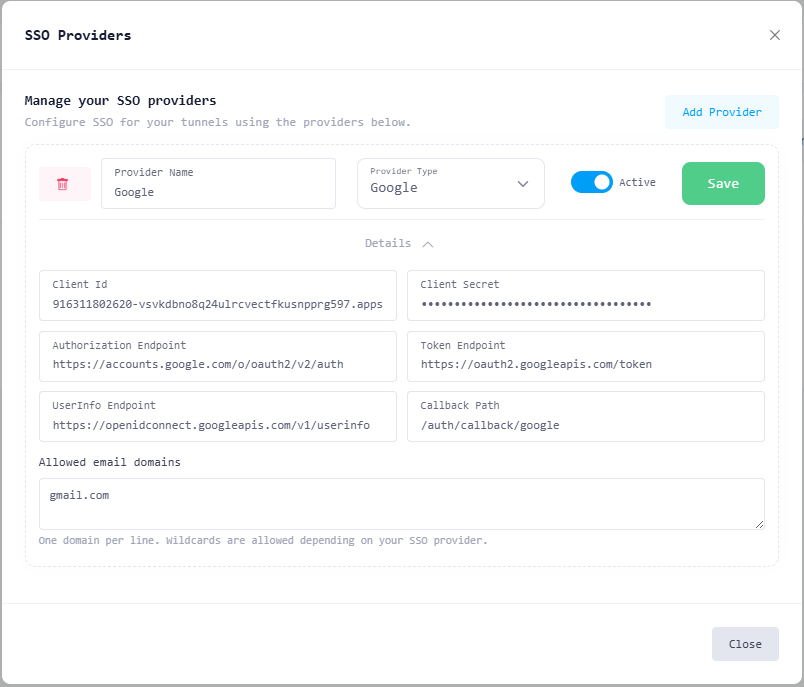
Your Google SSO provider is now available for use.
Step 3: Enable Google SSO for an HTTP Tunnel
Adding a provider at account level does not automatically protect tunnels.
You must enable it per tunnel.
Open the HTTP Tunnel Settings for the tunnel you want to protect.
Navigate to SSO Providers → Manage.
Enable SSO for this tunnel.
Toggle Google to enable it for this tunnel.
Configure optional tunnel-level restrictions:
SSO Path(s) – paths that require authentication
Logout Path – logout endpoint for the tunnel
Allowed Domains / Emails / Usernames – additional access restrictions
Click Save Changes.

What Happens Next?
When a user accesses the tunnel URL:
The request is intercepted by the Localtonet authentication layer.
The user is redirected to Google for authentication.
After successful login, the user is redirected back to the tunnel.
Access is granted only if all provider and tunnel rules are satisfied.
Your local application remains unchanged and does not handle authentication.
Notes & Best Practices
Use domain restrictions for internal or company-only tools
Prefer Google SSO over Basic Auth for production environments
You can enable multiple SSO providers for the same tunnel
OAuth credentials can be rotated without affecting tunnel configuration

